
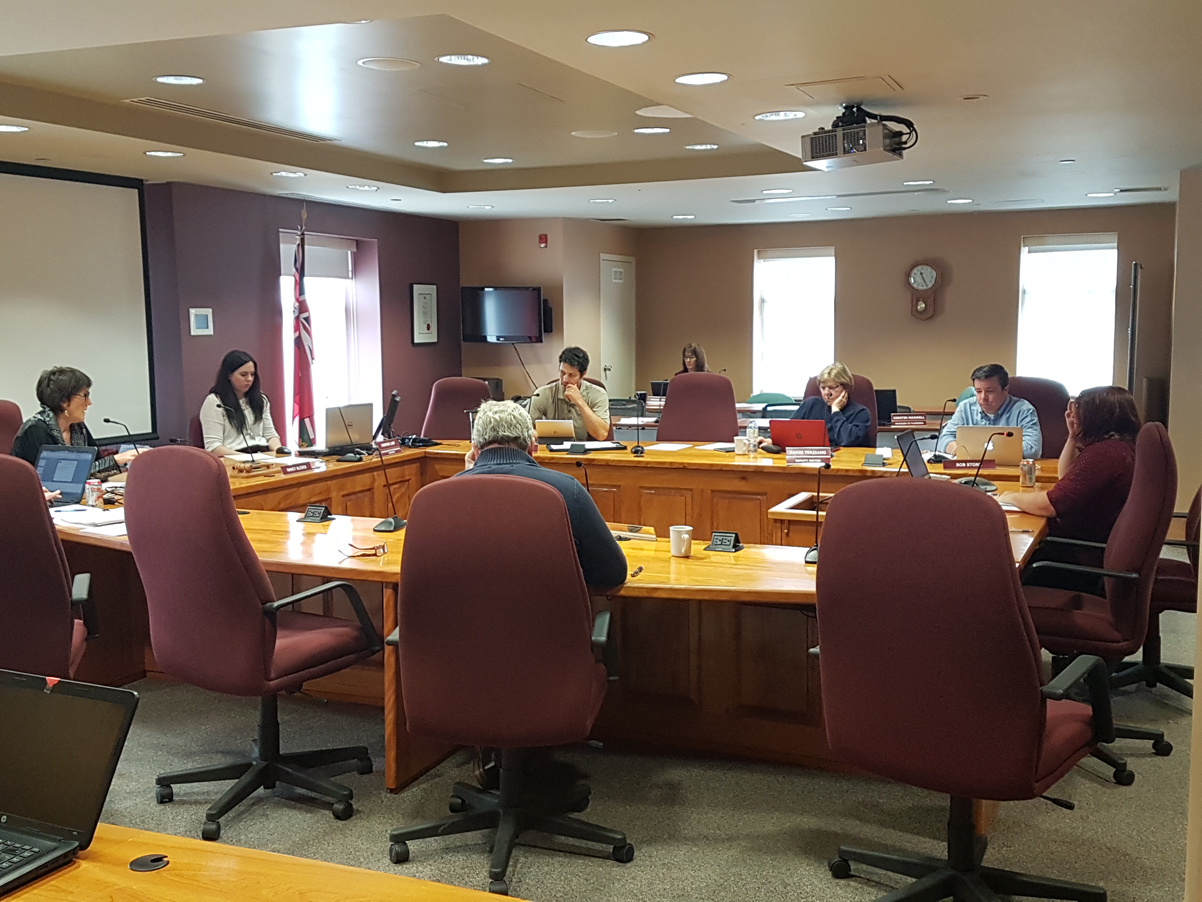
Planning applications in Huntsville are on the rise and expected to continue on an upward trend into 2018.
Prompted by a rise in the number and complexity of those applications, Huntsville Council has agreed to delegate more authority to staff.
Starting sometime in the new year, staff will have the ability to lift holding symbols in order for developments to proceed as long as the applicants have met the holding provisions.
Holding symbols are generally used to ensure that certain criteria are met before development proceeds in a designated location. The most commonly used application for holding symbols in Huntsville is related to ensuring the development has adequate municipal water and sewer services and that additional capacity is available in the system.
In a report submitted to Huntsville’s Planning Committee on December 13, 2017, and subsequently approved by council at its December 19, 2017 meeting, Huntsville Senior Planner Elizabeth Reimer made the case for the process to be delegated to staff in order to save time for staff and committee while also expediting the approval process.
According to Reimer the number of planning applications has almost doubled since 2011. Some, like minor site plan approvals, are already under staff’s sole purview. The number of planning applications entertained by both the Committee of Adjustment and the Planning Committee has increased from roughly 111 in 2011 to approximately 187 in 2017 and is expected to continue increasing. Likewise, combined committee meetings have gone from an average of 2.5 hours in 2015 to more than 4 hours in 2017 and the average length of meetings is expected to increase to 4.5 hours in 2018 if changes are not implemented.
“In an effort to maintain and improve upon current service levels, staff are always considering methods to streamline the Town’s approvals processes. As the Removal of ‘-H’ Symbol reports and presentations typically do not elicit any questions or concerns from committee, and are more an administrative task, consideration of the delegation of this function to staff should be considered as it could achieve time savings at committee meetings. More importantly, such a delegation of authority could also shorten, or in some cases eliminate, the delay between the committee report/meeting cycle and the council meeting at which the bylaw is passed,” she stated.
Moving forward, any requirements resulting in a holding symbol on a property will be heard by committee but when the applicant is ready to proceed it will be the Director of Planning who will either approve or deny the removal of the holding status. Public consultation before the removal will continue to take place. If an applicant or another party contests staff’s position, then the application will be bumped back to committee and council.
All holding provisions put in place before the passing of the change will continue status quo.
Councillor Jonathan Wiebe asked how committee would know that the holding provision had been lifted on a particular application to which Director of Planning Services, Derrick Hammond, indicated it could be included in committee’s agenda for information.
Staff noted that two municipalities – Haldimand and Kingston – have implemented similar changes. “This is one of the things that I challenged planning staff with when I came on board… and they’ve risen to that challenge and they’re looking at a couple of other types of approval which are fairly routine in nature, which they could also look at having committee or council delegate. So, I think that this is really exciting.”
Don’t miss out on Doppler! Sign up for our free newsletter here.
Even minor site plan approvals should be examined through both the lens of accessibility and the environment. These are functions of Council (and I assume Planning Committee); so I would hope that staff planners are observing this essential step.
Also, I’ve noticed several instances when staff recommendations have been summarily dismissed by Planning Committee. Any further streamlining must be cogniscent of this fact.