
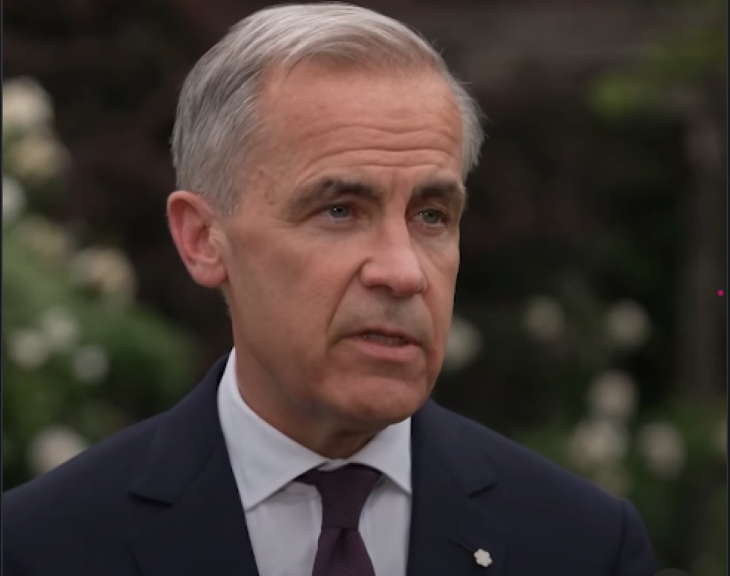
Prime Minister Mark Carney seems to think so.
In a recent interview, CNN Host Kaitlin Collins asked our Prime Minister, “And in terms of when you look back at it, do you believe the war (with Iran) was worth it, in Canada’s view?”
Mark Carney’s response to Collin’s question was lengthy, but this is the key part of it.
“And so, going and getting to a position where Iran is not going to have a nuclear weapon. Look, I am not naïve about this. The reintegration of Iran, this is a regime that needs to learn to be civilized, needs to behave. That’s why you have performance measures. Lots needs to happen. We all need to support it. But moving to this position, where that’s been taken off the table (nuclear weapons)? Yes, (the Iran war) that’s worth it.”
Some observations here. The war with Iran is not over. The Memorandum of Understanding (MOU) is essentially a 60-day cease-fire. It is not a peace agreement, and it is not an unconditional surrender by Iran as U.S. President Donald Trump has implied. Trump says he “smoked” Iran. He did not.
Although the MOU has not been made public in its entirety, there have been sufficient leaks and announcements to offer credible insights into its main components. Clearly, there is give-and-take on both sides, and the MOU advances most of the essentials of a real peace agreement, to be negotiated during a 60-day window.
Iran has agreed not to produce nuclear weapons. But the mechanics of that, inspection, enrichment limits, uranium stockpile disposal and verification, are far from settled, and Iran has been clear that there is a red line they will not cross.
Iran has also agreed to the reopening of the Strait of Hormuz with partial ownership to Iran, but, as of yesterday, it was closed again by Iran, proving that very little has been actually settled yet and that anything can happen in the next 60 days.
Subject to successful negotiations, the Americans will agree that Iran can continue to sell crude oil and remove the blockade on their ports. They will remove sanctions on Iran, release frozen funds, and provide Iran with a $300 billion fund, in part as a reparations fund. Strange, but I always thought the loser in a war provided the reparation funds and not the winner.
It is also, in my view, important to remember that Donald Trump started this war, unilaterally, without NATO consultation and without Iran posing a clear and present danger to the United States.
As well, Trump has not accomplished many of his stated objectives, including regime change. The Iranian government remains in power. There is no indication that their reprehensible behaviour on many fronts, as referenced in Carney’s response to Caitlin Collins on CNN, will change, and there is no apparent mechanism to make them do so.
Now, let’s get back to Prime Minister Mark Carney. With all of this background, no matter what his rationale was, was he right to say that the Iran war was worth it?
There will be those who believe that Carney must be defended in all circumstances, that he can do no wrong. But there is no prime minister in my memory who, at one time or another, has not made mistakes or erred in judgment. Mark Carney is no exception.
I continue to believe that Carney, as prime minister, is in the right place at the right time and that he is making real progress in creating new partnerships and trade agreements internationally for Canada. However, in my view, it is counterproductive to gloss over issues that need to be addressed simply out of partisan loyalty.
I cannot believe that there are a lot of Canadians, both on the left and on the right of the political spectrum, who believe that the war between the United States and Iran is, under any circumstances, “worth it”.
Robert Fife is a journalist with the Globe and Mail who has, over the years, gained the respect of all political parties. He recently received a Lifetime Achievement Award from the Canadian Journalism Foundation. On a recent television panel discussion, he said this about Mark Carney’s comments related to the Iran war.
“It’s all an effort to suck up to Trump. This is a terrible deal, and everyone knows it’s a terrible deal. The mullahs are laughing their asses off at President Trump. They can’t believe their good luck. They’re getting $300 billion from him.”
Fife’s language is a little rough. I would say that Carney is trying to appease Trump, not suck up to him. But Mark Carney did not need to answer “yes” to Collin’s question about whether the Iran war was worth it. It sent the wrong message at the wrong time, not only to Canadians but also to our allies internationally.
To tell CNN’s Caitlin Collins that the Iran war was not worth it would, of course, have ruffled Trump’s feathers. However, any politician, newly minted or not, knows how to duck a question they do not want to answer. Mark Carney is as adept at that as anyone else, and that is what he should have done.
It is apparent that the Carney government is trying to control negative rhetoric prior to the CUSMA negotiations. I can understand that. But there must be a red line, and I believe saying the Iran war, under any circumstances, is worth it, crosses that line. To do that is indefensible.
But I know there are those who will try!
Hugh Mackenzie
Hugh Mackenzie has held elected office as a trustee on the Muskoka Board of Education, a Huntsville councillor, a District councillor, and mayor of Huntsville. He has also served as chairman of the District of Muskoka and as chief of staff to the former Premier of Ontario, Frank Miller.
Hugh has also served on a number of provincial, federal and local boards, including chair of the Ontario Health Disciplines Board, vice-chair of the Ontario Family Health Network, vice-chair of the Ontario Election Finance Commission, and board member of Roy Thomson Hall, the National Theatre School of Canada, and the Anglican Church of Canada. Locally, he has served as president of the Huntsville Rotary Club, chair of Huntsville District Memorial Hospital, chair of the Huntsville Hospital Foundation, president of Huntsville Festival of the Arts, and board member of Community Living Huntsville.
In business, Hugh Mackenzie has a background in radio and newspaper publishing. He was also a founding partner and CEO of Enterprise Canada, a national public affairs and strategic communications firm established in 1986.
Currently, Hugh is president of C3 Digital Media Inc., the parent company of Doppler Online, and he enjoys writing commentary for Huntsville Doppler.
Don’t miss out on Doppler!
Sign up here to receive our email digest with links to our most recent stories.
Local news in your inbox so you don’t miss anything!
Click here to support local news
Mr. Mackenzie, some reasonable comments so far posted to your article. Thank you for quoting the essential part of the interview within the body of your writing.
Want to make an issue/commentary of “…But moving to this position, where that’s been taken off the table (nuclear weapons)? Yes, (the Iran war) that’s worth it.”? Carney’s response seems most like trying to hit a moving narrative target (Iran War and Trump administration narrative), where nothing is yet settled or fully clear. I doubt PP could have been able to land his comments over such changing terrain.
It certainly appears, at this stage, that nuclear weapons off the table will not happen – you point out the number of supervisory supports (inspections, for example) that would have to be put into place as part of the package of agreement. However, if the outcome were to put the non- development of nuclear weapons as an agreed condition, then some positive would come from this fiasco of a war – worth it?- possibly.
The trade agreement relations and environment are prickly at best. Personally, whatever “deal” may be worked out, do we as Canadians really trust the US under this volatile administration to keep it?
The war was not worth it but Iran won over Trump.
“Following the conclusion of the spring 2026 conflict, public and geopolitical consensus—including a poll of 92% of Israelis—views Iran as the victor, primarily because it survived a combined US-Israeli offensive and forced Washington into a favorable agreement without capitulating on its core objectives.While the Islamic Republic suffered severe military and infrastructure damage, its strategic position strengthened
significantly.
The main outcomes and concessions include:Control of the Strait of Hormuz: Iran established de facto control over the Strait, solidifying its economic leverage.U.S. Sanctions Relief: In the June 2026 Islamabad Memorandum, the United States waived oil export sanctions and unfroze tens of billions in Iranian assets.
Shifted U.S. Objectives: Washington failed to achieve its initial goals of regime change and the complete dismantlement of Iran’s nuclear and ballistic missile programs. Instead, the U.S. entered negotiations without imposing limits on Iran’s regional proxies or uranium stockpiles.”
Prime Minister Carney says “where that has been taken off the table (nuclear weapons)?” Then he goes on to figure that the war was worth it. Naive? Presumptuous? On whose assertion have those supposed future weapons been brushed away? Iran claims the right to develop a nuclear program. For good or evil would be only a best guess. The US asserts such a bunch of statements that there is hardly enough salt to handle them all.
Bunker busters were to have eradicated the deep storage system employed by Iran. Seems that maybe that isn’t so.
‘the donald’ threatened to eliminate Iranians as a people. Yet they are still there.
As to whether the war ‘was worth it’. Is that a question? Is it important for there to be an answer? Who’s asking? Why? Will anything change if the questions are all answered? And before uou push
Before the ‘war’, the Strait of Hormuz was open and traffic flowed freely. Now it is ‘Open”, ‘Closed’, ‘Pending’, take your pick.
Before Netanyahu talked ‘the donald’ into a strike on Iran, a number of small monarchies had aligned themselves with the US, thinking that protection was absolute.
But this little ‘action’ in the middle east just proved that American logistics, though powerful, can’t force the issue. It is said that it will take the US 2 to 6 years to replace the weapons used up on a lot of sand.
It has also been shown that American resolve is not boundless. These small states were easily hit. It seemed unfair that the guy who started it all lived about 7,000 miles away. And he’s not so much interested in their lives as in their oil and their ability to move it to the west. And I bet he’s just eying up the possibility of creating a monarchy or dictatorship closer to home.
Lots of announcements coming mostly from ‘the donald’, often on ‘Truth Social’. Is that title a lot tactless or whatever? As if the man can handle or recognize the truth.
The Middle East is in a constant state of turmoil, dictated by the existence and attitudes of the nations involved. With no resolution just lurking on the horizon. America poking it’s nose in at the behest of a leadership that is much more interested in how it all looks than how it is. And in support of a combatant unbounded.
But these American ‘warriors’ seem to feel that if they look cool and in control, everything must be great? Americans must feel just a bit ‘ back-stabbed, door-slammed and dog bit’ when it’s said they may have to fork out 300 billion dollars to get Iran to ‘play nice.’ They get to pay for being ‘the winner’ according to ‘the donald’. Novel reparation concept there.
‘Is the war against Iran worth it?’ In whose perspective? Should the question have an answer or is it just there for the asking? Do we know that it is over? I’m sure there are a puckle of people with a scads of answers. But what difference when any result comes face to face with the butterfly attitudes of the combatants.
After thinking it over and working out an answer, fer pete’s sake, wait a few minutes before you hit ‘Send’. There’s been another pronouncement! Pretty sure.
I think the costs of inaction deserve as much scrutiny as the costs of military action.
Canada is not a bystander to global instability. We are a trading nation. When conflict spreads through one of the world’s most strategic regions, the consequences do not stay there. They ripple through energy markets, supply chains, alliances, and economies, including our own. Most Canadians would agree that war is a terrible thing, but foreign policy is rarely a choice between a good option and a bad one. More often it is a choice between competing risks and imperfect outcomes. The difficulty is that every path carries a price.
That is why I am less interested in whether Carney’s wording was perfect and more interested in whether we are accounting for the risks on both sides of the ledger. We can criticize Trump’s unilateral approach, question whether military action was justified, and still ask what the long-term consequences would have been if Iran eventually acquired nuclear weapons. The costs of military action are obvious and immediate. The costs of inaction can be harder to see, but they belong on the ledger too.
What I find missing from the discussion is not outrage over war. There is plenty of that. It is a serious examination of the alternatives and the risks they carry. Canada has never had the luxury of withdrawing from the world. Our prosperity depends on stable trade, reliable partners, and a rules-based international order.
What strikes me is that many countries appear to be reaching the same conclusion. As supply chains shift and geopolitical risks increase, Canada is increasingly being viewed as a stable and reliable partner. That does not make conflict desirable, but it does remind us that stability, democratic institutions, and dependable alliances still matter. In an uncertain world, those may prove to be some of our most valuable assets.
I agree with you but it’s a little more complicated. There is also the perennial war between Iran and Israel and Netanyahus quest for reelection coincident with Cusma negotions and Trump’s treatment of anyone who disagrees with him on anything. He has now stating the PM of Britain must resign. What’s the point of giving Trump more ammunition to use against us?