
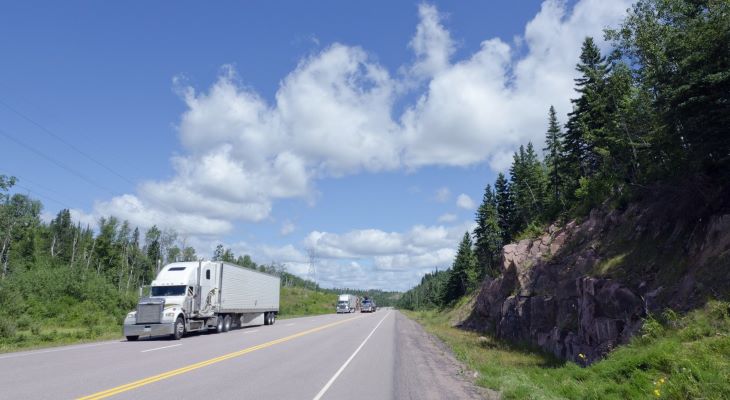
Ontario drivers will soon be able to travel faster on hundreds of additional kilometres of provincial highways as the provincial government expands its 110 km/h speed limit program across the province.
The Ontario government announced today that it is increasing the speed limit from 100 km/h to 110 km/h on an additional 938 kilometres of provincial highways. The move follows earlier increases on 10 highway sections in 2024 and six sections in 2022.
Once the changes are fully implemented, nearly 89 per cent of Ontario’s highway network will be posted at 110 km/h, compared with 43 per cent today. Currently, about 873 kilometres of provincial highways have a posted speed limit of 110 km/h.
Ontario Transportation Minister Prabmeet Sarkaria said the higher speed limits will help commuters and businesses move more efficiently across the province.
“Under the leadership of Premier Ford, our government is helping get drivers where they’re going faster and safely,” Sarkaria said in a news release. “We’re going to keep supporting commuters, workers and businesses by investing in our $31 billion plan to build and expand roads and highways, so we can get people and goods moving across Ontario and keep workers on the job.”
The province said the first phase of the changes will take effect June 26 on sections of Highways 401 and 416 in eastern Ontario. Additional sections of the Queen Elizabeth Way and Highways 400, 401, 402, 403, 416 and 417 will follow.
According to the government, the higher speed limits could reduce travel times significantly. Drivers travelling between Sarnia and Toronto could save nearly 20 minutes, while motorists travelling between Toronto and Ottawa could cut almost 30 minutes from their trips.
Provincial officials said speed limit increases are only introduced on highway sections that have undergone technical reviews and, where necessary, infrastructure improvements to ensure they can safely accommodate higher speeds. The government noted that most of Ontario’s freeway network was originally designed and engineered for speeds of 110 km/h.
The expansion, they said, brings Ontario’s highway speed limits more in line with those in several other Canadian jurisdictions, where 110 km/h limits are already common on major freeways.
Don’t miss out on Doppler!
Sign up here to receive our email digest with links to our most recent stories.
Local news in your inbox so you don’t miss anything!
Click here to support local news
The environmental impact of this policy is huge – but nobody seems to recognize it or care. Here is why:
For the average sedan, the most efficient speed is around 80 km/h. Going 130 km/h instead of 80 km/h uses more than TWICE the amount of fuel to go the same distance. This is the same regardless of whether your vehicle use gasoline or elecricity.
Every increase above 80 km/h makes a big difference. Driving 100 km/h instead of 120 km/h will save you a lot of money.
Why it rises sharply from 80→130 km/h: Aerodynamic drag increases with the square of speed — so going from 80 to 130 km/h doesn’t just add 63% more drag, it more than doubles it. At highway speeds, fighting air resistance becomes the dominant energy cost. This is also why roof racks and open windows hurt economy so much at high speeds.
The sweet spot (~80 km/h) is roughly where rolling resistance and aerodynamic drag are balanced most efficiently for a typical sedan. SUVs and trucks tend to peak a bit lower due to their larger frontal area.
Under the leadership of Premier Ford, our government is helping to increase travel costs, emissions and the risk of getting killed on our highways.
Driving at 110 km/h instead of 100 km/h directly increases fuel consumption and emissions by 10% per distance travelled and the risk of fatal collisions by 20%.
Fuel Consumption and Efficiency:
10% increase in fuel use: Reducing your speed from 110 km/h to 100 km/h decreases fuel consumption by roughly 10%. Conversely, pushing up to 110 km/h burns more fuel over the same distance.
Aerodynamic drag: Exponentially higher air resistance at 110 km/h forces the engine to work harder.
Financial and environmental impact: Higher consumption raises fuel costs for drivers and increases tailpipe carbon emissions.
The 20% Metric: A study in the journal Sustainability found that for every 10 km/h increase in speed limits on highways, fatal collisions increase by more than 20%. [1]
Crash Energy: Modest increases in speed produce disproportionately large spikes in kinetic energy, which causes more severe blunt-force trauma to vehicle occupants.