
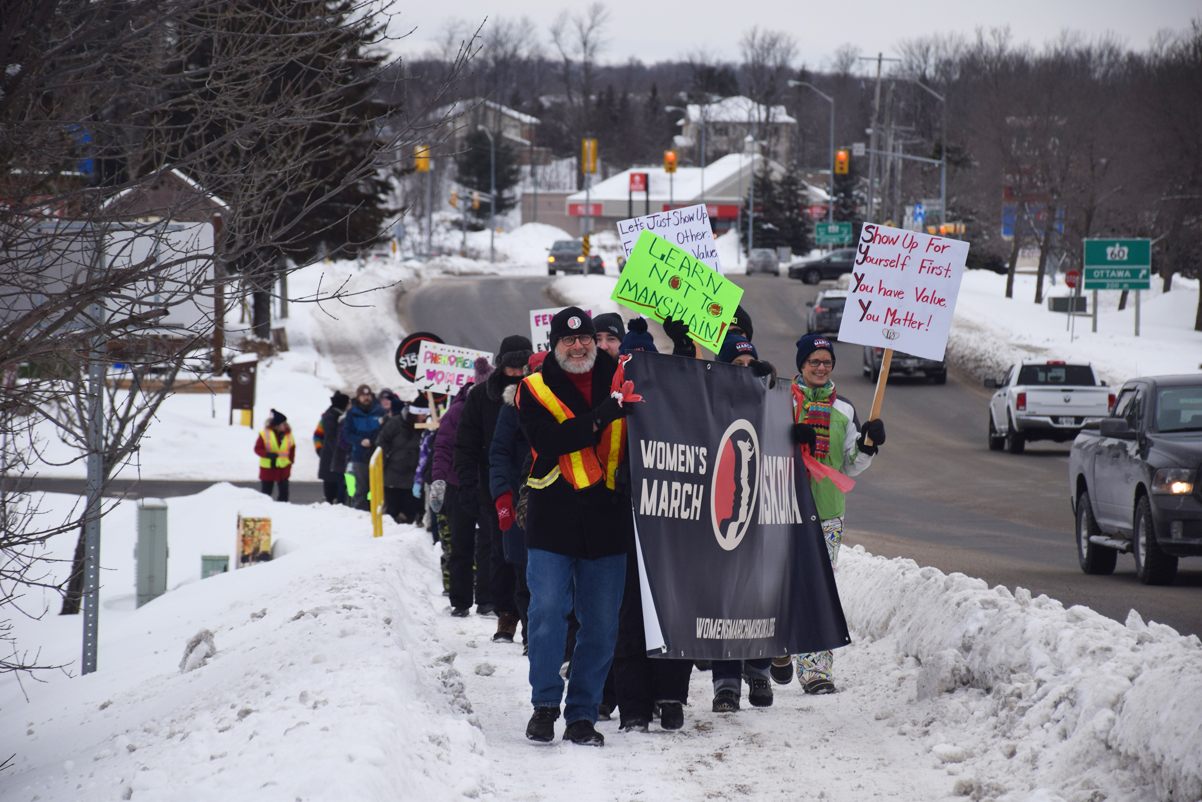
It was cold outside, but that did not deter them.
A group of women, children and men gathered at the Huntsville Place Mall on Saturday, January 19, as they prepared to participate in the Women’s March Muskoka and march for women’s rights on Huntsville’s main street.
Community Coordinator for Women’s March Muskoka, Kathleen May, thanked all volunteers and event committee members for their work as well as those who took the time to participate. She offered thanks and acknowledged that Muskoka is on traditional Indigenous land. “I say these words to offer acknowledgement and thanks, but also to disrupt colonialism and stand in solidarity with Indigenous people over the institutions that oppress them.”
She hoped the event would continue to inspire people about how they can participate to bring about social change on a local, provincial, national and global level.
“There remains disproportionate levels of poverty, abuse, discrimination, misogyny, inequality and prejudice toward women that is exacerbated at the intersection of physical ability and socio-economic status, gender identity and sexual orientation, immigrant status, race and creed. No woman should be excluded from the rights and freedoms that are fundamental human rights,” she said to applause from those present.
May called for a celebration of what makes people unique, rather than letting differences divide them. “We walk together in unison with a purpose to a common vision of a better world. We march away from violence, from the devaluation and dehumanization of women. Away from rape. Away from Indigenous women not being respected or heard. Away from survivors not being believed. We march away from racism and fascism, poverty and oppression.”
She asked those present to join in the conversation by telling those around them why they’re marching. “Equality,” said one person. “Equal pay,” said another. Others shouted out that they were marching for justice, to end violence against women, for missing and murdered indigenous women and girls, for a safe space for boys to grow, they were also marching against fear, in favour of education, for solidarity with the women of the world, in favour of children being taught consent in school, against homophobia and transphobia, in favour of celebrating different kinds of families, and for peace, love and diversity. A man also spoke out and said he was embarrassed of his fellow men.
-

- From left, Marlee McGary, 4, and her brother Preston also held their signs up high.
-
- From left, Ruby Truax and Yvonne Heath.

Nancy Osborne, who for many years worked abroad in support of women and girls through UNICEF, also spoke at the gathering. She said she worked in countries with extreme poverty, war, natural disasters, terrorism “and in places like that, and a lot of places in the world, women don’t necessarily have many rights. In some places they have no rights and aren’t even recognized as human beings,” she told those present. “But, I’ve got to say that in some of those places I met some of the most determined and courageous women that I have ever met in my entire life; women who had a voice, a voice no matter the consequences. They were willing to risk their lives to have that voice.”
Osborne said she sometimes hears people say ‘well, we don’t need to march. In Canada and North America women have rights. You know we’ve got it really good compared to other women in the world.’ To that, Osborne said that while women in this part of the world may be better off than in other places, there are still issues that must be addressed. “We’ve got Me Too, to put it mildly, wage disparity, we’ve got murdered and missing Indigenous women, unfounded cases (cases of sexual assault reported to police deemed unfounded), and hey lately even the backlash to a razor commercial gives us all the reason we need to be out here today, Yay Gillette!”
Osborne also expanded further on women in hostile situations abroad. “So I want to tell you about these other women and I want to say that those women may not share our rights just yet, but they count on us to keep moving that bar forward, to keep at it towards that true equity, that respect, that security that we all want. And our movement forward – that inspires other people globally, and those women when they get to close that gap and they get caught up with us, they’re going to say ‘why did you stop here?’ And I don’t want the answer to be, ‘well, we thought it was good enough.’ So, yeah, be an activist, be an ally, be an example to others – be a voice for all women.”
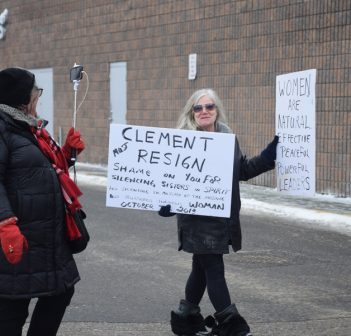
Nancy Osborne filmed everyone at the event, including Peggy Peterson who also brought her signs.
Muskoka/Parry Sound Sexual Assault Services Executive Director Lauren Power also spoke at the gathering and told those present that the theme of this year’s march is women’s wave. “We’re here because we all care about women’s equality,” she told those gathered. “And one of the lessons for me… which I’m always learning is to understand not only my own oppression as a woman, but my privilege as a white woman in our society. And so that’s the challenge I’m putting out to all of you today, is to begin to understand the levels of oppression that our globe operates under,” she said.
“And so we as settlers in this region, we have to really take in and understand what colonization means. I think that’s the first job for Canadians in 2019, is to really take that in and really understand that colonization has meant the ongoing oppression of Indigenous people on this land, which they have taken care of for our benefit for thousands of years,” said Power. (See video below).
Don’t miss out on Doppler! Sign up for our free newsletter here.
0 Comments