
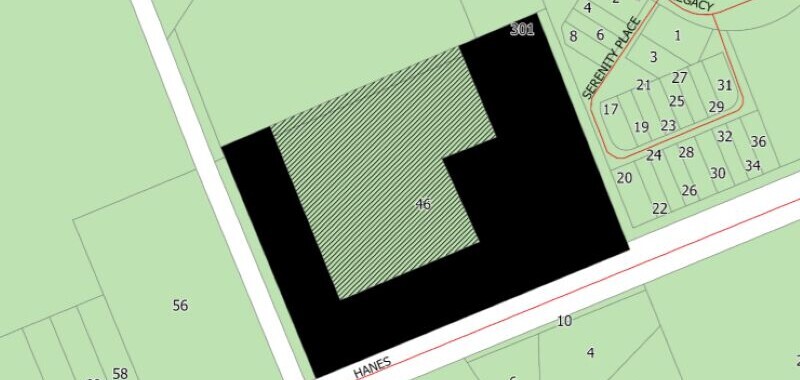
Huntsville’s planning committee has approved rezoning applications for 38 townhouses and up to 80 new apartments at 46 Hanes Road.
Coupled with planning approvals already in place at 12 Legacy Lane, which also forms part of the Highcrest Muskoka development, there’ll be up to 151 new units added to Huntsville’s housing stock once the project is completed.
The size of the land at 46 Hanes Road is 2.5 hectares with 190 metres of road frontage, while the property at 18 Legacy Lane is 1.8 hectares in area with no municipal road frontage.
The file was deferred by committee last month following concerns expressed by neighbouring residents at Serenity Place Crescent. They requested that planning approvals be put on ice for another month to give the board of the condominium an opportunity to review the proposal.
Committee was also not prepared to approve a height exemption of five metres for each of the two buildings proposed, from Huntsville’s current 11-metre height bylaw, at least not without seeing diagrams of the buildings first.
Planning consultant, Wayne Simpson, on behalf of applicant Dave Goodfellow, was back before committee at its August 11 meeting. He said his client has withdrawn the five-metre height exemption request for now. Planning staff noted that if the applicant wanted to pursue a height exemption in the future, a separate rezoning application would have to be submitted.
Other changes to the application included specifying that required vegetative buffers will consist of both retained and planted trees and that the buffer will be left in a natural and self-sustaining vegetative state, according to staff. In addition, a tree buffer has been added as a condition of rezoning approvals along Hanes Road.
The updated approval bylaw will also state how the height of the multi-residential buildings proposed should be measured, “from the average finished grade along the wall where the front entrance to the buildings is located.”
Bob Mallette, president of the board of the condominium corporation at Serenity Place Crescent, on behalf of the residents thanked development representatives and Town staff for addressing the retention of trees and maintaining vegetative buffers around the property lines.
He noted that outstanding concerns include the capacity for the disposal of wastewater associated with the development as well as the flow from surrounding fire hydrants. He said along with other development planned for the area the infrastructure to service that area “will require significant upgrades to the water-handling systems.”
Simpson noted those issues would be addressed by consultant Pinestone Engineering Limited and the District of Muskoka.
Other issues expressed by Mallette included traffic. Committee heard that staff are taking into consideration other proposed developments in the area, which could result in traffic lights at the Hanes and Centre Street intersection.
Councillor Bob Stone questioned what amenity space would be available for the residents of the development. “You know, we’re going to have close to 300 people living in this small space, where can the little people throw a frisbee?” he questioned.
Planning manager Richard Clark said parkland space is not provided in the property, “but I believe the approach would be for residents to be able to use community amenities in the area.”
Stone referred to that as disappointing, while Councillor Nancy Alcock, who chairs the committee, questioned “how it is that we would consider approving a development of this scale without amenity space? I mean we do in other residential neighbourhoods, we talk about parks, parkettes, trails, and I don’t understand that.”
Clark said with any development the proponent can either provide “park amenities onsite or they can pay a sum, cash-in-lieu of the park requirement,” which he said equates to about five per cent of the developable area. “So that would be the approach in this instance.”
Councillor Jonathan Wiebe said he’d be less in favour of approving the cash-in-lieu of parkland approach because “where this development is situated, it doesn’t lend very well to going to a neighbouring park. There are no neighbouring parks…” He added that it should be reconsidered.
In terms of traffic in the area, Wiebe said he’s not keen on more traffic studies but would rather see traffic lights at that intersection. “We’ve been talking about it for six years. I avoid it every time I can because I dread making a left turn there… so to me, I don’t need an expert to tell me it’s busy. It’s busy,” he said.
He also said he wants it ensured that the flows of water and sewer are adequate to service the area.
Alcock agreed with the need for lights at the intersection. “It’s a corner I already try and avoid,” she said.
Town engineering technologist Brandon Hall said with the Paisley Centre development also proposed in the area, the Town is pushing for traffic signals. “What we’re doing right now is we’re looking at all the development in the area to put that into play. That is the Town’s standpoint, that is our push. Not only with the Paisley Centre, we’ve been in talks with Goodfellow – how that all falls into place, that’s what we’re trying to establish today,” he said.
Director of planning for the Town, Kirstin Maxwell, reminded committee that there are holding provisions associated with the rezoning approval which include proper water and sewer servicing provisions and impacts to traffic.
In terms of amenity space in the development, Stone raised the issue once more.
Clark noted that the proponent would be establishing a north/south trail connecting Hanes Road to Kinton Avenue and a sidewalk along Hanes Road. “They’re also going to be working, based on the adjacent condo corps’ comments, on a tree planting program on Town-owned property,” said Clark.
“Trails are great. They’ll get you to, you know, a dealership or Home Depot but it doesn’t lead to any parks. We don’t have any parks over there and again, where are you going to throw a frisbee,” said Stone.
“As Richard said, I believe this was reviewed by our operations and protective services, also reviewed by our park staff and that recommendation would’ve came through them if they felt that was needed in that area, which they didn’t address. So… I think they’re the professionals and I don’t think we should be starting to add things as we go forward with this so I’m fine to let it go. I’m ready to pass this,” said Councillor Dan Armour.
Simpson said the “intention is to provide [amenity] space. The intention is not that it be public parkland per se because it’ll be situated within a private development, or private road network and those sorts of things…” He noted that the municipality does have the final say as to whether it will required parkland dedication or cash in lieu. “Our expectation or hope would be that the municipality would accept some cash-in-lieu and that the developer would be able to develop private open space, amenity space within the development knowing that the trails that are being built around the perimeter are public as well.”
Simpson also noted that part of the height exemption request from 11 to 16 metres involved creating amenity space at the top of one or both buildings when he attended the committee meeting last month.
Maxwell also noted that the issue can be discussed further at the site plan approval stage.
In the end, committee approved the rezoning application with some conditions. You can find those in the staff’s planning report here.
Related story: Committee defers planning approvals for the next phase of 151-unit development
Don’t miss out on Doppler!
Sign up here to receive our email digest with links to our most recent stories.
Local news in your inbox so you don’t miss anything!
Click here to support local news
Huntsville has never had enough public park space. If Huntsville wants to be a city then this the way to do it. Intense development characterizes cities. The small town ambience will be lost. Placing green space within the development is isolating the people from the rest of the town. The developed area will be like an island apart from the town. In my opinion, not good for the well being of the residents in either the development or the town.
The “cash-in-lieu” approach continues to rear its ugly head, and this in spite of the growing demand for public parks and green spaces. This is betrayal by our councilors, plain and simple. Come on people.
Perhaps Town could take a look at their publishing of planning data.
For example, the map included in this article is such that it is virtually impossible to gain a grasp of what is being proposed by looking at it.
If the town is going to put a plan or map out for view, and this applies equally to those published in the Forester, they should make it large enough and clear enough that it is at least possible to read it and know what is actually being shown.
Some of the little maps in the Forester, for example, are of such poor technical quality they are pretty well useless as an information item.
It would be nice if the maps actually were readable and referenced accurately to the article in these kind of things. Might save a lot of time hunting up details elsewhere as they sure are not clear with these notices.
One thing councilors don’t seem to understand is the affect of population density on quality of life. It is a basic fact that increased density leads to decreased quality of social interactions. The amount of destructive behaviors evident daily in large densely populated cities is proof of this phenomenon. Growth is going to happen but we must be cognizant of the effects.
I agree with Mr Markle. There is plenty of space to build a less dense project in Huntsville. The area being discussed has a high volume of traffic without adding living space for 300 +/- in a busy commercial area of our town.
Mr. Stone, I appreciate your comment. In this project, where indeed might one throw a frisbee? Or have a wiener or corn roast? Is there even room to allow a grandchild to jump in a puddle, or have a puddle? Any room to sit outside in the evening with some friends, have a cocktail and watch ‘cave man tv’?
Our property is 2 acres and it is home to 2 people, lots more when family and friends stop by. It is certainly not a large holding, but that whole project is about 11 acres and to cram ‘close to 300 people (living) in this small space’ seems unnatural for our town. Especially since I was born and raised here with lots of room to roam.
I’ve been to cities where population density is high, but they do it because they have no space and there is little option. Do we have no option but to warehouse all those people in these small spaces? Or is the objective to just build and sell as many units as possible? It seems very mercenary.
.