
The maintenance of the status quo can feel like a neutral continuation of normalcy. We could be forgiven if we assumed that ‘business as usual’ means that, without dramatic intervention, things will carry on as they always have. In this way, we sometimes consider the status quo to be natural, traditional, a way of life. In fact, the definition of status quo is ‘the existing state of affairs.’ It implies something neither good nor normal–just what is.
In Canada, and other countries that enjoy a relatively stable democracy (recently excluding the United States), the status quo is actually quite malleable and change can often be made through public opinion. We are fairly eager to adopt certain social changes, preferring to consider ourselves advanced rather than regressive.
Of course, we also kick up quite a fuss when it comes to progress on certain issues like reparations for Indigenous genocide, our toxic addiction to petrol products, and the shortsighted reliance on capitalism and models of impossible endless growth. But in many ways, Canada prefers to move forward democratically and public opinion is worth a great deal.
In contrast, consider the status quo in Belarus. President Alexander Lukashenko has been in power for almost twenty-seven years. In countries like ours, that term length is almost unthinkable. The Belarusians agreed with their most recent elections. Opposition leader Sviatlana Tsikhanouskaya claims to have won the 2020 election with 60 per cent of the votes, but along with her cabinet is currently in exile in Lithuania due to challenging the status quo and the resulting violence. Widespread protests against Lukashenko’s refusal to cede the presidency are being confronted with extreme police brutality, supported by Russia who is a very close ally to Belarus and who is, indeed, a very close ally to the concept of status quo.
Last year, the European Union imposed sanctions on Belarus officials they deem responsible for “violence, repression, and voter fraud.” Canadian Foreign Affairs Minister François-Philippe Champagne stated last summer that Canada does not accept the results of the fraudulent election and has demanded free and fair elections in Belarus. Lukashenko declared that there will not be another election “until you’ve killed me.” That’s about as status quo as you get.
Sanctions were imposed, including by Canada, but eventually the furor around this illegitimate presidency died down, at least in the Western world.
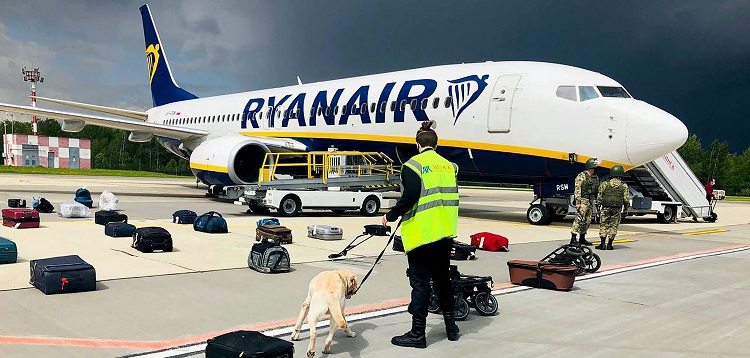
Awareness of the oppression of Lukashenko’s opponents escalated again, however, with a spectacular show of ill-begotten power and pride: the dramatic diversion of a civilian aircraft carrying twenty-six year old journalist, Roman Protasevich.
The plane was flying over Belarusian airspace between Greece and Lithuania when a bomb threat was called in and the plane was forced to make an emergency diversion, escorted, oddly, by a Belarusian military jet. Roman Protasevich is also an activist and vocal critic of illegitimate president Lukashenko. He was aboard the flight with his girlfriend and when it was announced that the plane would be landing in Minsk, Belarus, he began to panic and told the Ryanair flight staff that he would be killed.
Fellow passengers recalled the abject terror that political dissident Protasevich displayed, and reported that he said, “I know that death penalty awaits me here.”
According to the New York Times, another stated that it became clear that the bomb threat was a ruse to facilitate the arrest of the journalist: “When we landed people were standing around the plane doing nothing, looking pleased with themselves,” Mr. Danauskas said. “They didn’t let us out for half an hour,” he added. “If there was a bomb on the plane, why would they not let us out?”
Upon landing, both he and his girlfriend were detained and Protasevich was arrested.
It’s hard to imagine something like this happening in Canada, but the truth is, it is because we have freedom of the press that it doesn’t. Journalists are a country’s first line of defence against misinformation, political manoeuvring, and propaganda. The importance of journalism to democracy cannot be understated. Its ability to connect people, hold politicians accountable, and demand justice is exactly why so many regimes work so hard to annihilate it. It is one of the first civil liberties to fall when abuses of power take place.
In response to the illegitimate hijacking of the Ireland-based Ryanair flight and subsequent arrest of Roman Protasevich, Prime Minister Trudeau had strong words: he called Belarus’ actions “outrageous, illegal, and completely unacceptable.” In response, Belarus has closed Canada’s embassy in the country.
The UN has quickly come to a consensus to ban air travel over Belarus as a response to this egregious violation of human rights. This will make for some harrowing travel, as such a ban also exists over Ukraine, to the south of Belarus.
Distressingly, Protasevich’s girlfriend Sofia Sapega managed to text her mother before being forcibly removed from the flight only the word “Mama”. Sofia is a Russian citizen who lives in Lithuania, the country she and Protasevich were flying to.
Since Protasevich’s detainment, his mother has explained that he has a serious health condition. Many countries are demanding his immediate release, especially in consideration of Belarus’s well-documented track record with abuse and torture in their prisons. Yet, a video was released that showed Protasevich with injuries on his face stating that he has no health conditions and that he is confessing to the bomb threat on the Ryanair flight. False and forced confessions are part and parcel for the Belarusian regime under Lukashenko—and it may distress you to know how almost absurdly easy it is to get someone to make a false confession.
There comes a time when it becomes obvious that the status quo is not simply things remaining as they have always been. The status quo is actually violently enforced and any challenge to it is suppressed and destroyed. Nothing could be less natural.
When journalists, activists, students, medics, human rights advocates, and others we have declared untouchable are suddenly wrenched from planes and detained against a global outcry, we have to ask the biggest question of all: why?
Why have we allowed power to become so desirable that people will do anything at all to maintain it? Why are there so many perks and privileges to presidencies that those with that title will have others fight to the death to protect it? Why isn’t leadership seen as a position of respectable burden instead of one of unimaginable control?
Journalists fight to expose the corruption and machinations that go on behind the status quo. What has been done to keep it in place? What has been lost in the attempts to keep things as they have always been? Who is lost in the fray when they aren’t represented or even acknowledged by the government?
How much harder will it be to speak against despots like Lukashenko now?
The status quo, the current state of affairs, take exorbitant effort to maintain—it cannot exist without that constant pressure. As nature dictates, nothing stays the same forever—the only constant is that things will inevitably change. Imagine thinking you can win against nature forever.
The lesson here is to support journalism—democracy is not forever, either. There are forces at work all over the world attempting to dismantle it, piece by piece, pillar by pillar. Democracy is not an inalienable fact—it is something we all work toward, together, when we decide it’s important enough.
And the people that help us understand why it’s important are journalists. They are the ones standing between us and the efforts to whittle away our power. They are our microphones, our amplifications. And without them, it will become very quiet, very quickly. We can’t let that happen.
Don’t miss out on Doppler!
Sign up here to receive our email digest with links to our most recent stories.
Local news in your inbox three times per week!
Click here to support local news

Kathleen May (Photo: Kai Rannik)
Kathleen May is a writer, speaker, and activist. Her column, She Speaks, has appeared in the Huntsville Doppler since 2018. Her work in our community includes co-founding the long-running Huntsville Women’s Group, volunteering with Muskoka Parry Sound Sexual Assault Services, and her role as a front-line counsellor at the women’s shelter. Kathleen is a 2018 Woman of Distinction for Social Activism and Community Development. She was longlisted for the 2020 CBC Short Story Prize, short-listed for the 2019 CBC Nonfiction Prize, and received the Best Author award for her 2018 submission at the Muskoka Novel Marathon, a fundraiser for literacy services. When she isn’t writing, she’s designing a tiny house which she intends to be the impetus for a sustainable women’s land co-operative in Muskoka.
Excellent!