
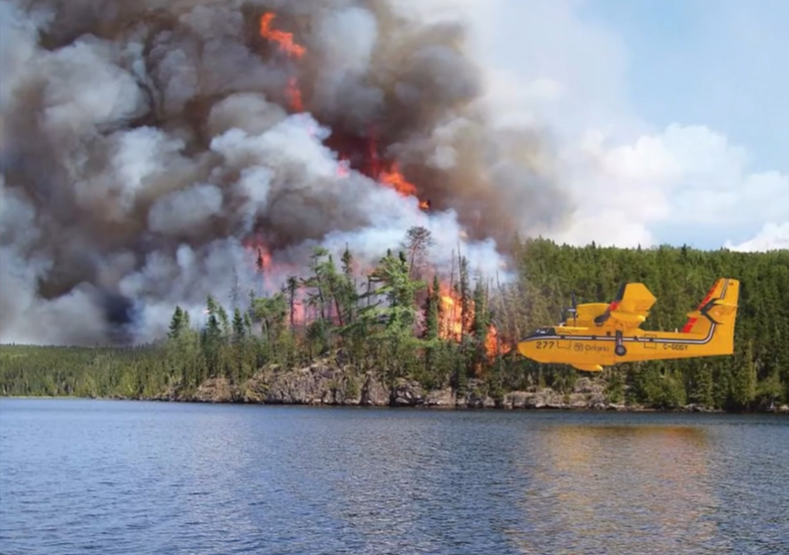
Residents across Muskoka are being encouraged to take steps to protect their homes and properties from wildland fires as officials continue to stress the importance of preparedness and mitigation.
A presentation on Wildland Fire Mitigation and Preparedness at Lake of Bays Council on June 2, 2026, by Ken Cox, Southern Region Fire Advisor for the Ministry of Natural Resources, highlighted the increasing impact of forest fires in Ontario and outlined practical measures homeowners can take to reduce risks.
The presentation noted that Ontario has experienced several significant fire seasons in recent years. In 2021, the province recorded 1,201 wildfires that required action by the Ministry of Natural Resources and Forestry (MNRF), burning more than 793,000 hectares. While fire activity dropped substantially in 2022, large-scale wildfire seasons returned in 2023 and again in 2025, when nearly 598,000 hectares were burned.
Cox explained that while wildland fires can have negative impacts on communities, infrastructure, air quality, and wildlife, they also play an important ecological role by renewing forests, improving habitat conditions, and supporting biodiversity.
The presentation reviewed the factors that influence wildfire behaviour, including weather conditions, forest fuels, topography, and wind. Dry conditions, low humidity, and strong winds can dramatically increase fire intensity and spread rates. Certain vegetation types, particularly coniferous forests and dead grasses, are more prone to rapid fire growth than deciduous forests.
A key focus of the presentation was the FireSmart approach to reducing wildfire risks around homes and buildings. Property owners were encouraged to think about their land in three distinct zones.
The Immediate Zone, extending from a structure to 1.5 metres, should be kept free of combustible materials that could ignite from embers.
The Intermediate Zone, ranging from 1.5 to 10 metres from a structure, should be managed to reduce fuels that support fire growth. Homeowners are encouraged to favour deciduous trees and plants, which are generally more fire-resistant than coniferous species such as spruce, pine, cedar, and fir. Fire-resistant vegetation typically has moist leaves, limited dead woody material, and low levels of oils and resins.
The Extended Zone, extending from 10 to 30 metres, focuses on reducing fire intensity rather than eliminating all vegetation. Recommendations include thinning coniferous trees so that crowns are separated by approximately three metres and pruning lower branches to reduce the potential for fire to climb from the forest floor into tree canopies.
The presentation also highlighted the importance of monitoring fire conditions through tools such as Ontario’s Interactive Fire Map and the national fire hazard maps available through FireSmart Canada.
Cox stressed that wildland fire preparedness is a shared responsibility. By managing vegetation around homes and understanding local fire conditions, residents can significantly improve the survivability of their properties and enhance community resilience during wildfire events.
Ontario’s Haliburton Fire Management Headquarters oversees wildfire response throughout the region, including Muskoka, as part of the province’s broader wildfire management system.
You can find the presentation HERE.
Don’t miss out on Doppler!
Sign up here to receive our email digest with links to our most recent stories.
Local news in your inbox so you don’t miss anything!
Click here to support local news
I agree and live with ther fear of reckless behaviour especially with tourtist. But why has tMuskoka and in particuliar Huntsville not put in a TOTAL ban on fireworks. I have asked Huntsville to ban them and they have resisted. It is time you also go beyond thee status quo.