
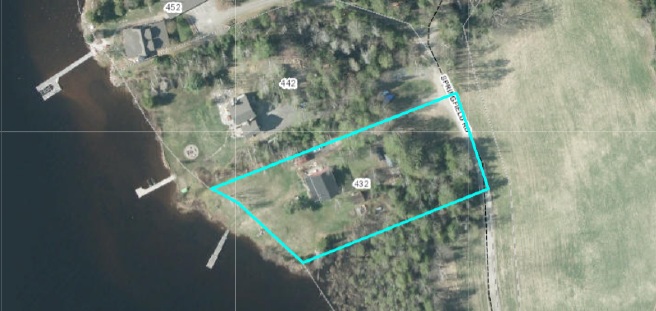
At its April 13 meeting, Huntsville’s planning committee went against a staff recommendation to deny a zoning bylaw amendment which would allow the short-term rental of a cottage on Springfield Road.
Huntsville manager of planning Richard Clark explained to the committee that the reason staff was recommending that approval be denied is because a portion of the lot is zoned Natural Resource (NR). Lands containing flood-prone areas are zoned NR, a category that is among the most restrictive in the municipality and accessory uses on those lands are restricted to boathouses and docks only.
Clark also told the committee that in the municipality’s short-term rental accommodation bylaw (STRA), passed in 2020, short-term rentals are not permitted as a right on flood-prone lands.
“This was due in part to concern that STRA uses within flood prone areas could increase the intensity of residential uses in these high risk areas, leading to increased risks to life and property,” noted Clark in his report to committee.
The property, located at 432 Springfield Road, has an area of about .5 hectares and 58 metres of frontage on Fairy Lake. It’s developed with a single detached dwelling, a utility shed, and a dock. It’s zoned NR towards the front (lakeside) of the property, and Rural 1 towards the rear.
Neither District staff nor Huntsville planning staff were recommending approval of the application and while two letters from nearby residents were submitted in support of it, seven were submitted against. Most of those against were concerned with the STRA use as it pertains to noise, safety and private road use as well as the suitability of such use given the risk for flooding.
Clark said municipal building staff noted that access to the property had been restricted in the past due to spring flooding and the road had been washed out in the past as well.
Committee also heard that based on modelling and taking into consideration the deck and entrance elevation to the house, during a hundred-year storm or major flooding event, the first floor could have up to 0.66 metres of flooding in it.
“Fire department staff noted that access to this property may become restricted during a flood or a high water event,” particularly where there is a dip or drop in the elevation of the road, said Clark.
He said should the committee consider approving the application, both building and fire response staff recommend that the short-term rental use only be permitted when there is no usual risk of flooding.
Brandy McCarey, who described herself as the future owner of the property, was before committee. Somewhat emotional, she told committee the approval process has been difficult.
“My family does not want to cause any stress or harm or any unwanted conflict with any of our neighbours. This is a future retirement place for our family. We are a young family of six, I have four children, and my husband grew up in Huntsville and all of his family still live there,” she explained.
“It was mentioned in one of the neighbours’ letters that waterfront is no longer affordable to locals and that’s partly why I feel like we are in this situation.” She said when the cottage was put on the market the price was out of their range, but her father fortunately stepped in and agreed to help them finance it. She said they need the rental income to help them make their payments.
“We knew that we would need rental income in order to afford this place. If I could just say, the main purpose of this place is not for rental income. We do rent it but that is not the main purpose of it. This is our family’s happy place,” she said.
She told committee that not all of the property is in a flood zone, that they’d be willing to help mitigate flooding should it occur, purchase the shore road allowance and have blackout dates when the cottage could not be rented. They’re also planning to revegetate the shoreline, which is flat. It would also help protect it from the wake caused by boats, she told committee.
She said all of the bedrooms are on the second floor, there is no basement on the property, “and we feel as far as renting out because you just follow the driveway up and it is out of the flood zone, unlike a lot of the areas to the left of us where they live there 24-7… we’re just asking for limited rentals to be able to afford this place for my family and I.”
In terms of complaints from neighbours, committee heard that many of those issues could be addressed through the STRA’s licencing regime.
Councillor Dan Armour said he understood the issue surrounding the affordability factor. “I can definitely understand the concern, especially with the real estate market the way it is today and trying to enjoy some waterfront property like this in Muskoka and especially being able to afford it,” he said. “Thank you for coming forward and I’d love to see you become a permanent resident here in the Town of Huntsville one day, and I actually would like to see us approve this.”
In the end, committee approved the application provided that the cottage not be rented during the months of March and April, that it be only rented up to 30 consecutive days, and that the owners purchase the shore road allowance, come up with a revegetation plan through site plan approval, and remove all shoreline structures on Town-owned land. With the approval, the applicants will also have to get an STRA licence.
Huntsville Mayor Karin Terziano, who has property in the area, declared a conflict and removed herself from the discussions.
You can find staff’s full report here (pdf).
Don’t miss out on Doppler!
Sign up here to receive our email digest with links to our most recent stories.
Local news in your inbox so you don’t miss anything!
Click here to support local news
Once again council ignores the bylaw and staff recommendations and makes an exception. If you keep doing this, there is no reason to have any bylaws- or for staff to prepare recommendations.
I feel sorry for the owner and I don’t have an issue with renting per se – but the fact is that there is a rule in place for a good reason, and we are breaking it. I don’t see any special circumstances here.
By making so many exceptions / amendments, you are encouraging anyone who does not meet requirements to come forward and request an exception. This just wastes everyone’s time and is a terrible system. I am not arguing for or against the specific rule – just the fact that the zoning bylaws don’t mean anything anymore. Maybe the bylaws need to be fixed.
I remember this property selling to the current owners just a few years ago at about $750k or so. Talk about timing. The property is likely now worth close to $1.75 million. To carry a property costing $750k, in terms of mortgage payments and property taxes, etc., I’m guessing that you’re looking at $40k to $50k per year. Since cottages in the area rent for about $5k to $6k per week, they likely need to only rent the place out 8 to 10 weeks per year to cover costs (if this isn’t intended to be a money-maker and is indeed for use/retirement…now/35 years from now).
How about limiting short-term rentals to no more than 12 weeks per year and how about using the money collected by the town for hospitality taxes to fund a hot-line so that when (as has happened at this cottage in the past with noisy renters), there is abuse, neighbours who bear the brunt of the damage caused by inconsiderate renters are able to get help in real-time from the town.
Just a thought.
Planning committee goes against staff recommendation and allows short-term rental in a potential flood zone.
Maybe I missed something? What is so special about this property or the owners that requires this unusual decision?
Will other properties/owners be treated in the same manner? Just curious!
“He said should the committee consider approving the application, both building and fire response staff recommend that the short-term rental use only be permitted when there is no usual risk of flooding.”
It would be great if everyone understood that there is no usual risk of flooding. In 30 years of living in a flood zone, there have been floods in 11 different months. Mother nature doesn’t always throw curve balls in the spring. January floods are really ugly when they freeze hard afterwards.
The issue with an unusual flood is the volunteer fire fighters that get sent in to fish people out when we shouldn’t be putting people in the way in the first place.