
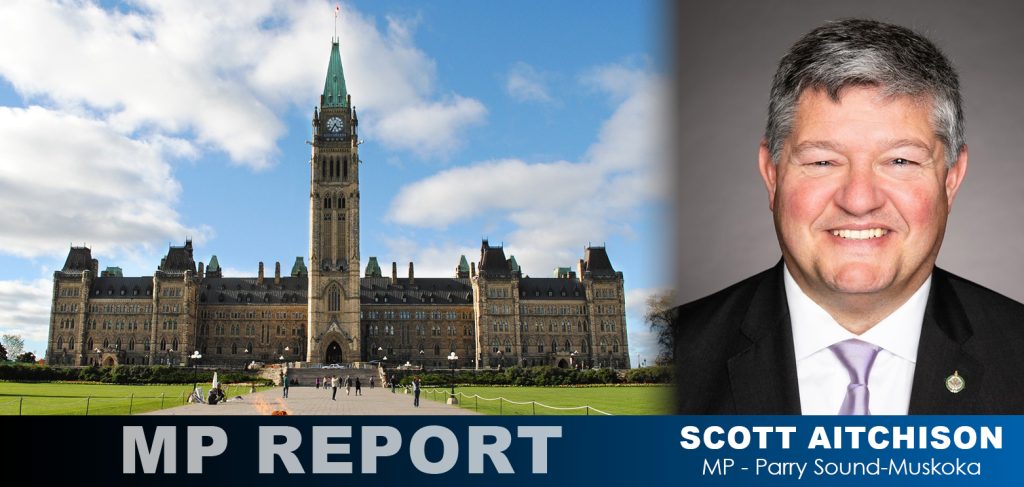
By Parry-Sound Muskoka MP Scott Aitchison
On October 26, I had the honour of seconding and speaking on Bill C-210. This is a piece of legislation presented by my friend and colleague MP Len Weber. It is a simple Bill that would add a box on the federal income tax return form offering Canadians an opportunity to register for organ and tissue donation.
Organ and tissue transplants improve, extend and save lives for thousands of Canadians every year. In fact, one deceased donor can potentially save up to eight other lives through organ donation and improve the lives of up to 75 more through tissue donation.
This is an incredible field of medicine that Canadians wholeheartedly support—in fact some 90 per cent of Canadians indicate they support organ and tissue donation.
And Canada has been a world leader in the development of transplant surgeries, having performed the world’s first successful heart valve transplant in Toronto in 1956, the world’s first successful lung transplant in 1983, and the world’s first successful double lung transplant in 1986—all performed here in Canada!
Despite Canada’s pioneering role in transplant medicine, despite the undeniable success of these life-saving procedures and despite the overwhelming support of 90 per cent of Canadians, merely 20 per cent of Canadians have registered for organ and tissue donation.
The impact of this chasm between intention and action can be measured in lives lost.
In 2019, there were 4,527 Canadians waiting for transplant surgery. Of those 4,527 patients, 710 either withdrew from the list or died.
Those 4,527 Canadians do not tell the full story. The Kidney Foundation of Canada reports that of the 22,000 Canadians whose kidneys have failed, only 16 per cent of them are even on the transplant wait list.
Why the discrepancy in the face of such need and so much support?
In testimony before the House of Commons Standing Committee on Health in 2018, Ms. Ronnie Gavsie, President and CEO of the Trillium Gift of Life Network explained that the variety of reasons for this discrepancy include misconceptions about donation. Some people think their age or health might prohibit them from being a donor or that becoming a donor would affect the hospital care they receive. Another factor is simply procrastination.
Ms. Gavsie also explained that in 10 to 15 per cent of circumstances, organ donor registrants’ wishes are overturned by their loved ones at the time of their death.
Remarkably, the most common reasons for the gap in organ donor registration could be solved with a conversation!
Canadians need to be reminded of their intention and Canadians need to be encouraged to have a conversation with their loved ones about organ donation!
Public education, awareness campaigns, and greater opportunities to register can help. And as we have heard, tragedies have spurred Canadians to register as donors also.
An option to register for organ donation on the federal income tax form will spur the conversation, and it will save lives.
Among the witnesses the Standing Committee on Health heard from while preparing its 2018 report on Organ Donation in Canada was Laurie Blackstock.
Laurie arrived home one day to find her husband unconscious and suffering multiple seizures. He was rushed to the hospital where he then suffered a heart attack. The medical staff at the Ottawa Hospital brought him back to life, but he was transferred to the ICU and put on life support. After two days in the ICU, they knew that her seemingly healthy 57-year-old husband Stephen would not survive. Stephen had told Laurie that he had checked the donor registry and the doctors knew he was a registered donor.
Laurie, along with Stephen’s mother, met with the Trillium Gift of Life Coordinator in the hospital and the decision was made. Through their despair, they knew that potentially eight families could be spared their grief and pain—that their loved ones could be saved and live a much healthier life.
Many weeks later, Laurie received a thank you note from a young man who had been the recipient of both Stephen’s lungs. She described that in the note he wrote that he thinks of his donor family every time he breathes and that the word grateful could not begin to describe his feelings. He thanked her and her family for saving his life.
Laurie went on to say, “I’m here to emphasize that organ and tissue donation doesn’t just help the recipients and their families. It doesn’t just reduce the tremendous cost of long-term kidney treatment. It also can be an incredible gift to the bereaved families like mine, because when presented gently and ethically, at the right time, when there’s little or no hope of a loved one’s survival, it is a gift. Knowing that five people’s lives probably improved dramatically with Stephen’s lungs, kidneys, and corneas doesn’t change his death and the intensity of our grief, but it gives us moments of relief. Stephen lives on through those five people.”
What an extraordinary gift.
For the sake of the thousands of Canadians who desperately need their fellow citizens’ best intentions transformed into action, I ask every citizen to register as an organ donor today.
You can register, check, or update your consent to donate here.
(Photo of Parliament Hill by festivio on Pixabay. Photo of Scott Aitchison courtesy of Scott Aitchison.)
Don’t miss out on Doppler!
Sign up here to receive our email digest with links to our most recent stories.
Local news in your inbox three times per week!
Click here to support local news
Thanks Scott,
Signed mine years ago but like Brian … Let me finish with them first, Ok ? :-))
Thank you for this important initiative, Scott.
But I agree with Colin that if we really want to have a significant impact on increasing the availability of transplant organs we need to make the default a widely publicized opting in, so that everyone will be a potential donor unless they specifically opt out. There are so many impediments otherwise, some of which you have highlighted, to action in timely removal of organs. In addition there is general inertia in any population in actually getting around to opting in. (See “Nudge” by Thaler and Sunstein).
And while I like the idea of a check off to opt in on one’s income tax return I don’t see how that information could be readily accessed and used at time of death.
Kudos to Scott for supporting this initiative.
Well done, let’s hope it passes. Even if it results in a few more donations being possible, it’s a very good thing.
Scott, I have signed up on my driver’s license.
Great job!
Scott, I have a cousin who received a kidney from her sister and then a lung from another donor. Without these organs she would not have lived to enjoy life as long as she did. She and her family were always so grateful to have had this opportunity to donate and for her to receive organs to extend her life.
I always say to people, you don’t need your organs when you are gone so give the gift of life or sight to someone who will benefit and have more time with friends and family.
My family know my wishes for my organs!
Scott, this is a gift of life indeed. Our good friend Jim that we met in Florida is a retired orthopedic surgeon from Illinois. Jim has a genetic kidney disease and was weeks away from going on dialysis. He received a call to be at the hospital at 6 pm to receive a kidney transplant from Kaylee, a 17-year old girl who died tragically in a car accident. Jim later made friends with Kaylee’s family and is now funding her younger brother’s college education which he otherwise would not have had. One gift of life turned into two.
Curious Scott – why not support an opt-out policy instead? Defaulting to opt-in would provide a much larger donor pool.
https://sparq.stanford.edu/solutions/opt-out-policies-increase-organ-donation
Scott:
This is important and vital information for Canadians to embrace. I was astonished that my 90 year old mother while in Grace Hospice in Huntsville was asked if she would like to donate body parts after her death. Initially my Mom thought the question was quite humurous, after all she was a few months from her 91st birthday and didn’t think she would have anything left to contribute to Science and Research….turns out that her eyes could be used and she agreed….so I’m with you Scott….this is a great initiative and hopefully will pass through Parliament.
BTW…I have signed my Driver’s License and if anyone would like my body parts, they are most welcome. But please, wait until I don’t need them anymore….LOL
Sounds good Scott! Well done.