
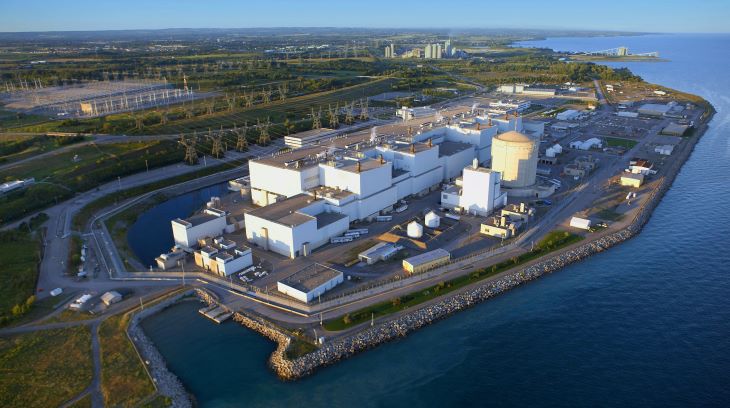
The Ontario government is working with Ontario Power Generation (OPG) to commence planning and licensing for three additional small modular reactors (SMRs), for a total of four SMRs at the Darlington nuclear site.
Once deployed, these four units would produce a total 1,200 megawatts (MW) of electricity, equivalent to powering 1.2 million homes, helping to meet increasing demand from electrification and fuel the province’s strong economic growth, announced the provincial government on Friday.
“Our government’s open for business approach has led to unprecedented investments across the province — from electric vehicles and battery manufacturing to critical minerals to green steel,” said Todd Smith, Minister of Energy in a media release. “Expanding Ontario’s world-leading SMR program will ensure we have the reliable, affordable and clean electricity we need to power the next major international investment, the new homes we are building and industries as they grow and electrify.”
For the first time since 2005, Ontario’s electricity demand is rising. While the government has implemented its plan to meet rising electricity demand this decade, the experts at Ontario’s Independent Electricity System Operator have recommended the province advance new nuclear generation to provide reliable, baseload power to meet increasing electricity needs in the 2030s and beyond.
Subject to Ontario Government and Canadian Nuclear Safety Commission (CNSC) regulatory approvals on construction, the additional SMRs could come online between 2034 and 2036. This timing would allow Ontario Power Generation to apply learnings from the construction of the first unit to deliver cost savings on subsequent units. Building multiple units will also allow common infrastructure such as cooling water intake, transmission connection and control room to be utilized by all four units instead of just one, reducing costs even further.
“A fleet of SMRs at the Darlington New Nuclear Site is key to meeting growing electricity demands and net zero goals,” said Ken Hartwick, OPG President and CEO. “OPG has proven its large nuclear project expertise through the on-time, on-budget Darlington Refurbishment project. By taking a similar approach to building a fleet of SMRs, we will deliver cost and schedule savings, and power 1.2 million homes from this site by the mid-2030s.”
The Darlington SMR project is situated on the traditional and treaty territories of the seven Williams Treaties First Nations and is also located within the traditional territory of the Huron Wendat peoples. OPG is actively engaging and consulting with potentially impacted Indigenous communities, including exploring economic opportunities in the Darlington SMR project such as commercial participation and employment.
Ontario’s robust nuclear supply chain is uniquely positioned to support SMR development and deployment in Ontario, Canada and globally. Building additional SMRs at Darlington would provide more opportunities for Ontario companies as suppliers of nuclear equipment, components, and services to make further investments to expand their operation to serve the growing SMR market both domestically and abroad.
Supporting new SMR development and investing in nuclear power is part of the government’s larger plan to prepare for electricity demand in the 2030s and 2040s that will build on Ontario’s clean electricity advantage and ensure the province has the power to maintain it’s position as leader in job creation and a magnet for the industries of the future.
Quick Facts
- The Independent Electricity System Operator’s Pathways to Decarbonization Report forecast that in less than 30 years Ontario could need more than double its electricity generation capacity from 42,000 MW today to 88,000 MW in 2050. The report forecast an additional 17,800 MW of nuclear power could be required to meet that increased demand.
- Nuclear power currently provides about 50 per cent of Ontario’s electricity supply and has positioned Ontario as one of the cleanest electricity grids in the world.
- To meet growing electricity demand this decade, Ontario is conducting Canada’s largest clean energy storage procurement, has invested more than $1 billion in energy efficiency programs, is supporting the continued safe operation of the Pickering Nuclear Generating Station and has re-contracted existing electricity generation resources at a 30 per cent discount, keeping costs down for ratepayers.
- In December of 2022 OPG broke ground to prepare for the first grid-scale SMR in Canada and the G7 at Darlington. OPG is partnering with GE Hitachi Nuclear Energy, SNC-Lavalin, and Aecon on the project, with the construction of the first unit scheduled to be complete by 2028.
Additional Resources
Ontario Breaks Ground on World-Leading Small Modular Reactor
A Strategic Plan for the Deployment of Small Modular Reactors
On July 10, 2023, the province further released the Powering Ontario’s Growth plan, outlining the actions the province is taking to meet the increasing demand for electricity driven by strong economic growth and electrification through the 2030s and 2040s. These actions, which include new zero-emissions electricity generation, long-duration storage, and transmission lines will provide families and industries with the reliable, low-cost, and clean power they need and power our future, according to the provincial government.
It states, Powering Ontario’s Growth outlines the actions the province is taking to meet electricity demand over the long term, including:
- Nuclear Energy – Advancing reliable, affordable and clean nuclear power through pre-development work at Bruce Power and the three additional small modular reactors at Darlington
- Competitive Procurements – Starting to plan for the next long-term competitive procurement of non-emitting electricity resources including wind, solar, hydroelectric, batteries and biogas
- New Transmission Infrastructure – Designating and prioritizing three new transmission lines that will power Algoma Steel and job creators in Northern Ontario, and one new transmission line to power growth in the Ottawa region and across Eastern Ontario.
- Hydroelectric Power – Asking OPG to optimize hydroelectric generation from current sites and working with IESO to assess two proposed pumped hydroelectric storage projects in Marmora and Meaford to improve grid efficiency
- Keeping Costs Down – Starting planning for the future of energy efficiency programming in Ontario to help reduce demand and supporting the deployment of distributed energy resources (DER) such as rooftop solar and the EV batteries
- Planning for Future Transmission – Directing IESO to report back to the Minister with transmission options to address system bottlenecks between Toronto and northern Ontario, and into downtown Toronto, to enable growth.
Don’t miss out on Doppler!
Sign up here to receive our email digest with links to our most recent stories.
Local news in your inbox so you don’t miss anything!
Click here to support local news
With nuclear whatever the billions and billions cost estimate is, double it.
Whatever the duration estimate of the project is, double it. 6 years for a brand new design? Try 12.
But I’m sure that won’t happen this time… like every other time. LOL.
“Report slams NuScale SMR: “Too late, too expensive, too risky”
“Premier Doug Ford’s decision to tear up 750 renewable energy contracts shortly after winning the election last year is costing Ontario taxpayers more than $230 million.”
Would have already been operating. Storage projects as well.
He prefers to burn 100s of millions of taxpayer dollars. Not exactly green. Or sane.
Build them. When the rolling blackouts start cause we don’t have the generation capacity things will really change up! There is risks with any type of generation! Great idea Doug. I like to say Here it is then where the heck is it!
Hugh Holland: I’m not much on number crunching, but if I was to put any faith at all in someone who does just that, it might be you. Not meaning that statement to be the beginning of an admiration society, just a comment. But when I see what you feel needs to be done, and realise the chasm that exists between that, and what is being done, I wonder if you often scream, or at least feel like it!
I recall that person who lost it in the office of MP Scott Aitchison, making some untoward remarks, and causing a well meaning group to have to apologize. I think that is the kind of scream I mean. Seeing something very wrong, but unable to do anything about it.
We could argue as to the efficiency of, or ability to lead, of our present PM, but we would likely agree that the man hoping to take his place would be a disaster. There is no ” here’s what we will do” plan from either our federal or provincial Conservative governments. Just a “the Liberals are doing it all wrong” plan.
The world is pumping billions into a war between the Ukraine and Russia. It’s unsettling and I’m sure it’s not very eco-friendly.
China quietly buys up American agricultural land. Here at home, Doug Ford hopes to have Ontario agro land under roof shingles and asphalt, before the Chinese get here.
Japan is about to drain millions of liters of radioactive water into the ocean.
Oil-sands here in Canada are working towards emptying huge, toxic, settling ponds into a river system that drains into the Arctic Ocean.
At present there is a race between clear cut loggers and a Mother Nature on steroids, playing with lightening, to see who can destroy our forest the fastest.
No numbers at all here, but it’s things like that, that make me uneasy. Maybe want to scream.
There was also the question posed to our local MPP, as to whether he felt there was some cord or correlation between global warming and the forest fires raging, in Ontario and across the country.
His answer was something like, “Ontario has always had forest fires.” These people have a plan?!
So Hugh, when you state that the country will have to build 10 SRM units per year for 20 years, do you think our governments know that; might they thinks it’s what should be done; maybe realise they should be doing something. Or is the task, or even the planning of the task too much?
Maybe it’s just easier to let us scream.
Mac Redden, anyone who knows me knows I don’t always agree with the Ford Government, but in this case of building more nuclear capacity, I agree for the following reasons:
1. Major energy projects take at least 10 years from start to finish. People cannot possibly understand the magnitude of the challenge of replacing the fossil fuels that still make up 75% of our total energy supply without doing many hours of rather complex calculations. I have put in those hours of work, and I find the OESO to be a very competent organization.
2. We do indeed need to conserve energy, shift demand, and add storage where it makes sense. The biggest conservation item in the last 15 years was a massive shift to LED lighting that uses 80% less energy than incandescent and fluorescent lighting.
3. Demand is growing again because of population and technology growth. Energy planning just gets more and more difficult. We have more and more people, using more and more energy, while protesting every type of clean energy production. It is terribly frustrating when our best energy planners are stopped at every turn by NIMBY attitudes.
4. Electricity is currently only about 24% of our total energy supply (TES). The other 76% still comes from fossil fuels. After adapting every known efficiency and conservation strategy such as electric vehicles and mobile equipment, and cold climate heat pumps, we will still need to increase our electricity supply by 2.5 to 3 times the current level.
5. We need to use every available type of clean energy capacity if we are to have any hope of replacing fossil fuels before we run out of them. That means adding solar, wind, hydro, bio-waste, geothermal, big nuclear, and small nuclear. They are all been proven perfectly safe when done properly. We absolutely cannot put all our eggs in any one or two baskets.
6. No country anywhere has been successful by putting too many eggs in too few baskets. For example, China has the most solar capacity in total, but solar is only 1% of China’s TES. Coal is still 61% or China’s TES. After 20 years of intense effort, Germany has the highest % of solar capacity, but solar is only 1.6% of Germany’s TES. Denmark is a small peninsular surrounded by offshore wind turbines. Denmark has the world’s highest % of wind energy, but wind is only 8.5% of their TES.
7. Bio-waste incinerators, geothermal, and small nuclear reactors (SMRs) are the ONLY SOURCES that can co-generate electricity and heat at the same time from the same energy source. They can provide virtually free industrial heat and district heating for residential and commercial applications with no additional energy (fuel) consumption. Those sources have just begun to come on stream in Canada. Alberta has had our first large scale geothermal plant in operation for 4 years. After 10 years of failing to get agreement on a new landfill site, Durham-York built a bio-waste plant that meets every Ontario clean air regulation. OPG is planning to build 4 SMRs on the existing Darlington Nuclear site. It would be better to build them close to industrial plants that can use the heat, but the NIMBY factor will prevail until people get used to this new idea. After those SMRs have been proven safe and effective, they will build more. We cannot replace fossil fuels without as many as 200 SMRs across Canada. That means building 10 per year for 20 years.
8. Canada is lucky. Our oil and gas workers already have most of the skills they need to transition to the thousands of new clean energy jobs. The federal government’s new Sustainability Program will help them make that gradual transition. The amount of land needed for new energy will be about half the current amount used for coal, oil, and natural gas production.
Conservation of energy, storage and shifting power demand to off peak is FAR cheaper than new generation from any source.
But Ford prefers wasting billions on new generation instead.
Ontario used to have Save On Energy rebates.
Power demand went DOWN in Ontario from 157 TWh to 132 TWh from 2005 to 2017 in spite of the population going up.
Until Doug Ford in 2018.
Now the trend is reversed and climbing again.
Save on Energy rebates and the big EV rebate were immediately cancelled by Ford.
He ripped out functioning EV chargers at GO stations saying “EVs are only for the rich.”
EV hostile.
Just a simple timer, EH40 at HD, on your electric water tank shifts the big morning peak to the middle of the night at much lower rates.
In fact heat pump water heaters save as much energy as an EV uses so no new energy would be needed at all.
After federal, provincial and utility rebates in the US they are the least expensive type of water heater as well. $200 in some states.
Peanuts cost to operate in Ontario at the new 2.4 cents per kWh overnight. Almost nothing. Less than gas.
More expensive GHG spewing gas water heaters would be obsolete.
But Ford prefers spending billions on new generation including new GHG spewing natural gas power plants instead of millions in energy saving rebates like Ontario used to have.