
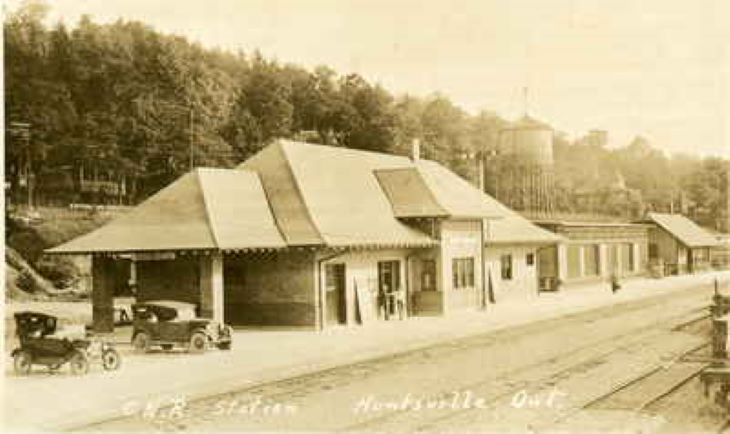
We’d walked up to the rail track, hoping to maybe flush a partridge from the berry bushes and shrubbery along the fence line. It was cold and wet, and any self-respecting bird would be under cover, not out getting rained on. But my father hadn’t asked what I thought, so there we were.
“Ace said you could wait along the tracks if you heard a train coming,” Dad told me. Ace was his grandfather and had been a cadge and coach driver before the train hit Huntsville. “Pump your arm or shotgun over your head, and if they saw you, the fireman might kick you out a shovel full of clinkers.” Clinkers were the molten, glowing remnants of spent boiler coal.
“You could kick them up in a heap and get your hands and feet warm. Or add some fuel and have a nice little fire.”
Just one of those things that early rail had brought to the area. Like it had brought passengers into the Huntsville Station under cover. Somewhat protected from the rain and snow of the day and from most of the sparks hidden in the boil of smoke. Belched by a chugging engine, under load, on every grade. Early settlers had the land afire. Burning logs and brush in their determination to clear the land for farming. For sure, the train had helped to spark up a few of those early blazes.
On the subject of fly ash and sparks, I was informed by one oldtimer of the ability of the frontiersmen to absorb a lesson quickly. Something never before anticipated. He’d been told that ‘in the day,’ back when the Northern ran, it was unwise to attempt a bridge crossing as the boat ran under said bridge. The Northern was our first lake boat, and its boiler vented straight up! There were sparks and glowing ash in that smoke. A story he had heard and recounted to me.
There are records of young men walking cattle and oxen cross-country, from miles south of Huntsville. Spending days driving the animals and living rough. Now, stock could be loaded up and ride into the frontier in style. The odd spark just a minor inconvenience. Or not if it got caught in a fold of clothing on a dozing passenger. As inconvenient as stowing a pipe away when it wasn’t quite out.
Just as boat traffic had reduced freight prices from those charged by coaches and caged wagons, the train was an even better deal. The tonnage hauled, and to a regular schedule, meant variety began to show in the trade goods offered in local stores. Today, the expression is ‘If you got it, a truck brought it.’ Back then, it was the train.
There’s the story of a man bringing a piano to the area to keep his wife happy. Before the train! So, it had come by boat and cadge wagon. Must have been a hell of a task. I think the story goes on to tell us that the lady left anyway. Apparently, she just couldn’t live on the frontier. Maybe she was packed and gone as soon as she could get a ticket on the train?
Once the schedule had been set and the run established, punctuality was built in. You could get here when you had said you would. It was only a short jaunt (all uphill) from the station to fine lodging. If you had arrangements for pick-up, your ride knew when to be there for you. There was also the opportunity to change from rail to steamer and be off to any of the fine hotels and vacation sites that dotted the shoreline around the local lakes.
Punctuality was important because business counted on it. The mail arrived and departed according to a schedule as outlined in the notes and letters of Postmaster Davis. Mail into boxes and bags in time to meet the office and other customer requirements in the town. Then all ready again for the next delivery, South and North. Once there was more traffic going North, it meant Mr. Middleton ran to a tight schedule as he held the mail delivery contract.
The train brought Foster Hewitt to town. The future legend of ‘Hockey Night’ would be here to do commentary and recordings for the performances of the local tannery band. Into Huntsville on time. Get the recording finished up and then back to the city. In time to call the play-by-play for the Toronto Maple Leafs. In time to deliver on cue his “Hello, Canada, and hockey fans in the United States and Newfoundland.”The train got him here for the show and then back to TO.
Special trains were organized to carry revellers, competitors and fans to Huntsville. If you wanted to do downhill, cross-country, jump at the Mica mine or recover from doing any of those, the train was ready to fetch you here or trundle you back.
Every lumber mill had access to a siding and to the rail. Over the years, there were a lot of mills coming and going and burning. Boiler-powered mills had a nasty habit of burning down. They had the same problem with sparks and fly ash as trains did. Muskoka Lumber, Huntsville Lumber and Bethune Pulp and Lumber were big players in the 20s and 30s. I wonder how many trees were cut and the lumber shipped from yards in Huntsville? Scaled and loaded at those local sidings? Hundreds of millions of board feet hauled away by train.
Some of our first cars arrived in Huntsville in crates, on flatcars, behind a chugging train. Packed and secure and only partially assembled, they needed someone to make the pieces fit. In 1913, Mr. J.E. Mosely, a local hardware store owner, sold 6 or 7 new Fords. The locals seemed capable of making the pieces all fit. In Dave Johns’ book ‘Pathways to Highways,’ we read where Mosely sent Gord May away to Detroit to train as a proper ‘licenced’ Ford mechanic.
My grandfather had the opinion that if you couldn’t fix it with wire, pliers, a ball peen hammer and maybe some sugar cubes, it was too damned complicated. Gramps had always been a teamster, and I suppose the sugar cubes were to get on the good side of a recalcitrant mare. I was never sure where the hammer fit in.
In 1914, Mr. Mosely brought in 20 more Fords. They were assembled under the watchful eye of Mr. May and arranged for sale in front of Mosely’s hardware on the corner of Main and Brunel. Car salesman became a vocation, brought here by train.
Now we wait for this ‘second coming’ of passenger rail to Huntsville. The provincial government has spent $138 million to create a dedicated passenger corridor. Another $ 100 million in upgrades to the track and infrastructure. The route created will be some 740 kilometres from Toronto to Timmins. To be rumbled on by 3 new train sets comprised of a locomotive and 3 passenger cars, or two passenger cars and one cab car. A cab car is another driver’s compartment, negating the need for a turntable at the end of the run. The engineer just installs himself in said cab car and journeys off on the return run. According to the CBC, the train sets cost another $139.5 million.
All the tough stuff seems to have been done by those who came before. We are indebted. All that is left for these new trains to do is perform as advertised. In the future, maybe years on or maybe not, someone, hopefully, will write about the success of this new enterprise. How the system supplies reliable service at a reasonable price. I hope to take a ride on this new train myself.
But I can’t write about the future of this enterprise. How do I write about wishful thinking?

Allen Markle was born in Huntsville and lived on Brunel Rd. Around Forbes’ corner, up Carter’s hill, and he was home. He says his dad kept him busy working for many of Huntsville’s Italian families and main street businesses, and doing construction for lodges and cottagers on Lake of Bays.
He spent a couple of years in the south, but eventually returned to the Huntsville area in 1967. Spent 10 years in the employ of Wiik and Hoeglund and another 27 at Kimberly-Clark.
“I enjoy woodworking and have fished and hunted for many years. Still spend a lot of time regaling my family and anyone who’ll listen about how it was ‘back in the day,’ he says.
Don’t miss out on Doppler!
Sign up here to receive our email digest with links to our most recent stories.
Local news in your inbox so you don’t miss anything!
Click here to support local news
I agree that this article is a good read. As usual, Mr. Markle paints a picture of Huntsville’s past with a personal and colourful touch, giving those of us who weren’t here in the mid 1900s, a glimpse of what Huntsville has evolved from.
Having said that, I imagine how different things would be if the railway had made Hoodstown its depot as opposed to Huntsville.
Even today, Etwell ( adjacent to Hoodstown ) is relatively untouched by development,
Could the site of the Etwell Concert Series have become the site of Walmart?
Humour aside, the throw back communities of Etwell, Stisted, Aspdin and Lancelot all face the ugly reality of being in the path of the new Hydro One Transmission Line, linking Barrie to Sudbury, that threatens to cut a 75 metre wide swath through our rural habitat. We are in one of the 3 proposed routes between Huntsville and Party Sound. One route will be selected next year and the massive towers will up and running by 2032.
As opposed to a similar attempt 40 years ago, which we stood up against under the leadership of Jack Newton, this time the line will go through in one of the 3 proposed routes that are now on the table,
Just in case you didn’t already know. Hydro one is currently seeking input,
One thing I took away from your article is that the railway was never just about transportation. It connected people, communities, businesses, mail and opportunity. Huntsville grew because it was connected to the rest of Ontario. I hope the new passenger service succeeds for much the same reason. If it proves reliable, affordable and dependable, it could once again become part of how people visit, work and experience Muskoka. Your article reminds us that good infrastructure does more than move people. It helps communities grow. If this new service serves Canadians well, I hope it becomes another successful chapter in that story.
And when passenger rail returns to Huntsville, one memorable stop for visitors could be Smoking Hot in the old train station. I had dinner there recently, and everything was delicious. The ambiance, the music, and having a train pass by just a few feet away was sensory overload in the best possible way. Next time I’ll probably take my hearing aids out first!
Can you imagine if Captain Hood had his way and the R.R. went through Hoodstown?
I enjoyed your article, Mr. Markle. It is great to read about how the railway contributed to the settlement.
Thank you, Mr. Markle, for another enjoyable story. I hope you’ll become a regular columnist for the Doppler. I always look for your name in the comments as well.
A very interesting and informative story
I always enjoy reading about Huntsville’s past.
It was very well written. I look forward to reading more. I hope this will be an ongoing article on Doppler.
Ditto to the comment above. Excellent article as always, Mr. Markle, keep them coming!
This was an immensely enjoyable read. Thank you Mr. Markle for writing this. Our beloved town has such a rich history that most don’t know well enough, myself included. I am grateful for a chance to learn.