

By David Harrison
Noble cause corruption refers to unethical behaviour by individuals or groups who believe their actions are justified because they are in pursuit of a noble or morally righteous goal. The idea behind it is that the end (the noble cause) justifies the means, even if those means involve dishonesty. While this term is often used in relation to law enforcement and criminal justice, it can also apply in other fields, especially in politics, where people think they’re serving a greater good, leading them to compromise ethical standards.
According to the Hon. Pierre Poilievre, the Liberals are guilty of Noble Cause Corruption, and the upcoming election will be a referendum on Canada’s Carbon Tax.
To clarify my position on global warming, climate change, and CO2 issues, I consider myself a pragmatist rather than a skeptic. I prefer to rely on peer-reviewed facts, not opinions, and I like to examine facts in context rather than in isolation. This approach helps me cut through the political bluster and extremist propaganda on both sides of the debate.
The Carbon Tax, introduced by the Liberal Government in 2019, is designed to change our national habits by reducing our carbon footprint—that is the amount of CO2 we’re each responsible for emitting into the atmosphere. But is the Carbon Tax truly an effective way to change behavior? If there’s no significant change in individual or corporate habits, then, as the Conservatives argue, the Carbon Tax is just a costly burden imposed on Canadians by the current government.
Has the Carbon Tax become a ‘political corruption of a noble cause’? Let’s look at the numbers, courtesy of Statistics Canada.
Statistical Sleight of Hand?
British Columbia is often held up as an ideal example when discussing the Carbon Tax as it was the first province in Canada to introduce one back in 2008. But what has been the outcome?
According to Statistics Canada, gasoline purchases in BC increased from approximately 4,496 ML* (million litres) in 2008 to 4,918 ML in 2023, an increase of 12%. However, during that same period, BC’s population grew by 25.8% (context). On a per-person basis, gasoline consumption has actually decreased by 14% over those 15 years.
*A ML (mega litre) = 1-million litres.
You might think, “Aha! That proves the Carbon Tax works!” Not so fast…
Currently, a litre of gasoline in Vancouver averages $1.76 (CAD). Just across the border in Washington State, the same litre of gasoline at a Costco gas station sells for $1.20 (CAD), which is 32% less. Furthermore, back in 2013, the Business Council of BC reported that same-day trips to the U.S. from the Lower Mainland region rose from 2.3 million trips annually to nearly 5.7 million that year, a 248% increase! More context.
If we assume that each same-day traveller from BC fills up with 50 liters of gasoline before returning to Canada, this suggests that 285 mega litres of gasoline are purchased annually in the U.S. by these travellers. Additional context. This amount represents significantly higher consumption than what official statistics recognize—about 6% higher, negating 68% of the supposed reduction in gasoline use.
Does your government “promise to give the truth, the whole truth, and nothing but the truth”?
We also need to consider the “COVID factor” in questioning the effectiveness of the Carbon Tax. Currently, 20% of British Columbians work from home, a reduction from the 40% who did so at the peak of the pandemic in April 2020. Even more context.
The simple truth is that gas consumption in “eco-friendly” BC, despite the tax, driving habits remain largely unchanged. Has it been worth the hassle? You can let the politicians know your opinion at the next election.
Behavioural Change?
The main argument against the Carbon Tax, particularly one that increases gradually over time, is that it’s unlikely to change Canadians’ behavior—the very goal of the tax. Consider the following example:
“From 1990 to 2013, per capita Vehicle Kilometres Travelled (VKT) increased by 2.56%, reaching 9,014 km per person in 2013. During that same period, inflation-adjusted gas prices in Canada increased by about 38%, peaking in 2008.” (Shenstone/Harris, 2016).
In January 2006, the average price of gasoline in Canada was $0.95 per liter. Adjusted for inflation, that would be $1.40 today. As of January 2024, the price is $1.44—an actual increase of only 0.03%. Has a three-tenths of one percent increase really changed anyone’s driving habits?
Similarly, gradual price changes are unlikely to alter other behaviours—such as eating habits. During the long Canadian winters, most fresh produce is imported by truck, with only a small portion of the total distance driven occurring in Canada. Additionally, Canadians will continue to heat their homes in winter and cool them in summer out of necessity, regardless of ‘minor’ energy price increases.
While the Liberal government promotes the idea that families will receive a rebate at the end of the year, it’s important to note that this rebate comes from money taken out of Canadians’ pockets each month through increased food prices, etc.,—typically when families need that cash the most. With a recent headline stating that “40% of Canadians are $200 away from insolvency” (though this statistic is viewed with some skepticism), it highlights just how crucial cash flow is to families; making a twice-yearly rebate less helpful.
The Carbon Tax costs Canadian taxpayers $100 million per year, with 465 full-time government employees. Add to this the administrative and reporting costs imposed on businesses.
Another contextual consideration is that Canada’s largest industrial polluters are either exempt from the Carbon Tax or pay reduced rates. In this context, only a very direct “carrot and stick” approach will be effective in changing individual habits.
What can we do to make measurable changes to Canada’s carbon footprint?
No. 1. Improve public transit. There is a direct correlation car usage and the availability and efficiency of public transit. In the chart below compare Prince Edward Island to British Columbia. This chart also shows the dip in most provinces caused by the 2008/2009 economic crisis.
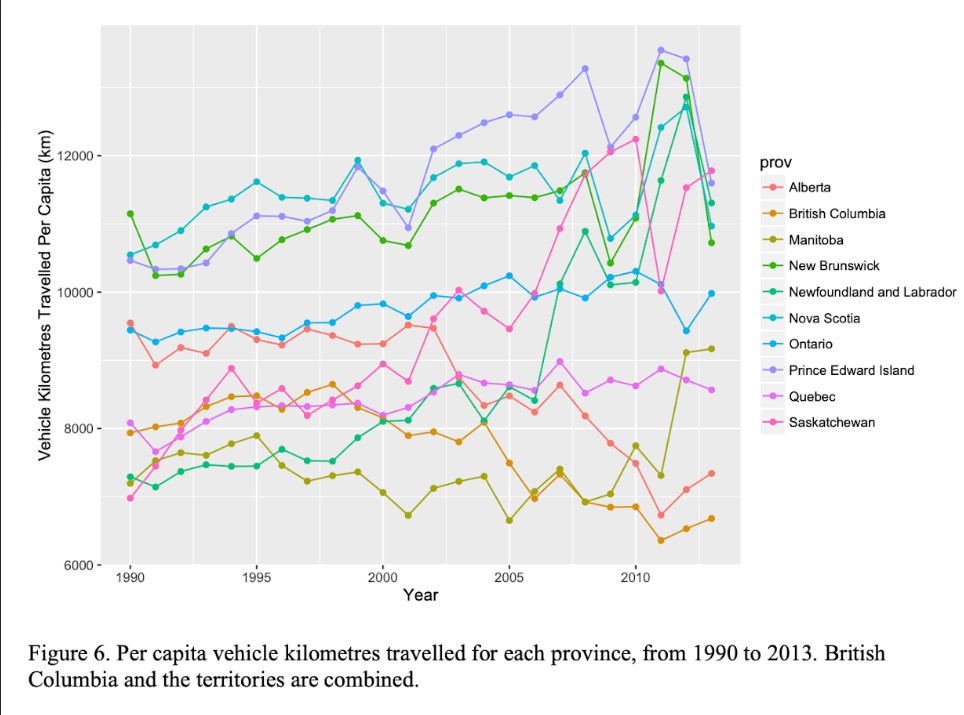
No. 2. Encourage the use of electric vehicles. Place a premium ( an ‘ICE Tax’) on vehicles with internal combustion engines and use that same tax to subsidize zero-emission vehicles. 1.756 million new vehicles were sold in Canada in 2023. Placing a graduated tax, starting at $500 and raising it to $5,000 for the worst polluters, would bring in approximately $3 billion in revenues per year that could be used to directly subsidize ZEV purchases. The revenues would be on a declining scale as more and more ZEVs are purchased. Going all-electric would reduce Canada’s total CO2 emissions by 28% in about ten years. Ontario has introduced a pricing plan where you can charge your EV overnight for only 2.7 cents per kWh (peak rates are higher with this plan). If you average 19,200 km of driving, it will cost you $81 to fuel your car (30,000 kWh) for a year.
No. 3. Use the same incentive principle for the purchase of transport trucks. Most major truck manufacturers are investing in ZEV technology, and an ICE Tax would accelerate their introduction.
No. 4. Invest more in solar, wind and hydro technology. This year, 2024, California has reached 100% renewable electricity production.
No. 5. Incentivise people to improve their personal energy efficiency. For example, using a $99 programmable timer on an electric hot water tank (so that it is off during peak periods) can save the homeowner $200+/yr.
No. 6. Incentivise Canadian (local) manufacturing. This is usually done by cutting through the ‘red tape’ (unnecessary rules and restrictions) and reducing corporate taxes for manufacturers. When an individual purchases products from outside of Canada, transportation is one of the most significant CO2 contributors to a product’s carbon footprint. Canada as a whole doesn’t emit a lot of CO2 compared to other manufacturing countries like China and India. The establishment of the carbon tax in Canada will have a minuscule effect on worldwide CO2 emissions, while other countries will not have to pay that carbon tax. The carbon tax will stifle our industries while other countries produce the same goods at a significantly lower cost.
The following is a simple example:
Today 1-pound of steel costs +/-$0.40 including the Carbon Tax. Chinese steel costs $0.20 to $.032 per pound with no Carbon Tax (Canada is introducing a 25% duty on Chinese steel this month).
No. 7. Level the playing field. If there is going to be a Carbon Tax, apply it to all imports. As of 2017, only 27 countries, representing about 14% of global GHG emissions, have put a price on carbon.
A Few ‘DID YOU KNOW’ Facts (from the EDGAR database):
1. “A conservative estimate of Canada’s existing carbon-absorption capacity, based on land area and the global carbon-absorption average, indicates that Canada could already be absorbing 20 to 30 per cent more CO2 than we emit. Using the same calculation, the “Big Four” polluters of China, the U.S., the European Union, and India, which together are responsible for a whopping 60 per cent of global CO2 emissions, release 10 times more CO2 than their combined land area absorbs. Canadians don’t seem very dirty now, do we?” Financial Post
2. Canada ranks 9th in the world on total CO2 emissions, and 12th on individual emissions.
3. Canadians produce 62 tonnes of CO2 per sq. Km/yr. This compares to Russia’s 103 tonnes, New Zealand’s 136 tonnes, Mexico’s 258 tonnes, the USA’s 519 tonnes, and Holland’s whopping 4,176 tonnes. Denmark, the land of wind turbines, produces 779 tonnes. Canada is blessed with having the second-largest landmass in the world.
3. Canada’s 33 million individuals each produce 16.9 tonnes of CO2 per year. This is in spite of two very important facts: we live in a country with annual temperature extremes*, especially in the winter. We also live in a country of extreme distances**. In comparison, individual Danes produce 5.9 tonnes of CO2 per year, Australians 16.4t, and South Koreans 13.2t.
*Canada’s temperatures have a huge impact on individual energy consumption. In Winnipeg, MA, mid-winter temperatures average -21.4C and summertime temperatures of +25.9C. Denmark averages +1.5C in winter and +17.2C in summer.
** A direct flight from St. John’s, Newfoundland, to Victoria, BC, takes 8 hrs and 20 min, covering a distance of 6,800 km. Denmark, by comparison, is a country that has 0.43% of Canada’s land mass, and the farthest distance you can travel in one direction is 385 km.
4. Did you know that about 76% of Canada’s electricity comes from zero-CO2-producing sources (hydro and nuclear)?
5. Did you know that synthetic fabrics create a +/- 40% smaller carbon footprint than fabrics made from wool or cotton?

Following his retirement, David Harrison and his family moved to Huntsville in 2017. That year, they started a B&B that has since been ranked (twice) by Airbnb as the ’No. 1 most hospitable hosts in Ontario.’ During the COVID shutdown, David expanded his occasional blogging to book writing and has a number of titles on Amazon, one of which has become an Amazon Best Seller.
Don’t miss out on Doppler!
Sign up here to receive our email digest with links to our most recent stories.
Local news in your inbox so you don’t miss anything!
Click here to support local news
I’m beginning to think that numbers have different values, depending on the political tint of the glasses one wears. I wouldn’t have believed it possible but, it seems to be presented that way here on Doppler by the smart guys who spin those numbers.
The numbers these guys present to me, I find more to be NUMBers!
I do take issue with the Dave Wilkin comment. Where he admits “Canadian oil and gas production is a major emitter.” Some sort of understatement, comparatively or not.
I know a lot of people who have flown over the area. Over those miles of Canadian boreal forest. Most have been on their way to fish in the waters of Bear, Slave, Lake Athabasca and myriad other smaller lakes. They all marvel at the expanse of the terraforming and destruction.
The poison stretches over 119km square kilometers and grows daily. The array of tailing ponds contains some 1.18 trillion liters of toxic soup. It can’t be cleaned up, the technology doesn’t exist to do that. If it were possible, they would clean up. But would there exist a profit afterwards?
So; soon, they will begin to release (treated ?) water into the Athabasca and a watercourse will begin dying. In time it will reach the enormous freshwater delta at the mouth of the Mackenzie. Then the Arctic. If Mr. Poilievre becomes PM, it may be a PC government that lets the devastation begin.
Some kind of “major emitter.”
Bob Braan, another incorrect claim you make is about emissions per-capita in Canadian provinces being similar to Europe. In 2022 EU per capita emissions were 7.25 tons. That is lower than in every Canadian province, including Quebec, Canada’s lowest. Ontario was about 10.5 tons, cold Manitoba, 15 tons, neither of which have significant oil and gas production.
Indeed, a big cold country with larger vehicles and homes means more energy consumption & emissions per-capita, a hard fact.
Yes, Canadian oil and gas production is a major emitter, similar to every other oil & gas producing country, including Norway. Yes, the industry needs to do more to lower their emissions. Using SMR’s, which they are looking into, will help do that.
Bob Braan, again, where are your energy stats coming from? Many are biased/misleading or wrong. You claim China’s coal power boom is OVER. The facts suggest otherwise, as China’s coal combustion grew by almost 5% in 2023, pushing their global share up to 56%. It’s total growth exceeded non-hydro renewables growth by a third.
Coal for power generation grew by 7%. Yes their renewables are growing more quickly but their grid generation share remains below 20%. As that share rises, growth will slow. It’s a reality of power systems today.
Again, I encourage you to read the report from the Energy Institute’s Statistical Review of World Energy.
https://www.energyinst.org/statistical-review
Remember “Poilievre ran in favour of carbon taxes multiple times in his career.”
He hopes you have forgotten.
Despite what Poilievre keeps ranting “What if ‘Axe the Tax’ leaves most Canadians worse off?”
and “If Canada axed its carbon tax — and rebates — this is how different households would gain or lose.”
Despite what Poilievre keeps ranting “There’s now a Bank of Canada number for carbon tax’s impact on inflation. It’s small”
“That number: 0.15 percentage points of the inflation increase can be attributed to the carbon tax.”
Almost nothing.
While climate change is hugely expensive and responsible for a huge part of inflation.
Search “From chocolate to home insurance, climate change is making life more expensive.”
The carbon tax is a small part of the price of gas which is a small part of the cost of transportation which is a small part of the cost of goods. So the carbon tax is obviously a tiny part of the cost of goods.
Inflation is way down while the tax and rebate have gone up.
So obviously the tax is a tiny part of inflation. Almost nothing.
Renewables plus storage are now less costly than fossil fuel power, according to Germany.
“Falling fertility rates mean nearly every country could have shrinking populations by the end of the century.”
Conservatives would have you believe the future is a crowded, fossil fueled dystopia.
Absolutely not true.
The future is bright with lower costs for energy, cars and health care, along with fewer power outages.
You will have far more disposable income as a result.
In spite of Conservatives the world is rapidly going green with renewables plus storage.
Because it’s the cheapest source of energy now.
Not just to mitigate climate change,
According to the largest solar research institute in Europe, the Fraunhofer Institute for Solar Energy Systems ISE, who reported that solar and storage are now less expensive than the lowest cost fossil fuels.
Even in Germany which is not the sunniest part of the world.
The big emitters are also rapidly going green.
“China is installing the wind and solar equivalent of five large nuclear power stations per week.”
“It’s installing at least 10 gigawatts of wind and solar generation capacity every fortnight.”
“Energy experts are looking to China, the world’s largest emitter, once seen as a climate villain, for lessons on how to go green, fast.”
“Concurrently, China is increasing renewable energy capacity at a staggering pace that far outstrips every other nation on the planet.”
“Coal power stations losing billions – China’s coal-fired power boom is OVER”
Those loud pops you hear are Conservative minds blown.
https://doppleronline.ca/huntsville/life-in-the-biggest-greenhouse/
While Ontario goes rapidly backwards due to Ford’s many mistakes.
Search “This community just threw a wrench into Doug Ford’s plans for new gas plants”
Search “Polluting gas will provide 25% of Ontario’s electricity in 2030 – up from 4%”
Search “Court sides with youth in historic climate case against Ontario”
Doug Ford was fighting to pay much more for fossil fuels to pollute much more against students in court.
And lost.
Only Conservatives would pay much more to pollute. Including paying lawyers.
In fact, most Canadians do not produce unusually high emissions.
Little or nothing to do with cold temps, long distances, big houses or big cars.
GHG emissions per capita depend entirely on which province you are talking about.
In fact most Canadian’s emissions per capita is similar to those in Europe.
But then there is the oil and gas industry in AB and Sask.
Without that industry’s massive emissions included Canada’s GHG emissions per capita are not unusually high. Context matters.
Search “conferenceboard /hcp/ghg-emissions-aspx/”
The big issue that most Canadians have with the Carbon Tax is that the ‘big polluters’ pay less than half of anyone else, the biggest corruption of a Nobel cause.
The effective rate that Canada’s oil and gas industry pays for carbon pollution is generally lower than the headline federal carbon price due to specific exemptions, rebates, and tailored pricing mechanisms aimed at preventing economic disadvantages for the sector. Here’s how it breaks down:
1. Output-Based Pricing System (OBPS)
• For industries like oil and gas, Canada uses an Output-Based Pricing System (OBPS). Under this system, companies pay the carbon price only on emissions that exceed a certain benchmark, based on the average emissions intensity within their industry.
• This benchmark allows for a portion of emissions to be effectively exempted from the carbon price, meaning the industry does not pay the full carbon price on every tonne of CO2 emitted.
2. Effective Carbon Cost for Oil and Gas
• While the federal carbon price is CAD $65 per tonne in 2023, the effective cost for many oil and gas operations is significantly lower. Estimates suggest the effective rate is often around CAD $15 to $30 per tonne due to these benchmarked exemptions.
• Oil sands facilities, for instance, receive a high benchmark allowance, reducing the actual amount they pay per tonne of emissions.
3. Provincial Variations
• Provinces that use their own carbon pricing mechanisms also tend to structure systems that reduce the burden on large industrial emitters. For example:
• Alberta’s TIER Program (Technology Innovation and Emissions Reduction): Sets specific benchmarks and provides additional flexibility, lowering the effective cost of carbon for oil sands and other high-emission industries.
• Saskatchewan’s OBPS: Saskatchewan also implements an output-based pricing system with benchmarked allowances for emissions-intensive industries, lowering the effective carbon rate in the province.
4. Carbon Capture Incentives and Offsets
• Many oil and gas companies offset their emissions through carbon capture and storage (CCS) projects, which receive government support and credits. These credits can reduce their carbon pricing liabilities by offsetting emissions and lowering the net effective cost of compliance with carbon pricing rules.
5. Comparison to Other Sectors
• Canada’s system for the oil and gas industry aims to prevent “carbon leakage” (where production might move to jurisdictions without carbon pricing). However, it means the industry pays a lower effective rate than other sectors or individual consumers who bear the full carbon price on fuel costs.
In Summary
The headline carbon price is CAD $65 per tonne, but due to benchmarked allowances, rebates, and exemptions, the effective rate for the Canadian oil and gas sector is closer to CAD $15 to $30 per tonne in many cases. This effective rate varies by province and specific facility characteristics, but it’s substantially lower than the headline price.
Thanks to all the respondents as hearing many points of view on issues related to to the global climate change problem is crucial.Maybe we may reach a consensus that we really must commit to stronger action to reduce our dependence on fossil fuels,( like a strong federal emissions cap on industry and an end to taxpayers subsidizing the fossil fuel sector) I can recommend Andrew Watson’s thoroughly researched history of settlement and tourism in Muskoka “Making Muskoka: Tourism, Rural Identity and Sustainability 1870-1920” ( 2022) Aside from being an interesting history of the earlier struggles to carve out life in Muskoka, logging and farming, he also notes displacement of local supply steamboats and tourist travel by train. It is the cars, trucks and paved roads that have made growth in Muskoka’s tourism (and I would guess growth of seasonal homes/cottages) We rarely think about how the widespread ownership of internal combustion engine vehicles has made possible Muskoka’s tourist based seasonal economy. Instead of depending on our own gardens and farmers, we are now all routinely consumers of goods and groceries from across the globe.
I am pleased my commentary has sparked meaningful debate. I want to respond to some of the comments briefly:
JT noted, “Our tourism and local economy is dependent on people who want this escape from the pollution of our fossil-fuel based economy.” Our experience has been that our B&B guests come to enjoy the beauty of God’s creation, visit some great restaurants, and enjoy a peaceful night’s sleep. Many do say they are happy to have left the city(s) behind, but none have mentioned pollution or the economy as a reason for visiting beautiful Muskoka.
BB noted, “Electric vehicles are not affordable for most and until prices drop sales will remain at less than 10% of the market.” EV sales worldwide in 2023, were 18% of all passenger vehicles sold, up 35% from the previous year. EV car prices are now reaching parity with ICE vehicles, and once one takes into account the ‘fuel costs,’ they can be significantly lower with overnight at-home charging.
TP, regarding Canada’s population, you are correct. The statistics presented, however, are mostly taken directly from the Statistics Canada website.
BB noted “My neighbor complained that he has to drive less because of the price of gas.
Well, I guess the tax is working correctly!” An incorrect assumption. Presently, the CPI-adjusted cost of gas is as low as it was five years ago (if there was no Carbon Tax it would actually be considerably lower). Also, Total Kilometres Drive has not fallen (except during COVID) so the Carbon Tax has not had any meaningful impact on individual driving habits, which, I presume, was its intended purpose.
AC notes, “A family of two adults together in Huntsville will lose about $1000 a year in Carbon Rebate if the Tories win. More if you have kids. This about pays for the annual gas on our two ( economical) vehicles. Does anyone think gas prices will decrease to match?” This is something of a misnomer. While one will lose the rebate, the cost of groceries, transportation, heating, etc. will fall. This argument (concerning rebates) put forth by certain politicians is a perfect example of Noble Cause Corruption. Will gas prices fall if the Carbon Tax is taken away? Yes, gas pricing is based on the world price of crude oil, not on the taxes added after the fact. Assuming your two ‘economical vehicles’ get 7l/100km, and gas costs $1.45/litre, you would be able to drive a total of 9,852 km (both vehicles combined), approximately half the national average.
David, your article contains lots of good ideas for reducing the emissions causing climate change, but it also sews misinformation and confusion on an important environmental program. A price on carbon emissions (AKA carbon tax) is in force and working in 68 countries. These programs take considerable time and effort to set up. It makes no sense to toss an established program in favour of a less effective one that would be even more opposed by many.
Under your suggestion, those buying an ICE would pay an escalating tax, and those buying an EV get a rebate. The people buying the EV will be happy, but those who think they need or really do need an ICE will be opposed.
Under the current program, I received a $5,000 federal rebate when I bought my EV. I don’t pay c-tax on the electricity it uses, but my quarterly c-tax refund fully pays for that electricity my EV uses. So, it is a much stronger incentive to consider an EV, and that is what is needed. If we think we can defeat climate change without any even a minor effort by consumers or minor cost to consumers, dream on. The Federal cap on emissions provides incentive for large industrial producers to reduce emissions.
Conservative efforts to discredit the carbon tax is a bad way to score political points. It delays progress against the existential threat of climate change, when there is no time to waste.
70% of Canada’s electricity is indeed clean, but electricity is only 25% of our total energy supply. The other 75% of our energy supply still comes from fossil fuels. Canada is one of the top ten countries in total emissions and fourth highest in emissions per capita. If Canada has any excuse to do nothing, then every country has an excuse to do nothing, and we will leave our grandchildren in a terrible mess.
Offering a statistical update..The population of Canada as of the 2021 census was 36.99 million, estimated to be 39.7 million in 2024, rather than 33 million.
Pragmatically a family of two adults together in Huntsville will lose about $1000 a year in Carbon Rebate if the Tories win. More if you have kids.This about pays for the annual gas on our two ( economical) vehicles.
Does anyone think gas prices will decrease to match?
On a recent visit to Vancouver and Whistler , our first since CoVID, traffic seemed horrendously worse even outside rush hour. Plenty of EVs around.Gas pump prices were about 10% higher than Huntsville but they always ae.
Carbon Tax didn’t seem to have reduced driving much.
Incidentally Canada has well blown past 33 million people. We are neatly 42million if you include temporary residents.
Ask the people in FL who can’t get flood insurance whether climate change is an issue. And this might be the tip of the iceberg if there are any left.
Excellent summary on the carbon tax issue. The facts certainly point to another money grab by the Liberal government (with the assistance of the socialist NDP). Time for a change before they come after the profit on the sale of our primary residences as well.
There is carbon tax and carbon emissions trading. Many countries use a form of carbon pricing. As of 2023, there were 73 carbon-pricing systems operating worldwide, covering around 23 per cent of global greenhouse gas emissions. My neighbor complained that he has to drive less because of the price of gas.
Well, I guess the tax is working correct ! Pierre wants to AXE THE TAX but has no idea as to how to fight climate change. It’s time to AXE him.
Great article . I like the idea of taxing combustion engines and putting that money directly into E V purchase assistance.Much like the myth of ” affordable housing ” , Electric vehicles are not affordable for most and until prices drop sales will remain at less than 10% of the market.
Mr Harrison presents some interesting ideas about carbon pollution reduction measures. Unfortunately, he is not Pierre Poilievre who has given no indication what his solutions are to meet the global climate change crisis that involve all of us in the world- except to “axe the tax” -his simplistic catchy three word mantra. It is alarming is that Mr Harrison is quoting data that seems to say that people in this place have no responsibility for impact of our highly developed, fossil fuel based, polluting overconsumption of earth’s resources. Why does he think tourists come to his B and B to enjoy our natural benefits of clean air and water and escape from dense urban development elsewhere? Our tourism and local economy is dependent on people who want this escape from the pollution of our fossil-fuel based economy, looking to connect with nature- the real Muskoka experience – so we are inextricably linked with the fossil fuel polluting industry( enabling the global polluters essentially) On a personal every day consumer note, I would challenge the notion that synthetics in clothing are somehow a better product than pure wool or cotton which are at least compostable vs blends( so synthetics are just more plastic really) – we need more circular production design.