
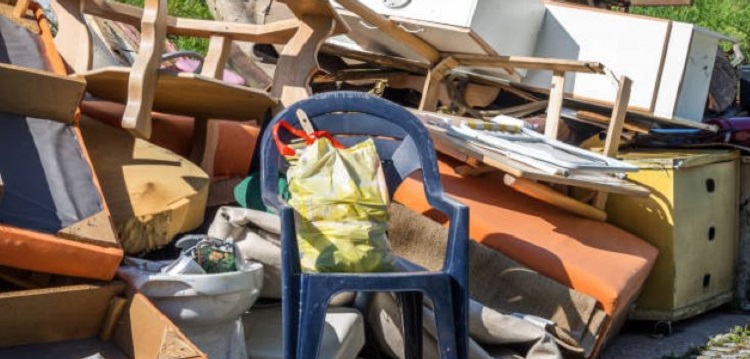
The District of Muskoka is running out of landfill space.
“To be blunt, we’re not doing very well. At our current rate, our landfill will be full by the year 2036,” Muskoka Lakes Mayor Phil Harding told his fellow councillors at their June 21 council meeting.
“To put this into perspective, my grandson will still, or just be graduating high school when this landfill is full,” added Harding who is chair of the District engineering and public works committee.
Currently, the District only has one landfill servicing all of Muskoka which is located in Bracebridge. All other waste disposal facilities, like the one at Stisted, operate as transfer stations. Waste from the District’s licensed transfer stations is delivered to the Bracebridge Rosewarne Landfill.
The Bracebridge Rosewarne Landfill expansion opened in 2016 with a 950,000-tonne capacity. At the time, it was noted that it could service Muskoka for 20 years, which could be expanded to 30 years through waste diversion programs.
In 2020 alone, 32,000 tonnes of waste went into the landfill.
The diversion of recyclables and organic materials is key to extending the life of the landfill, but Muskoka is not diverting enough, said Harding. “In Ontario, top-performing municipalities divert roughly 60 per cent or more of their household waste. In Muskoka, we’re tracking at roughly 35 per cent. So clearly, we’ve got a long ways to go.”
Harding said staff have made some strong and impactful recommendations but said the committee wanted 30 days to contemplate some of the actions being considered “and also let the public be aware of the actions that we are contemplating” before bringing forward recommendations for approval to council.
“As a spoiler alert, let me say we’re talking about reduced bag limits, expanded organics, and the possibility of clear bags are all being recommended to help the diversion rate.”
Don’t miss out on Doppler!
Sign up here to receive our email digest with links to our most recent stories.
Local news in your inbox so you don’t miss anything!
Click here to support local news
The issue of overproduction of largely unnecessary waste remains: it is not a “too late”question of who does what with the waste entering the District to stay; it is to Rethink waste stream policy entirely and to Refuse waste at the District municipal doors. At the very least require the producer to take it back out.
Only then is waste production reduced at the source when it becomes inconvenient and very expensive for corporate handling and disposal of it.
Why does nearly everyone deny the source problem and always revert to some fabulously expensive, local, energy intensive, highly technical “solution”?
Are we so locked into our packaged consumption paradigm that we are purposely blinding ourselves to the upstream real issue? Denial kills opportunity. The blue box is a tiny bandage on a gushing wound.
Must we perpetuate the existing paradigm by teaching our grandchildren to extract “resources”, to consume infinitely and accept locally all forms of huge waste?
I agree with Judith…it’s hard to know what to do! Individually, we need to chose to buy and consume less. As a district, we could have better and more easily accessible sorting stations. I’m thinking of when I lived in Georgina, York District. Very strict limits on garbage, but the recycle station was great. Also, they picked up big items, like couches for nominal fees. It seems to me that is a better solution is possible, if there is some political will. Especially for “take-out” containers. Big deposits will help this material get back to where it came from.
I think you had better have all your ducks in a row before reducing bag limits and the use of clear plastic bags.
You might have to get a few more people hired to clean up all of the roadside garbage that will be dumped. As it is, there is too much piling up at the sides of country roads…or even Shay Rd. here in Huntsville but if strict rules come out about restrictions, guaranteed, the dumping will get worse!
Most people are conscious of recycling but there are the ones who don’t do it. They simply don’t care about the future of this planet!
Smarten up, people! As with everything else….we are in this together!
We can do so much better. This is a SHAME! I have approached the Town of Huntsville many times expressing the importance of Waste reduction and I have been pushed aside. I am currently at a standstill in what to do. Lack of support and concern makes one weary.
As Brian Tapley points out, we have indeed become a very wasteful society because we always had lots of land and lots of energy. The amount of electronic waste is growing exponentially. The next emerging area of concern is used solar panels and wind turbine blades both of which are hard to recycle.
Certainly, as John Riviere-Anderson points out, emissions from waste incineration must be carefully engineered and managed, but it can be done. Sweden has been one of the world’s most environmentally conscious countries for a long time and they get a significant amount of their electricity and heat from waste incineration. Norway has abundant hydro power, and their rocky terrain makes landfill problematic, so they ship their waste to Sweden for co-generation. Sweden is happy to get it.
Also, the cost of managing emissions from incineration must be compared to the cost of managing methane emissions from land-fill sites. After 15 years of failed attempts to get approval for a new landfill location, Durham Region resorted to installing a new waste incineration facility. They have had a few start-up issues, but it is now working without any serious issues.
Finding landfill locations is becoming increasingly more difficult. The idea of incineration should be considered and not just categorically ruled out, because there is new science every day.
Our society is it;s own worst enemy. I run a tourist resort with what amounts to about 17 “households” on site when we are full. We do virtually everything we can to divert, recycle and reuse what people throw out but we could do much much better if the people staying on holiday actually followed a few simple rules of recycling. Simply put, they don’t!
Example, my wife and I create less than a bag of garbage per week. Almost all our items are recycled. As a matter of fact the deciding factor in the tossing of garbage is not quantity at all but the fact that it starts to smell bad so we often send off a quarter bag to the dump for a week..
On the other hand I have commonly seen a family of 4 to 6 tourists generate 3 or 4 bags of trash per day!! They recycle essentially nothing, not caring to take the few minutes to do so even though we provide separate containers, all labeled and picked up for them as part of our service. We provide a 5 stream system. Glass and cans, paper, compost, garbage and beer-LCBO returns and have done this for over 20 years now.
Occasionally I take apart a few bags and find everything mixed together, paper, bottles, liquor bottles and beer cans and food waste. This is just simply laziness on the part of the person generating the waste. I could usually reduce the actual trash to less than a quarter of what these folks toss out as trash but you know, I draw the line at taking peoples garbage apart and picking out their kids diapers from the beer cans. I’d need a lot more money per day to justify my hiring someone to do this job.
In our society, personal “rights” trump everything else so I can do very little about this.
On the assumption that the process is similar across the area there must be a lot of trash going to landfill that need not go there.
It is kind of sad to think that a lot of people just don’t care. I do note that Americans, and some foreign ethnic groups tend to be the worst offenders. Hate to be a bit racist, but this is the case and I can prove it so I’ll just say it and leave it at that. Canadians at least try, but their various different recycling regimens at home cause a lot of confusion when they come on holiday.
Has anyone looked into plasma gasification?
One must be extremely wary of waste incineration as some of the most toxic recombinant chemicals – notably dioxin resulting from the burning of lignin and certain unrecycled plastics – are produced at various temperatures, especially in the chimneys, and are emitted into the air. The very sophisticated stack scrubbers and their maintenance are not affordable by the District tax base. The fly and residual ash of garbage incinerators is considered toxic and must be stored under special and expensive conditions. Various cancers and immunodeficiencies have been recorded in the vicinities of European incinerators. Without expensive research and scientific monitoring of facilities and people, the deteriorating health of both local populations and those downwind is often undetected until it is too late and significant, long-term healthcare costs are incurred.
Heat pumps and geothermal heating are less expensive, ecologically sound, and their implementation can be incentivized for both new and existing homes, businesses and industry, and can be powered by inexpensive electricity that is available now from Hydro Québec’s existing reservoirs.
Waste reduction is successful only if District policy makers remember the forgotten, but sine qua non first two of the five Rs: Rethink and Refuse. All packaging and pallets, etc. must be either blocked at the District doorways and/or removed from the District by the product maker and/or shippers, on whom the District must fully reposition the responsibility for waste generation.
This not a new proposal; it has been ignored for decades and has pandered to corporate convenience. Failure to cut waste at its sources costs taxpayers a fortune in waste management and new landfill siting.
I hope the district will consider a waste burning co-generation facility for making clean electricity and heat. It should be located where the free heat can provide a competitive advantage in the form of district heating to local industry. There are many successful models to emulate, especially in Europe. That is the way of the future.