
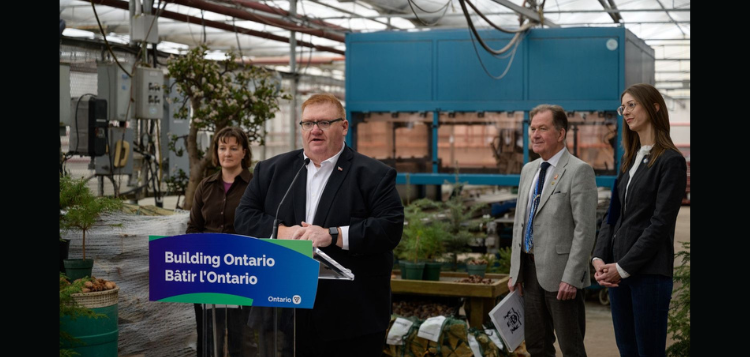
From the Government of Ontario:
The Government of Ontario is delivering on its commitment to build a stronger forest sector by making an historic investment of $60 million in the Forest Biomass Program. Over the next three years, the program will make targeted investments in forest sector initiatives to develop the economic potential and environmental benefits of underutilized wood and mill by-products, known as forest biomass.
“This new Forest Biomass Program funding will grow businesses, strengthen communities and put workers to work,” said Graydon Smith, Minister of Natural Resources and Forestry. “We are investing in the technology, the people and the expertise that drive our forest sector into the future– and together, we are achieving our government’s plan for forest sector prosperity.”
The announcement of additional funding follows the Forest Biomass Program’s third phase of investment, which committed more than $6.1 million to 12 research, innovation and modernization initiatives. Projects include:
- Millson Forestry Service – $500,600 to support forest sector integration by acquiring equipment to convert wood residues into mulch, fulfilling local demand for mulch and compost and providing an on-site heating source for the facility’s greenhouse.
- Apitipi Anicinapek Nation – $250,000 to build community readiness and capacity to participate in forest biomass opportunities that will deliver economic, social and environmental benefits to Indigenous communities and local municipalities.
- Wikwemikong Unceded Indian Reserve – $250,000 to pursue local community energy production by examining the feasibility of an advanced biochar/biocoal product that would be developed at a proposed pellet plant facility.
- Walker Environmental Group – $100,000 to advance forest biomass innovation and pursue environmental benefits by exploring cost-effective options to use biomass as a source of renewable natural gas and other low-carbon energy products.
Since its launch in May 2023, the Forest Biomass Program has committed over $17 million to 41 projects, including recent announcements in January 2024 and December 2023.
In Spring 2024, the Forest Biomass Program will be open to applications for businesses, municipalities, Indigenous communities and not-for-profit organizations in Ontario that have a project to expand the use of forest biomass and enhance the forest biomass supply chain.
To learn more about the program, visit: https://ontario.ca/page/forest-biomass-program
Don’t miss out on Doppler!
Sign up here to receive our email digest with links to our most recent stories.
Local news in your inbox so you don’t miss anything!
Click here to support local news
I have concerns with forestry biomass. It includes harvesting all parts of the tree – trunk, limbs and even roots. The trees in Muskoka already struggle to recover the effects of acid rain which leached key nutrients from the soil back in the 70’s and 80’s, in particular, calcium. If you remove the entire tree, nothing is left to decay and return nutrients to the soil to support growth of remaining trees and new growth.
The big biomass source has been corn to produce ethanol. When corn is harvested, the fields are fertilized to return nutrients for future crops. What is the plan to replenish nutrients to the soil for the trees (crop) removed?
I can see the merit of the government’s plan to create jobs and revive the forest industry in Muskoka. I just hope it is not another short sighted plan that will see our beautiful forests cut down with no plan for a truly sustainable forest industry.
I would prefer to see a program to chip/mulch existing dead falls throughout the forests and spread the mulch around the trees. I believe the mulch would work like it does in your garden to hold moisture, prevent weeds and add much needed nutrients.
What exactly, (lie give an example) does it mean to
“build community readiness and capacity to participate”?
I wonder if someone is inventing terminology as they go along to justify $$? My experience with programs such as this is that if you can’t explain it clearly in plain normal language then it either has some fishy financing or often simply does not exist (vaporware?) Both common features of government give a ways.
Can someone enlighten us with a second post?
What about the biomass plant in cochrane on 2 mills right next door mountains of wood waste waiting for plant resurrection no brainer