
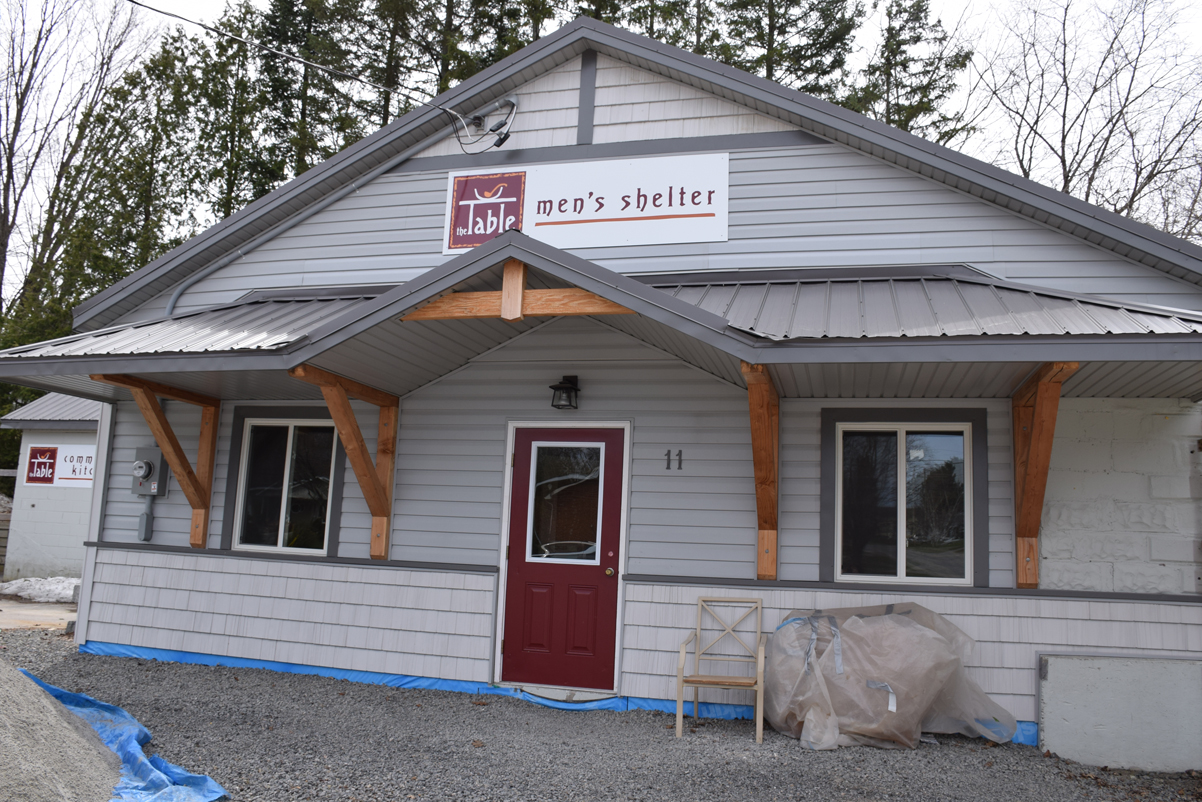
The Table Soup Kitchen Foundation’s men’s shelter has been built – thanks to fundraisers as well as the generous donation of materials, labour and expertise from the community – but it sits empty.
While the Town initially issued the Foundation a building permit to construct the 16-bed men’s shelter, it has since expressed concerns with the number of beds and egress being proposed.
“As I understand it, we’ve issued a permit and the permit was to convert to this use,” explained Derrick Hammond, who was recently hired as the director of the Town’s building and planning departments.
So we issued the permit and I guess there’s a bit of a discussion going on between ourselves and their designer about the occupancy load and the egress requirements of the Building Code as it relates to this use that they want. Huntsville Executive Director of Development Services Derrick Hammond
The Foundation’s Heather Berg said there’s been a lot of back and forth regarding the project but she’s hopeful that the shelter will receive an occupancy permit soon. She said although the shelter was initially approved and built with 16 occupants in mind, the Foundation has now agreed to start with just four occupants at any given time. She said the Foundation’s board fought for 12 beds but has since settled for four with the possibility of adding an additional four beds if it is able to demonstrate a need, secure ongoing operational funding and quell concerns about whether the shelter will have properly trained staff do deal with crisis situations.
But any hopes of receiving operational dollars from the District of Muskoka, which gets funded to provide social programming in the community and provides vouchers to motels for individuals in a housing crisis, are quickly disappearing. Alarm bells about the project have been sounded vociferously by District Commissioner of Community Services Rick Williams. He’s not only concerned about the number of occupants initially proposed to be housed in the shelter, but also questions the need for a men’s shelter in the first place.
We still have great concern on the service being proposed and I believe the thinking on shelters has really changed over the last several years such that many shelters are now seen as potential problems in that they could mix together people in crisis or people in crisis with very vulnerable youth. It is likely that there could be concerns coming out of that type of a mix, especially if it’s in an unsupervised arrangement. District Commissioner of Community Services Rick Williams
In terms of the need for a men’s shelter, Williams said, “We’re just simply not seeing the numbers that would justify this type of service so we have problems about volume; we have problems with the model. In addition, over the last few years, we’ve developed programs that move people more quickly to rental accommodations, in other words to stabilize their housing, and that seems to be a more effective response than some type of ongoing shelter accommodation. I think we have some comfort in the type of response we’re providing right now which is to place people in temporary accommodation in motels and then move them quickly to rental accommodations and apartments.”
Williams did say he’d be more amenable to a smaller number of occupants at the shelter. “On that issue, I’d be more than willing to have ongoing discussions on how to best serve this population,” he said, referring to supports such as counseling and employment training that he thinks the District could be helpful with, but he won’t commit to any type of funding.
“I think the model itself is problematic and there are so many other pressing concerns. Huntsville has managed to exist without a men’s shelter for a long period of time. There are pressing concerns in a number of other areas including seniors’ support and health supports and so on that I think probably are more urgent than this particular initiative.”
In terms of supporting a women’s shelter over one for men, Williams said generally speaking the situations encountered differ. He said women often seek shelter to escape domestic violence and in most cases security for their children.
In a men’s shelter they’ve often times been engaged in a conflict with a partner or roommate – it might be two guys sharing accommodations who get involved in a conflict and one is asked to leave. So often times they’re in an agitated state whereas often times the women seeking shelter are doing so to avoid threats to themselves or their children, so I think the arrangement that they are seeking and the state of mind that they’re in is oftentimes very different. Williams
Although the exact number of men who experience a housing crisis is difficult to quantify, Williams said occasionally men are sent to shelters in Orillia and North Bay where there is more experienced staff, but he said he does not believe the numbers merit the recreation of such a service in Huntsville.
“The thing is I am prepared to work with the Table Soup people and with the mayor at looking at best options, but the concerns that the District has on the feasibility of this model have to be addressed. This isn’t necessarily the best way to serve this population or the most effective way or the most cost-effective way,” he said. “We’re quite willing to put resources into services but they have to lead to positive results.”
The Foundation already hosts soup kitchens, a food bank as well as a household exchange store and Berg says the Foundation is often approached by clients seeking shelter.
We don’t need funding or support from the District in order to proceed, but we had hoped that they would come along side us and help meet the need together. Table Soup Kitchen Foundation Founder Heather Berg
She said the Foundation has managed to raise enough funds to hire paid staff and will rely on its volunteers to make the project work. She said a recent Barn Bash fundraiser in Lake of Bays managed to raise $80,000 for the project with support from the Sprott Foundation, several banks as well as a large number of seasonal and some permanent residents.
“Our hope is for open communication with the District regarding those men that we are serving and we look forward and are open to a partnership with the District. Perhaps in the future they will see that we are meeting the need well and would be able to help financially support the Table’s men’s shelter,” she said.
You can read more about the shelter here and the Mayor’s position on the shelter here.
Don’t miss out on Doppler! Sign up for our free, twice-weekly newsletter here.
Strategies regarding homelessness have been changing, as District Commissioner Rick Williams clearly understands. There has been a movement away from shelters as a solution. The Canadian Alliance to End Homelessness has developed a national strategy which is being used with success in many communities and Muskoka is on the right track. I recommend reading of :
A Plan Not a Dream: How to End Homelessness in 10 years.
This story angers me how dare the town put a stop and negotiate less beds…the table food bank has provided a much needed service for years and the town flip flopping and bullying is unfair and nothing less then extorting the table food banks acceptance of agreeing… The reasons of supporting a woman’s shelter to a men’s is plain sexist… Unbelievable!!
As a housing provider within Muskoka, I feel that although Rick Williams does raise some valid considerations, I do believe that the District has downplayed the reality for the need for this type of facility within Huntsville. Heather Berg/The Table Soup Kitchen Foundation have worked selflessly, for years, in the public’s best interests and they have made it explicitly clear that they do not require District funding or support. It just does not seem to make any sense that a facility that has been expressly built to accommodate 16 beds remains empty (or be permitted only 4 beds) when a real need for it persists. For sure, individuals in need of this type of housing may be in an “agitated state”, but should the project be axed based upon the District’s concerns of how conflicts may be safely resolved? The District should not have a monopoly with respect to social housing; after all, if they were effectively managing the issue, would a need for the shelter even exist in the first place? Seems a bit callous to me.