
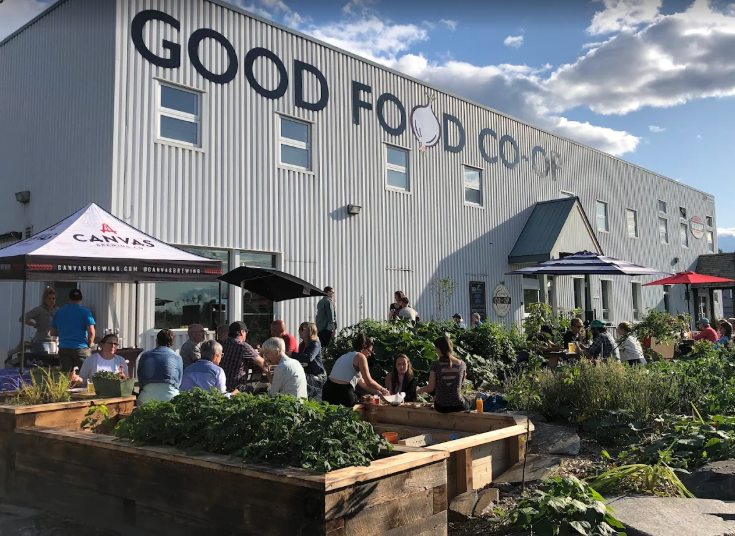
Just days after the Muskoka North Good Food Co-op (which changed its name to Muskoka Market & Eatery Cooperative) board announced plans to dissolve the organization, members voted to chart a different course, electing a new interim board and keeping alive hopes of saving the community-owned business.
The dramatic turn came during a July 9 members’ meeting that had originally been called to vote on dissolving the co-operative following the board’s announcement that the business would close on July 18 because of mounting financial pressures. According to the board’s July 6 letter to members, the organization was unable to overcome increased operating costs following its expansion project despite more than a year of efforts by staff and directors.
Instead of approving dissolution, members at the meeting rejected the proposal after the existing board resigned. A group of members then stepped forward to form an interim board with the goal of keeping the co-op operating while they assess its financial position and determine whether the business can be saved.
The decision followed a grassroots campaign urging members to attend the meeting and oppose dissolution. Members argued they had not been provided with sufficient information about the co-op’s financial condition. According to information released at the July 9 meeting, the co-op is roughly $400,000 in debt, but members wanted greater transparency before any decision to wind up the organization is made.
Since the meeting, questions have continued to mount over the co-op’s financial situation. Members have been seeking answers about the exact size of the organization’s debt, how it accumulated, and whether enough financial information was shared before the former board recommended dissolving the co-op.
Another pressing concern involves local suppliers. Several farmers and food producers have said they have not yet been paid for products delivered to the co-op prior to the closure announcement. The unpaid accounts have heightened concerns within the local agricultural community, with producers now waiting to learn whether they will be compensated. The interim board is expected to review all outstanding financial obligations, including amounts owed to suppliers, as part of its assessment of the co-op’s viability.
The co-op received more than $535,000 in federal funding in 2024 to modernize and expand its facilities, a project intended to improve efficiency, increase sales and strengthen the organization over the long term. However, the former board said the expansion also resulted in significantly higher operating costs than anticipated, ultimately contributing to the co-op’s financial difficulties.
The newly formed interim board now faces the challenge of reviewing financial records, determining the full extent of the organization’s liabilities and deciding whether there is a path forward for the member-owned co-operative.
For many members, the stakes extend beyond the future of a grocery store. The Muskoka North Good Food Co-op has spent more than a decade supporting local farmers, food producers and access to locally grown food throughout the Huntsville area.
While the future of the co-op remains uncertain, members hope the new board’s review will provide the transparency they say has been lacking and offer a clearer understanding of what led to the organization’s financial crisis. They also hope it will identify whether the co-op can be stabilized and continue serving the community while honouring its financial commitments.
RELATED
Muskoka Good Food Co-op announces it is closing its doors on July 18, 2026
Food Co-op reveals modular hydroponic farm
Muskoka North Good Food Co-op officially open for business
Don’t miss out on Doppler!
Sign up here to receive our email digest with links to our most recent stories.
Local news in your inbox so you don’t miss anything!
Click here to support local news
The misinformation here and on social media around this story is terrible. The board started sending out the 2025 financial statements in March 2026. They had a meeting in February 2026 to ask the members for help, and at that meeting they discussed the current financial problems. They clearly stated that the co-op was in trouble and that now (Feb) was the time to act. The board and staff said that they had decided to work as hard as they could for another 3 months to see what they could accomplish, and that if they did not succeed, then the co-op was probably finished.
To suggest that nobody was trying to save the co-op for the last 6 months is insulting. I don’t know any of the board members personally — but that is exactly what they have been doing. The management stepped down in Feb to help save costs, and the existing staff and volunteers stepped up to fill their roles. This VOLUNTEER board and the last remaining staff and volunteers should be commended for the amount of work they have put in to clean up the finances and try to turn the co-op around.
Your statement, “Instead of approving dissolution, members at the meeting rejected the proposal AFTER the existing board resigned.”, is incorrect. The existing board made it clear that they were willing to stay on and manage the dissolution of the co-op if the motion passed — but that they would be immediately removed (automatically) if the motion failed, which it did. I don’t understand why so many people are now claiming that the co-op was not transparent with finances. Even in this article you claim that the debt was not announced until the July 9 meeting — which is false.
To the best of my knowledge, all financial records have always been available to ANY member at any time. They certainly were when I was involved. At every general meeting I personally invited any member to contact me for any financial or accounting data that they wanted. Nobody ever did. Each member of the co-op is an owner — not a customer. They are responsible for how much they want to get involved, but they are expected to shop and/or volunteer and stay engaged.
The co-op has been in debt since 2017, and the ~$400k has certainly just been accumulating over the years. It is very difficult to sell local or responsible produce, pay living wages, rent, and loan repayments while also breaking even. The cafe, kitchen, and catering were there to help subsidize the store sales — and it was working in the beginning. I don’t know what happened after that.
I have not been involved with the co-op since 2019, but I can state that the public money invested in the co-op at that time was of great benefit to the community — not only financially (through wages, rent, and local producers) but also in many other ways. The co-op channeled at least 1.5 times the money we were given back into the community. We had regular workshops, projects, and events to build more energy and knowledge of the local food economy and the importance of food security. We were required to report on all expenditures of public money — where it went and for what purposes — and it had to be spent as outlined in the specific grant. We had to include receipts, invoices, etc. FedNor was well organized and responsible.
A huge number of people volunteered time and money to this cause over the years, and I am very sad that it did not succeed. It is important to remember that as a “Co-operative Without Share Capital”, nobody else profited financially from the operation of the co-op. I feel that it would have been much better to dissolve the co-op and give it a graceful sendoff.