
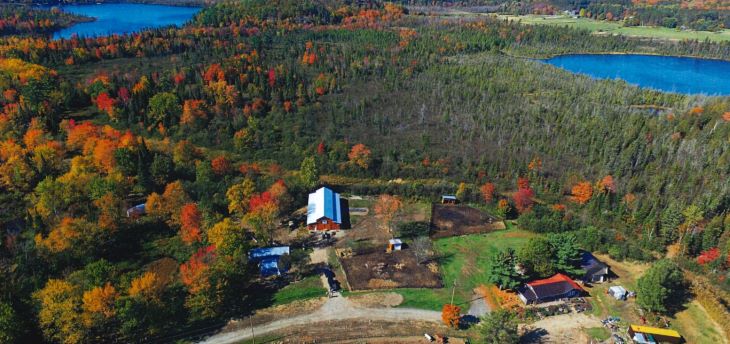
UPDATE: At the Monday, August 23 council meeting a majority of councillors voted to rescind the planning committee’s decision. Instead, they voted to recognize the barn and allow the applicants to use it to host events between May 1 and October 31. The owners will be required to get a building permit and an engineering report noting that the barn has been built to code. Huntsville Councillor Jonathan Wiebe voted against council’s decision to approve the barn.
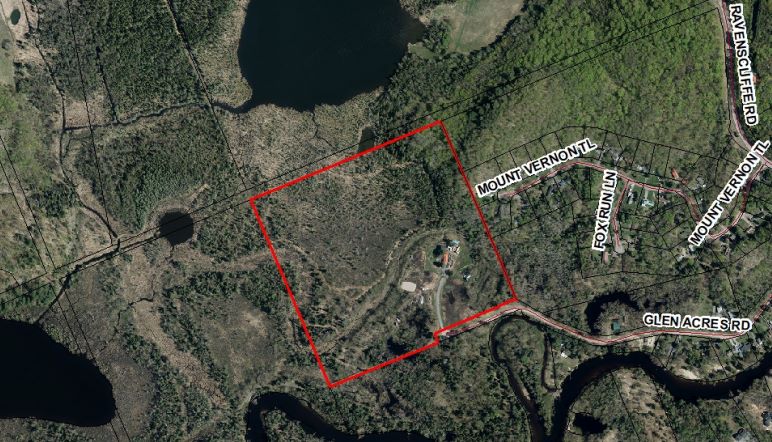
Attempts to have a barn—built without a building permit in a flood zone—recognized by Huntsville’s planning committee did not go well for the owners of a farm on Glen Acres Road, whose file was back before the committee for the third time.
But they may get a reprieve from council.
While most decisions by the planning committee are ratified as a whole at the following regular council meeting, this application, which planning committee denied, is slated to be voted on separately by councillors.
Wayne Simpson, the planning representative for the applicants, told committee members at their Aug. 11 meeting that the barn is part of a long-standing farm on Glen Acres Road and his clients built the barn because they’ve recently added Belgian horses to the property and needed to build a bigger barn to house them. He said while he understood the reason a building permit was not acquired, he did not elaborate further. Simpson said his clients were also hoping to get approval to host events in the barn between the months of May 1 and October 31.
He said recognizing the barn and allowing his clients to host events in the barn would add a community amenity and noted that the hosting of events would not be done until after the spring freshet, “so there’s no concern about the bride being swept down the [Big East] river on a big ice flow or swept away…,” he told committee.
But Richard Clark, manager of planning for the Town said planning staff were recommending that the application be denied. He said there were still matters that had not been addressed by the applicants such as a noise mitigation strategy and a floodplain study taking into consideration not only the velocity of flows but the depths of flooding that could occur on the property, particularly where the new barn had been built in what he referred to as a floodway area.
He said it is ultimately up to the applicants to prove that the barn is not situated in the path of floodwaters. Clark added that according to the municipality’s Official Plan policies, supported by Ontario’s Provincial Policy Statement, new development or site alteration is not permitted within a floodway. “The proposed use would utilize a structure, a barn, that was built without authorization in lands zoned natural resources floodway where no new buildings and structures are permitted in the Town’s zoning bylaw. In all the engineering studies submitted to date, the depth of flooding is ignored despite this clearly being criteria for delineating floodway lands. Staff expressed on several occasions that the depth of flooding must be taken into consideration,” he said.
“As the barn and proposed private event/function venue use are located within the Floodway associated with the Big East River Flood Plain and below the Static Flood Elevation of Lake Vernon, approval would not be consistent with applicable floodplain management policies of the Town, District or Province,” noted Clark in his report to committee.
In terms of a noise mitigation strategy, Simpson argued that the municipality has a noise bylaw in place. “I don’t think this property would be necessarily treated any differently than any other private events venues or River Mill Park or the Pub on the Docks or whoever might be conducting something in the municipality in proximity to some residential uses.” He said the noise bylaw allows an applicant to seek an exemption to the bylaw if they’re hosting an event, and told committee that his clients live on the property “and they want to maintain good neighbourhood relations.”
In terms of the flood zone where the barn is located, Simpson said Dan Duke of Duke Engineering was asked to assess the situation. “It’s his conclusion that the location of the barn would be better described as the flood fringe [rather than the floodway],” he said and asked Duke to speak to the matter.
Duke said his engineering firm looked at the project and provided a report on the matter in December 2019. He said based on a previous topographical report completed by land surveyor Bob McDermott, it was noted that the barn is approximately four feet below what’s considered a 100-year flood event. “So, during a hundred-year flood… there’d be about four feet of water around the ground level of the barn.”
Duke said among the things he considered in his assessment is whether there’d be enough buoyancy associated with the wooden barn, “is the barn basically going to float downstream? So, I did some calculations to show that the dry weight of the empty barn is significantly more than the buoyancy factor. So, the barn is at no risk of floating away or any damage to that extent.”
Duke also referenced a 1989 Paragon Engineering Ltd. report, which helped map the Big East River area for the Ministry of Natural Resources. “So, if we look at that Paragon report, they didn’t really get into a lot of detail of the… floodway versus flood fringe. What they were looking at was designating any lands underneath, below that hundred-year flood elevation, as NR [Natural Resource]. You know, the whole purpose of that report was to say we’re going to limit development below that hundred-year flood [zone]…”
He said the barn is about 350 metres away from the river and the trees would mitigate some of that flow. He told the committee there was much flooding in the area in the 1980s and a 100-year flood occurred in 2013. He said there was also significant flooding in 2019, and yet there is no indication of things like erosion or sediment on the land as a result of those events.
“So basically, what we’re looking at I think at the Wheeler barn is yeah, the river is going to come up, it’s going to spill its banks,” said Duke. “We’re 350 metres away from the creek. The trees are obviously going to have a major impact on flows. Their place is going to flood, you know, the waters are going to go away, and other than being wet, to me, that’s really the main issue…”
Duke added that the house on the farm has gone through decades of flooding “and we haven’t seen any significant impacts. So, I’m basing my opinion as much on the history and reality of the matter, as much as you know we’ve done some rough calculations to show what the velocity would be, based on the depth in the cross-section of the river… but again it is more supported by the real world [experience], saying that you know 60 years and two major floods, nothing happened… so that’s basically what our comments are based on.”
Simpson also argued that the farm is currently in operation, has been operating for more than 60 years and has a legal nonconforming right to do so, and the family has always been able to get in and out of the property.
“Nobody’s ever seen four feet of water on the property, and I can’t say that it’ll never happen, with climate change and all these other good things, but the reality is they’re already living on the property, so this barn is not creating new habitable space. It’s not going to create a new public health or safety hazard, so I think it’s important to acknowledge the history of the property and its use.” Simpson argued that within a kilometre of his clients’ property there are other uses like a trailer park. He said pretty much that entire property is within a flood zone and he said the zoning bylaw allows up to 210 camping sites there as a legal use and recreational trailers or mobile homes are included in that.
He said there are also about another 300 campsites within a short distance of the farm that are also within a Natural Resource zone with many of the structures on them located on those properties on a year-round basis and said his clients’ barn would do better in a flood than some of the motorhomes on those sites.
“I believe the municipality has the ability to permit the barn. And again because of the fair-weather use of the private events venue, then I think that should be permitted as well. So, we really hope the committee would see fit to recommend approval of the bylaw. It is very important to the Wheelers. The barn is most important and of secondary importance is the opportunity to put it to some summer use that will augment the income for the farm,” he concluded.
Councillor Bob Stone said he’d like to see the application approved. “We’ve learned at this meeting that it’s really not a threat to people or property. It doesn’t look like it’s a real hazard, and so I will move to change the word ‘deny’ to ‘approve,’” he said.
Councillor Jonathan Wiebe said while he had no issue with the information presented at the meeting, the idea of begging for forgiveness after the fact and erecting a barn in a flood zone without a building permit did not sit well with him.
“The message it sends to all other builders, in my opinion, is not worth it. I think that I’m not prepared to put my name on a precedence-setting motion that says you can build a large structure, not just for farming, not just for livestock, but for private use in a rural residential-type area to make money in the offseason as a party venue. To go through it in that process, I can’t sign on personally for it, so I’m going to be supporting the motion to deny,” he said.
Stone’s motion to approve the application was seconded by Councillor Jason FitzGerald, but with three other committee members voting against it, it did not pass.
Committee chair and Deputy Mayor Nancy Alcock asked what would happen to the barn if the application to recognize it and allow it to be used as an events venue were denied. Clark said it would have to be removed.
Alcock also asked if the application did not include plans for the barn to be used as an events venue, whether the application would be looked at in the same light. Clark said it would be no different in terms of new structures in a floodway. He said new structures in a floodway area are prohibited, “so we would have to tell people that that’s not supported by policy and if they wanted to seek a zoning exception then we would ask for a technical report to say why our mapping is wrong, so that’s what we did in this instance.”
In the end and after further discussion, the original motion as presented by staff to deny the application was passed by a majority of committee with Councillors Dan Armour, Wiebe and Alcock voting in favour of staff’s recommendation, and Stone and FitzGerald voting against it.
Huntsville Mayor Karin Terziano was away.
Planning committee’s decisions must be ratified by council to receive final approval. Huntsville council meets on August 23. The file is scheduled to be pulled from the meeting minutes to be voted on separately.
You can find the full planning report here (pdf).
Don’t miss out on Doppler!
Sign up here to receive our email digest with links to our most recent stories.
Local news in your inbox so you don’t miss anything!
Click here to support local news
Good, I hope it gets approved. I’m sick of any city or town requiring building permits, it’s private property, the town needs to keep off of it. Period.
With climate change causing more violent weather events , calculations based on 100 year events are near irrelevant. Perhaps the barn will slide down the Slippery Slope in a flood . The floodgates are open !
We all know the old saying, “Better to beg forgiveness than to ask permission.”
However, this is not an appropriate business practice.They should have applied for the permit. The township cannot continue to excuse developments that flout planning rules. It’s pretty simple.
Rules are ment to be followed not build and ask for forgiveness after the fact. Make them tare it down and do it with approval of the rules and guidelines. Let someone do it like its been done and you will have everyone building first and asking for forgiveness after the fact . Besides who is going to want a gathering in a smelly horse barn. Even with a cleaning you will smell horses .????????
Why make laws and then vote down the planning board. I don’t get it. Well if the weather gets to changing enough it won’t matter, building on a flood plain is kinda a self defeating idea.
Here we go again, someone builds without a building permit, and our council has to decide if we should change the rules. Good for those of you that voted it should go. It would just make way for the next person, to build now and ask questions later.
Follow the rules set forward.
Its one thing to ask for a variance to build, but, to build without a permit at all. Come on.
Regardless if it is in flood zone(which is a huge deal) they did not get a permit. I would say Remove and follow guidelines.