
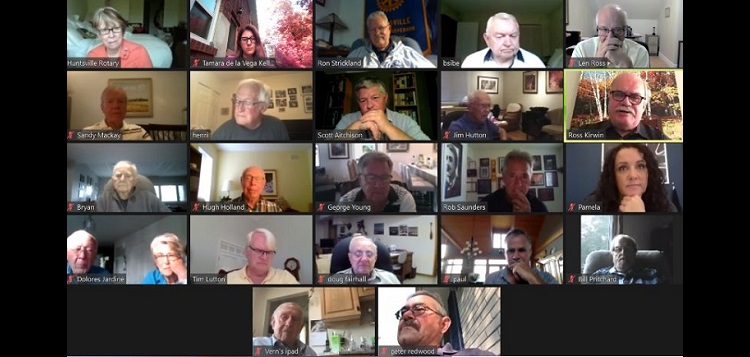
While fossil fuels, vaccine passports, and development in Huntsville were among the topics discussed at a remote meeting of the Rotary Club of Huntsville held last Wednesday with guest speaker Parry Sound-Muskoka MP Scott Aitchison, the need for more housing in the community was front and centre.
Aitchison was asked for his opinion on what is driving the housing shortage.
He said there are multiple factors. One of the main issues he attributed to driving the shortage here is people leaving cities and coming to the area. While in larger urban centres in Canada, such as Toronto and Vancouver, it’s foreign investment that’s driving the shortage and increasing the cost of housing.
“Our real estate market is red hot,” said Aitchison. “It continues to grow because global players see it as a great investment market and so that is actually helping to drive prices up in the larger urban centres… and of course our proximity to Toronto means that people are escaping there and coming here and that’s having a major impact.”
Measures have been announced such as a tax on non-resident homeowners or investors to make sure they’re not just buying and speculating and driving up costs, but they are not making a big enough impact. Aitchison said the rise in the cost of building materials is also driving up cost and in Muskoka, the growing income disparity between those who have moved here due to the pandemic, those who vacation here, and those who live and work here is increasing and making it difficult for year-round residents to buy and rent in the area.
And then there’s the Residential Tenancies Act. Landlords complain that the odds are increasingly against them. “I think a lot of folks that maybe would’ve considered renting, you know, a duplex or investing in that way, frustrations with the landlord and tenant act, it’s a problem. You know people are not prepared to lose money if they have a bad tenant, it’s hard to stomach that. So there’s a lot of factors,” said Aitchison.
As rumours of an election loom, Aitchison told Rotarians the Conservative Party would “have some pretty significant policy proposals for Canadians to help address this housing crisis,” although he did not elaborate on what those proposals would be.
Conversations about the housing shortage continued. One Rotarian suggested that resorts should provide housing for staff and went as far as saying that perhaps there could be a subsidy “to help major resorts do that.”
Aitchison noted that some business owners in the area, although they are not in the housing market, have taken it upon themselves to buy rental housing in order to house their employees.
“Larry Greenwood, who owns the, I’m sure you all know, owns all the Tim Hortons in the area, I was chatting with him the other day. I think he said he has about 16 rental units now. He’s not in the rental business. He’s in the coffee-selling business but he needs these units because I mean nobody here wants to work and if you allow me just a hint of partisanship, I think the CERB (Canada Emergency Response Benefit) is a bit of a problem. It continues to leave kids at home, choosing not to work if they don’t have to…and I’ve seen it all over the country the last couple of months, there is help wanted signs everywhere, so… they’re bringing people into the country that they can get to work but then they need to give them a place to live because there’s no places to live.” He said finding a way to support those businesses in that effort, “I think that’s a very smart investment of public funds to incentivize the private sector to get the job done.”
Aitchison added that an all-hands-on-deck approach is required to address the issue, much like in the 1950s. “We need a federal government that is prepared to focus on this as an absolute top priority, not as something where they sort of dribble out some money to provinces here and there and hope that somebody else takes care of the problem,” he said, adding that while it affects some areas more than others, it’s a crisis across the nation. “We need a new C.D. Howe, we need that kind of leadership in government, again.”
Prompted by a question regarding the extent of housing development in the area, Aitchison said within Huntsville’s urban service boundary there are approximately 3,000 draft approved development lots within subdivisions, many of which have had planning approvals for decades. “But they’re starting to get built now and you go to the north end of Town there, you’ll see where Andy Kidd… they’re expanding, they’re building as fast as they can because of course, the demand is so high.”
As far as the rural area goes, Aitchison, in speaking to his experience as former Huntsville mayor, said it is a lot tougher to find a rural lot these days. “And I’m partly to blame for that. One of the things that we did in one of our iterations of the Official Plan was that we doubled the minimum requirements to sever a lot and create a lot in the rural area. We did it because of course, we wanted to make sure the rural area remained as rural as possible so that these, you know, rural houses were a little further apart,” he said. “I don’t think it’s had a major impact on the ability of people to build and get lots, there continues to be lots of severances that happen throughout Huntsville. In fact, for the longest time, the majority of Huntsville’s growth was actually in the rural area, not in the urban area. That has shifted now… most of the growth is now in the urban area which has taken some of the pressure off the rural area.”
Aitchison said those subdivisions need to be built in order to help provide more housing. “We need to get shovels in the ground on a lot of these subdivisions and of course the developers are hungry, they’re eager to go because it’s very widely known that Huntsville is absolutely on fire and it’s the place to go make money and build,” he said. “So there is more coming for sure.”
He was also asked about vaccine passports, to which Aitchison said “right now I would suggest certainly in the short-term the concept of vaccine passports will probably be real if you’re travelling between countries. I actually don’t think it’s going to happen to travel within Canada. That’s my guess and I think that that’s probably fairly reasonable.”
Aitchison was also asked about the Enbridge Line 5 pipeline built in 1953, which opponents warn is old and unsafe and could cause catastrophic damage to the Great Lakes and the environmentally sensitive Straits of Mackinac, which connects Lake Huron to Lake Michigan. While the issue is currently before the courts, Aitchison spoke about fossil fuels in general. “You know there’s no question we need to be transitioning away from fossil fuels but it’s not happening overnight, and we continue to use the product while we have to. We can’t literally completely plunge the country into darkness, you know, while we deal with that issue, so I think we’ll be alright in the end.”
In terms of Line 5, Aitchison said: “There’s a part of me that feels like it probably should’ve been addressed earlier rather than sort of at the 11th hour, but I know that there was a lot of work going on behind the scenes on it.
“It’s not getting much airtime now I guess largely because it is in arbitration… in our own company, I’ve said to a number of Alberta members who are of course particularly excited about it, I said ‘you know what you should do one day,’ I said ‘Alberta should just decide to shut the tap off, just shut it off for a week and see how quickly the people who say we need to stop using fossil fuels right now, and see how quickly they kind of realize ‘oh, I guess maybe we need to make the transition faster but we still need to use it.’”
While an election has not officially been called, political parties have started campaigning.
Don’t miss out on Doppler!
Sign up here to receive our email digest with links to our most recent stories.
Local news in your inbox so you don’t miss anything!
Click here to support local news
Response to Sarah Leeder: I agree; it’s “insane.” The average person cannot afford to rent even a one bedroom apartment- let alone buy a house or condo. Moreover, it’s next to impossible to rent a SAFE and, affordable abode.
I ask again; what’s being done to address this?
Scott! I can’t believe you said that ‘I mean nobody here wants to work’. Shmoozing with people who have likely never had to be without housing or work for a minimum wage (todays version of indentured servitude) was hardly the time to ‘dis’ a goodly number of the very people you need to vote for you. Reading the 6 other comments on this subject might be worth your time.
Understand, I am no Liberal. The spending binge of the last 18 months is mind boggling; I realize some was necessary, but some not. Reading the figures that have been released makes one wonder if, as a nation, we can recover from this.
Any party could have spent the money, but in my opinion the election has been purchased and will result, I suppose in our Canadian version of an elected dictatorship.
That makes me wonder: sitting in opposition with a majority government in power, when ones’ ideas are not wanted and a dissenting opinion is of little consequence. Would that be akin to accepting CERB? Just on a different scale.
Just a quick question. As a working class citizen of Muskoka are there going to be more affordable rental options? Cause trying to find one in this town is insane
I suggest we build tiny homes. More affordable. Do able for people with minimum wage. People with minimum wage can’t afford a Subdivisions house.
Yes, Huntsville is in need of more housing. But, we desperately need A.F.F.O.R.D.A.B.L.E. AND SAFE housing as of yesterday. How will that problem be addressed, pray tell?
Scott, please rephrase the “no one here wants to work” to “no one here wants to work for minimum wage’ for only 2.or 3 days a week, up to 3 hours a day”
What an insult to Muskokans who would rather benefit from the CERB than pay for gas and their required uniform (Tim Hortons) with no opportunities to advance in any workplace. The owners of these workplaces DO NOT support families by giving them so few hours each week, if one is so lucky to even make it on the schedule!
Maybe you need to have longer conversations with those that are greatly affected by the choice not to work and the reasoning behind that choice and less time patting the back of millionaires who’s bottom line is their sales quota for the month!
It drives me crazy when politicians such as the MP and the local council always identify affordable housing as a “top priority”, emergency or apocalyptic and always someone else’s responsibility. I did a quick survey of Airbnb; Homeaway; Flipkey; VRBO and Deerhearst short term rentals for the week of November 20th through 27th (presumably indicating a 4 season unit) and came up with just under 890 units. These units represents between 8 and 9% of all private dwellings in the area.
Using the formula from Mercante and Horn (2016)( and about 14 other research groups both international and Canadian) these 890 units have increased the average cost of a house in Huntsville by just over $100,000 and increased rents by 29% or $350 per month.
The mechanism for this disruption is the artificial reduction in the housing stock caused by the local councils.
So here we have the MP point the finger at someone else to fix the problem that he was well a part of making (championing????). Indeed, the fastest short term solution to this crisis is to immediately ban all short term rentals by third party/investors, as has been done in most other Ontario communities. But no, that would take brave action on behalf of those elected to represent the all citizens of Huntsville….seems unlikely, they don’t have the fire in their bellies to personally stick their necks out to do the ‘right thing’….
Mr.Aitchison talks about the red hot property market in Huntsville but I have heard from a number of real estate brokers that sales are starting to level off. Listings are up. Maybe with the province opening up the attraction to move to Muskoka has changed. Who can predict housing sales in Huntsville over the long term. It is a guarantee that mortgage rates will go up in the next couple of years, or sooner, which will influence sales. The bottom line is that Canada has had very strong housing market for many years. Can it go on for ever?