
Submitted by Friends of the Muskoka Watershed
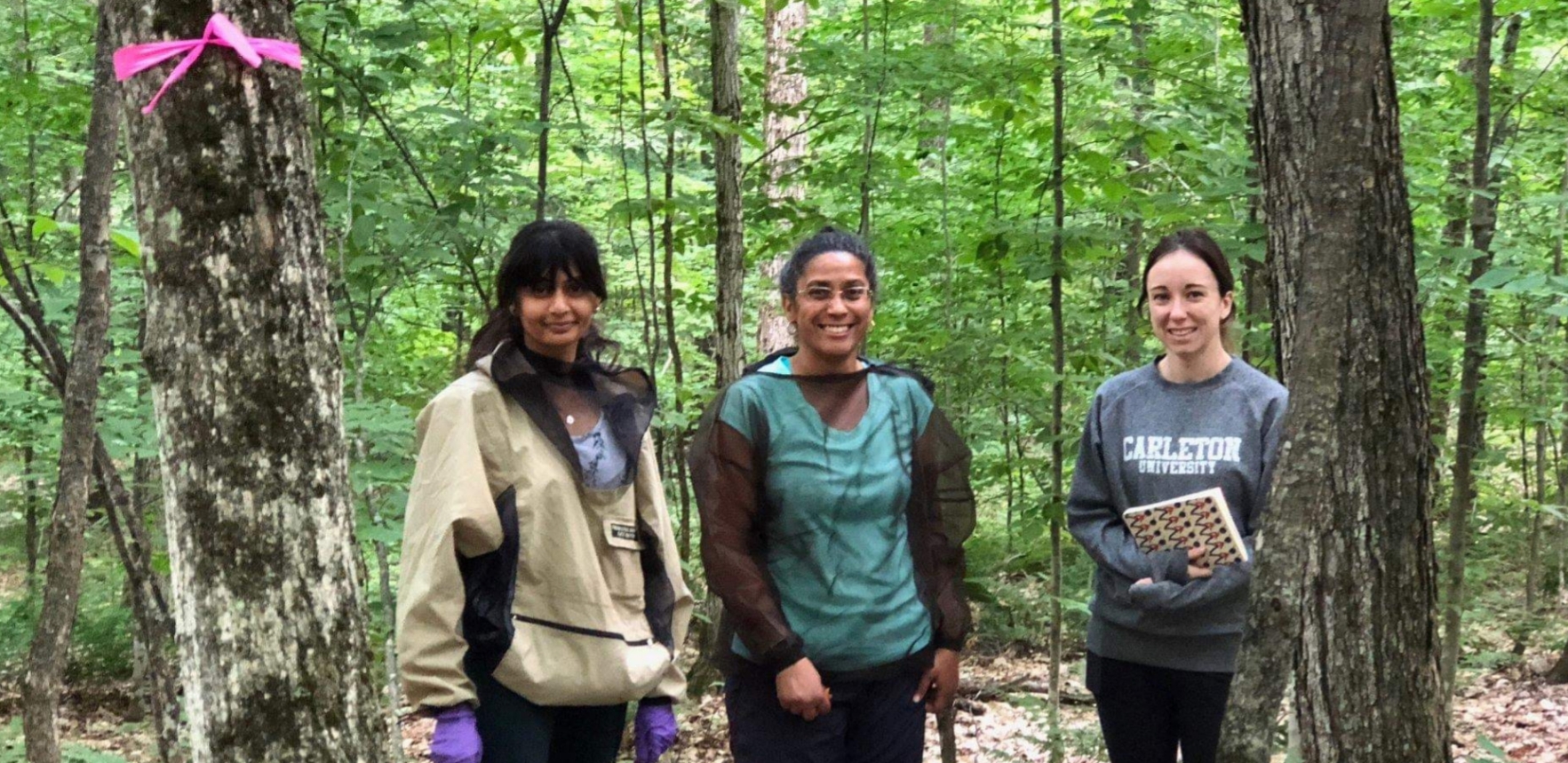
Main photo: Project lead, Dr. Shakira Azan (left) with two graduate students from Trent University (supplied)
In August, Friends of the Muskoka Watershed met with Dr. Shaun Watmough, Professor and Director of the Trent School of the Environment and a leading expert on calcium decline, and four of Dr. Watmough’s graduate students, to officially start the collection of field data for the applied research component of the ASHMuskoka three-year project.
Twenty, 10 x 10 metre plots were laid out in three local OMSPA (Ontario Maple Syrup Producers Association) sugar bushes—Brooklands Farm, the Creasor farm, and Mark’s Maples—marking 60 plots in total. In each plot, leaf litter, saplings, foliage from the canopy of leaves high up on the trees, and soil samples were collected.
“We are thrilled to be working with Dr. Watmough to determine the effect of residential wood ash on forest health,” states Dr. Shakira Azan, Project Lead. “With the findings from this research, we hope to identify a wood ash dosage that would make a positive difference in forests with low calcium concentrations.”
In addition to these samples, last March, Dr. Azan visited all three sugar bushes and took samples of maple sap from tagged trees.
Friends of the Muskoka Watershed, in collaboration with Trent University and volunteers, plan to distribute the wood ash collected thus far in all 60 plots next month.
Don’t miss out on Doppler!
Sign up here to receive our email digest with links to our most recent stories.
Local news in your inbox three times per week!
This is an amazing initiative! The trees are already providing a service (by acting as a carbon sink). Increasing the overall health of the forest (with a calcium injection) should increase their viability in this service; as well as producing more, and more healthful, maple syrup. Lest we lose sight of the important ancillary fact: they are recycling 100% of a readily available resource.