
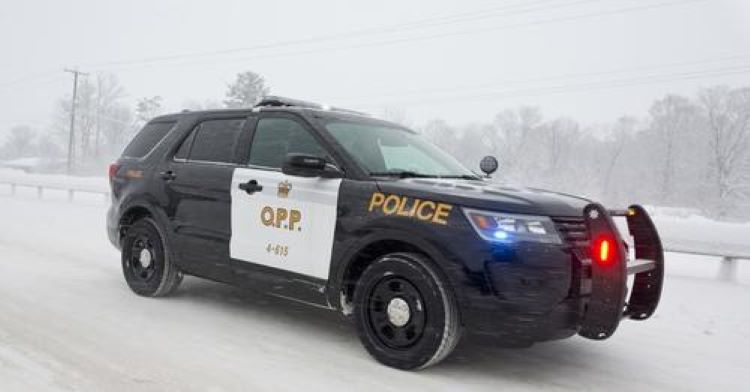
OPP Technical Collision Investigators (TCI) were called to assist with a motor vehicle collision investigation that resulted in the death of one driver.
On January 20, 2023, at approximately 1 p.m., members of the Killaloe Detachment of the Ontario Provincial Police (OPP) responded to a two-vehicle collision involving a sport utility vehicle (SUV) and a pickup truck on Highway 60 near Lake of Two Rivers, in Algonquin Provincial Park.
Preliminary investigation has revealed the lone driver of the SUV was proceeding eastbound on 60 Highway and struck the westbound pick-up truck resulting in a head-on collision. The 69-year-old driver of the SUV, Patrick LAKANEN of Ottawa, was pronounced deceased at the scene. The 44-year-old driver and 15-year-old passenger of the pickup truck from Madawaska Valley Township were taken to hospital by Nipissing and Muskoka Paramedic Services with serious injuries.
A portion of Highway 60 remained closed for approximately twelve hours and has since been reopened to traffic. A post-mortem has been ordered. Both vehicles were towed from the scene. Police continue to investigate the collision.
Anyone with information surrounding this collision is asked to contact the Killaloe OPP Detachment at 613-757-2600 or Crime Stoppers.
Don’t miss out on Doppler!
Sign up here to receive our email digest with links to our most recent stories.
Local news in your inbox so you don’t miss anything!
Click here to support local news
Totally agree with you Brian, In my opinion I think the OPP need to do some communication with us taxpayers of why this particular accident created such a necessity to close this road for such an extended period of time.
They may have had a good reason, but lets hear their side of the story.
Thanks for speaking out and bringing this reporting forward. John
Sad and sorry for all involved in this accident.
Just curious about the OPP however.
A few years back, this same type of accident occurred in the park while I was on my way home from Ottawa. They closed the road for about 16 hours that time. It was at night.
Many people ended up stuck in the park visitor center, which park staff very kindly kept open all night.
The problem was that the only alternate routes where to return to highway 17 and go across the top of the park to North Bay, or return back toward Bancroft and then West around the bottom of the park. Both options involved a lot of extra driving, minimum of about three hours and this being Ontario, remember at night, there are few if any gas stations open in rural areas. Many people had no option but to wait at the park visitor center as they had not enough fuel to make it either way. (electric cars would not have helped)
The point I’m getting to is why does it take so long to investigate a two vehicle collision and why does the entire road need to be completely closed while this is done? I can appreciate that the OPP need to be complete and accurate in their data gathering and if it was say a bus with 30 people on board or a train/car collision I could see the need for such a wait but with few options, many people ended up greatly delayed in my case and I’m sure in this one too.
I can see closing the road for a little while to sort out the mess, but surely it would be possible to allow groups of cars in single file to alternate past the site for most of the time that the road was closed. Some flagging people and slow speeds should work. It is not like a city, where there are alternate routes in all directions, and just a few blocks away. There is essentially no alternate route available in many rural areas.
I’m just curious, why it has to be this total closure routine. It didn’t used to be this way some decades ago and surely with all the fancy electronics and camera gear nowadays it must be possible to collect the essential data quicker than the period the OPP seems to require nowadays.
Am I missing something here, or is it just a convenience for the OPP to totally close a road for 8, 10, 20 hours to do an investigation that does not appear all that complex on the first look? Maybe they only have a very few qualified investigators to cover the vast area of Ontario and most of the time is spent waiting for them to get to the site?
I’m just curious if there could be a better way to do this kind of investigation, one that did not totally change hundreds of people’s travel plans and shut down important truck routes.