
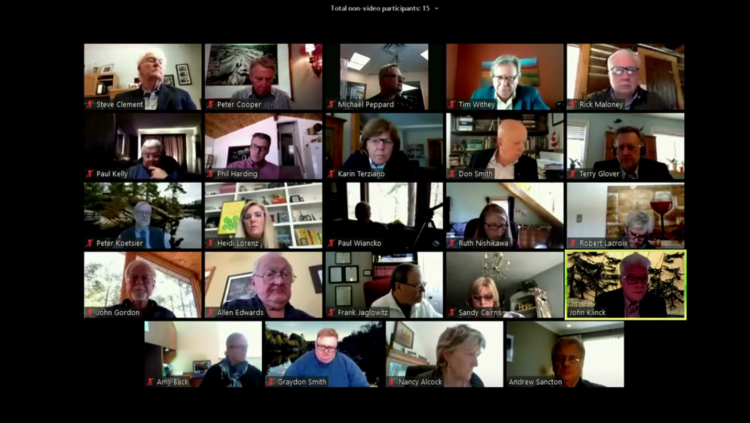
Despite hours of deliberations, countless committee meetings, and the help of consultants, things will remain status quo around the District of Muskoka council table, at least for now.
Neither the District Municipal Modernization Committee (MMC), tasked with evaluating how to decrease the number of councillors at the upper-tier municipality and enhance governance, nor all of District’s 22 councillors (23 with the District chair) could agree on how to move forward.
Currently, District representation is comprised of three townships—Muskoka Lakes, Lake of Bays and Georgian Bay—and the towns of Huntsville, Bracebridge, and Gravenhurst. The townships of Lake of Bays and Georgian Bay each have three representatives sitting at the table, while the Township of Muskoka Lakes, which has the largest seasonal population and assessment, and each of the towns have four representatives.
The townships have maintained for some time that they do not have an equal say around the table, particularly when it comes to major financial decisions which many see as mostly benefitting the towns, because when the towns vote together on an issue they have a total of 12 votes while the townships have 10.
The District is required by the Municipal Act to review District Council composition during this term of council, and again following every second regular election going forward. During this review, the District has the option to increase or decrease the number of council members, or can choose to remain status quo.
The MMC brought forward two very different motions for debate before District council at its March 15 meeting. Both would essentially reduce the number of District councillors by just four, despite calls for a greater reduction.
The first motion referred to as ‘representation by population’ was moved forward by Town of Bracebridge Mayor Graydon Smith and seconded by Gravenhurst Mayor Paul Kelly. It modelled a governance formula based strictly on the merits of representation by population, including seasonal residents. In that model, the Town of Huntsville and the Township of Muskoka Lakes would remain at four representatives while all other municipalities would lose one, thereby splitting the vote between townships versus towns from eight to ten, respectively.
The second motion, referred to as ‘equal representation’ and moved forward by Township of Muskoka Lakes Mayor Phil Harding and seconded by Lake of Bays Mayor Terry Glover, would’ve given all six municipalities an equal number of three representatives around the District table. That motion also included a somewhat complicated weighted voting mechanism, which could be triggered in the event of a tie vote on a particular issue. That weighted voting mechanism, based on population, would be applied as follows: Georgian Bay and Lake of Bays would get three votes per member; Bracebridge and Gravenhurst would get four; and Muskoka Lakes and Huntsville would get five.
Huntsville Mayor Karin Terziano, who sits on the MMC, expressed disappointment echoed by many of her fellow District councillors at the idea of only reducing District council by four members. “If we were to actually try and modernize, we’d be looking totally at service reviews at the District—how we do business, what businesses we do, and how we can do them better,” she said. “We’re not doing any of that and to consider this to be an exercise in modernization is absolutely ridiculous.”
However, Terziano said she favoured the first motion which she referred to as a beginning and hoped in future District council could be reduced further. She said she favoured representation by population and said giving Muskoka’s seasonal population full representation is the right thing to do. “And I’m sorry that the two… smallest municipalities only end up with two people based on their population, because I do agree it would be somewhat more of a workload, but that’s up to the District to come up with a better system for how we do business so that two people can do that workload.”
In terms of the second motion, giving all municipalities an equal amount of representatives around the table, Terziano said: “For me, I can’t go back to my municipality and say ‘listen, the four largest municipalities in the District of Muskoka happily gave up a seat at the table so that the two smallest municipalities at the District of Muskoka could remain at three.’ I can’t go back and sell that to my community because I don’t think I would be representing them well enough.” Terziano voted in favour of the first motion and against the second.
Lake of Bays Councillor Michael Peppard said he understands the argument for representation by population, has no fear of extra workload, and takes issue with Georgian Bay or Lake of Bays being referred to as smaller municipalities.
“That’s simply population, it’s not geography and it’s not issues, and I think there are really unique issues in the rural townships that differ from the towns… to drop our voice to two compared to say five… that’s three less people to argue significant issues. Looking at it from an environmental perspective, Lake of Bays is by and large upstream of everyone else and I would hate to see our unique issues not getting as much airing with only two councillors versus a lot of other councillors,” he said, adding that he would not be supporting the first motion.
Huntsville District Councillor and Huntsville’s Deputy Mayor Nancy Alcock rejected the premise that seasonal and rural residents are not being represented by town councillors. She said her municipality contains both and she has a fundamental problem when she’s told that the towns only seem to represent the urban interests because her municipality contains waterfront, seasonal, and rural residents as well. “So I don’t think it’s fair to put the urban representatives in one particular hole.”
She said those who are already not feeling represented will not feel any more represented on issues where weighted voting might apply. “I don’t see that option B is the magic bullet for creating unity that we think it might be,” said Alcock, who agreed that while neither of the motions could be referred as modernizing District governance, she preferred the first option.
Huntsville Councillor Tim Withey also spoke to the matter and said he would be supporting the first motion which is representation by population, “which is what this country is founded on… it’s how the numbers add up.”
Others, like Township of Georgian Bay Councillor Paul Wiancko, who said he travels about 2.5 hours to get to and from District council meetings, expressed the discontent felt around the table by some more succinctly. He said to be honest, “I’ve never felt equal at the existing council. I know that going to any council meeting, any decision we make, every decision we make, we’re outnumbered on the final decision. We’re not considered equal and during this process, we’ve all wrapped ourselves around the idea that we want to have seasonal representation equal to permanent, and yet when it comes to individual councillors, other councillors don’t consider us as equals and they want to keep the status quo that we can always be outvoted. And so it’s frustrating to drive all that way and know that on every vote we’re not considered equal and it would be nice in years to come that we could go to a council meeting and each councillor is equal…”
In the end, both motions were defeated. You can find both motions and how your councillors voted here (pdf).
Related:
Listen Up! Breaking up is hard to do | Commentary
Listen Up! A bunch of codswallop | Commentary
Don’t miss out on Doppler!
Sign up here to receive our email digest with links to our most recent stories.
Local news in your inbox three times per week!
Click here to support local news
Jim, those are very important points you make. One is particularly outstanding and heart wrenching; lack of SAFE, AFFORDABLE HOUSING is a huge problem.
Major disappointment !
So if I understand correctly this whole process wasted a lot of time
trying to address the overwhelming structural issues facing Muskoka. The economic consequences of failing to find reasonable options to help Muskoka move forward as a region and prosper are significant. We have never addressed affordable housing in the region. Our hospitals are overwhelmed and have been suffering from budget restraints for year’s. LTC has been plagued with problems for year’s and the results speak for themselves. Are services for healthcare in the area do not even come close to meeting the needs of and aging population. How will the youth we need for services be able to afford to live in the area with housing costs escalating rapidly. The needs of Muskokans far exceed the need to maintain this overpriced albatross that we have around our necks. Forcing it’s inhabitants to support one of the worst examples of governance in the province. And even though all the Municipalities and the District are suffering financially they could not agree on anything according to this article.
There Ladies and gentleman lies the real problem even with the help of a consulting firm they can’t agree on anything. They incurred additional costs to achieve nothing , astounding. It took a concerted effort by all to achieve this outstanding achievement. So nothing ever changes and costs keep escalating and the taxpayers of the region are just supposed to go along with it. This also happens continuously at the Provincial and Federal level as well. We have so many laws and regulations between levels of government that any chance of competent decision making is virtually impossible. It seems most of them at the table lack in budgeting expertise. Balancing the books is a forgone conclusion and the cost just keeps spiralling out of control. Is it any wonder they can’t agree on cost sharing for snow removal after all these years.
It just seems that having all this government overlap means one level deters the other level from implementing any meaningful change. If the current model can not even address infrastructure needs adequately whos best interests are being served by allowing this charade to continue?
To Mayor Terziano and all other Town representatives, You could quite easily go back to your constituents and say that you have agreed to equal representation at the District Council table in recognition that the Townships contribute close to 2/3rds of the funds to run the District and to provide services to ALL.
How much was spent on consultants?