
Muskoka’s economic activity has contracted by 4.5 per cent since COVID was first detected in Ontario on January 22, 2020.
Areas most affected have been tourism, education (nurseries and daycares), transportation, and the warehousing sector, according to Wayne Matthews, the District’s new employment partnership project coordinator.
In May of 2020, the unemployment rate had jumped to 12.2 per cent in Muskoka compared to Ontario’s 9.3 per cent, and now it could be higher, Matthews told the District’s community services and planning committee on June 24.
He also said that at the moment people who are without income are most likely receiving CERB (Canada Emergency Response Benefit) “which is about three times the rate of the moneys that they receive on social assistance and so I predict that in 2022, 2023, and 2024, we’ll see an increasing stress on social assistance in Muskoka because of the increase to unemployment due to COVID, and the fact that it’s not necessarily the case that with economic growth will come employment growth.” Matthews added that a more holistic approach to economic development strategies should be considered as it pertains to things like housing, health, and other social policies and programs.
With information from Statistics Canada and labour force surveys, Matthews presented an overview of Muskoka’s economy and labour market, which he referred to as dysfunctional, and not just because of COVID-19.
Since 2006, he said Muskoka’s population has been increasing while its core labour force – individuals between the ages of 24 and 54 – has been decreasing.
He said Muskoka’s higher-paying jobs are steadily being replaced by lower-paying ones as shifts from the production of goods in industries like manufacturing and construction take place in favour of a more service-based economy. He said many of the jobs that have been lost in the goods-producing sector have been replaced by service-sector jobs, which tend to pay less, be more precarious, and provide worse working conditions. In terms of the finance, insurance, and real estate sector, it’s on the rise but as a sector it tends to employ fewer people.
Fifty-one per cent of Muskoka’s workforce is employed part-time or for part of the year and only 49 per cent of the workforce works full-time all year.
“A worrying trend is the number of people who are now classified as sole or self-employed. So almost one in five workers in Muskoka are classified as sole or self-employed,” which is about 10 per cent higher than the provincial average, according to Matthews. “Generally speaking, people are forced into sole or self-employment because they cannot find opportunities in the labour market.”
He said the top job types in Muskoka are close to, or below, the minimum wage, provide no benefits, lack job security, and are likely to be temporary rather than full-time. They are retail salespeople, food-counter attendants, light-duty cleaners, and nurse aides.
“Muskoka is now lagging well behind provincial averages in terms of median income after tax and that gap between the provincial average and Muskoka’s number is growing and has been growing since 2010.”
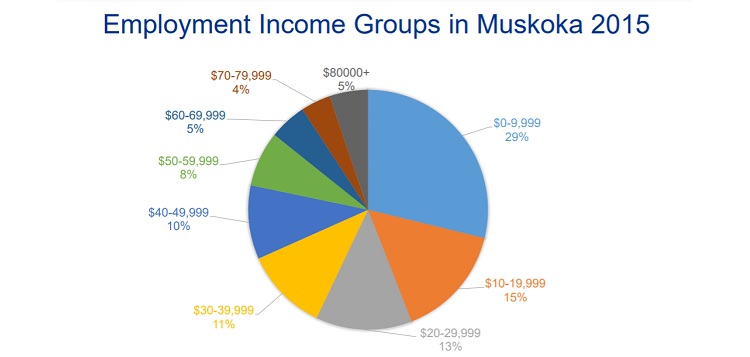
According to Matthews, roughly 50 per cent of the working population earns less than $30,000 per year, which has a direct correlation to adverse health effects and poverty in Muskoka. He said another consequence of a dysfunctional labour market is an increase in income disparity, which leads to a disintegration of social cohesion. “A consequence or a result of that is an us-versus-them mentality.”
The good news is child poverty has been decreasing in Muskoka since 2005, “and that is mainly due to the Canada Child Tax benefit introduced in 2006, but what we’re seeing obversely is a rise in the rate of poverty of those aged 18 and above and that number has gone up by 50 per cent between 2005 and 2015,” he said.
“The narrative I’m trying to present in this presentation is an increasingly dysfunctional labour market in Muskoka. We have a low wage, low growth economy with increasingly poor job quality but we still see labour shortages in various sectors. We have a number of key barriers to economic and employment growth in the district including affordable housing, transportation, lack of standard employment, and of course a shrinking labour force,” he added. “And we are seeing a public policy discourse where unemployment is considered an individual matter, rather than a structural consequence of economic transformation over the last 20 years.”
Councillor Mike Peppard questioned what is behind the drop in construction jobs, noting that it appears that construction is ‘non-stop’ in Muskoka. “Are we having to bring labourers in from outside, which is also what I’m hearing from some of the businesses, they just can’t find enough people?”
Matthews said in working with the Muskoka Builders’ Association, they are finding it difficult to attract the right kind of skilled labour for the right kinds of jobs. “So that’s one aspect of it but certainly the historical decline, it speaks to a decline which we’ve actually seen throughout Ontario particularly after 2015 with the energy crisis in terms of the acceleration of the worth of the Canadian dollar compared to the American dollar – so a big drop off in construction, and what construction that has improved tends to be in civil and heavy engineering, not so much in residential homebuilding.”
Councillor Don Smith also noted there are a number of small to medium manufacturers in Muskoka who are growing and “who in some cases support a living wage agenda. They are working hard to attract local employment.” Smith questioned whether the data was up-to-date.
Matthews said there has been an uptick in manufacturing employment in the last four years but noted that increasingly some of that work is being outsourced. “So, for example, non-core business activity like HR (human resources), like bookkeeping, they may well be outsourced and so they wouldn’t be represented in the number of people who are actually employed in construction and manufacturing.” Matthews added that there are manufacturers who offer career pathways and job security, “and those are the kinds of quality jobs that I’d like to see… more of in Muskoka.”
You can find Matthews’ presentation here (pdf).
Don’t miss out on Doppler!
Sign up here to receive our email digest with links to our most recent stories.
Local news in your inbox so you don’t miss anything!
Click here to support local news
Mike Ursini……This is one of those unfortunate posts that is very misleading. Clearly there must be more to your situation/claim than you have included here.
Your claim is that you have offered “framers, plumbers, electricians, roofers…” $42.75 an hour (which for a 40 hour week is roughly $1,710 per week).
And yet you conclude that local workers are so lazy that they would rather accept CERB’s $500 a week.
This doesn’t smell right to me. It sounds like your organization has bigger issues that simply economics and you chose to blame local workers and the federal government’s Covid assistance
I’ve had no choice but to bring workers from outside as I couldn’t find framers, plumbers, electricians, roofers or anyone else to show up after committing to do a job. People from the GTA came up here and did these jobs after 4 different individuals and contractors simply failed to show up. One of them asked for 2 weeks to go fishing before working and then he failed to show up after that. The pay was triple minimum wage but still no luck. The work ethic here is terrible and CERB only made it worse. It’s almost a certainty that people from the GTA will increasingly be taking these jobs and locals will be complaining about outsiders taking the jobs they didn’t bother to show up for
The pendulum has swung back in favour of the employees. There will be much moaning and crying from the business community
BUT the only decent answer has to be raise the minimum wage to a minimum living level.
Did the reporter or Mr Mathews reach out to any of the local and major industries in Huntsville for their input ? The comments and information is not reflective of what’s going on , these businesses are booming ,KC, MBRP, Panolam Upanor etc all are actively recruiting and looking for general and skilled trades with decent wages well above minimum wage Perhaps if the town took the approach of learning about local businesses and worked with them we could bring people into the area to grow business.
This report shows what we see. Reflection: the lack of qualified employees, the black market and self employed culture, and the quality of the jobs are narrowly related and spin a conscious circle.
Many people are self employed without fully understanding how this affects their current and future finale but because possible employees would rather not have to contribute to the social system. Those who do understand and build on this are fine but too often it is a matter of being taken advantage of.
Thank you for this interesting article
Hello Sandy,
Thank you for your comments. If you look at the presentation (link at bottom) chart 14 shows the median wage for the jobs Mr. Matthews references in his report, some of which fall below the general minimum wage of $14.35/hour (ten cents more from the previous increase) as of October 1, 2021. There are also different minimum wage rates for different sectors, as per the province.
“A worrying trend is the number of people who are now classified as sole or self-employed.”
Why worrying? Not by me. Good for those people (myself included).
“Generally speaking, people are forced into sole or self-employment because they cannot find opportunities in the labour market.”
And some people want to be more self-reliant, and innovative.
“top job types in Muskoka are close to, or below, the minimum wage”
Would the editor please explain how anyone is paid below minimum wage? (Are they under a certain age, or it’s a certain type of work: restaurant server anticipating tips?)
“The narrative I’m trying to present in this presentation is an increasingly dysfunctional labour market”
Why? This implies un-met expectations. Make Muskoka Great Again? What if we go with what is, and try to be better within the actual situation, now and in future?
“…construction is ‘non-stop’ in Muskoka. “Are we having to bring labourers in from outside?”
This question was not answered.
“a big drop off in construction, and what construction that has improved tends to be in civil and heavy engineering, not so much in residential homebuilding.”
Has this person been to Huntsville?
“…the kinds of quality jobs that I’d like to see”
Sounds like looking back. I’d like to see a more flexible, innovative, future-anticipating attitude.