
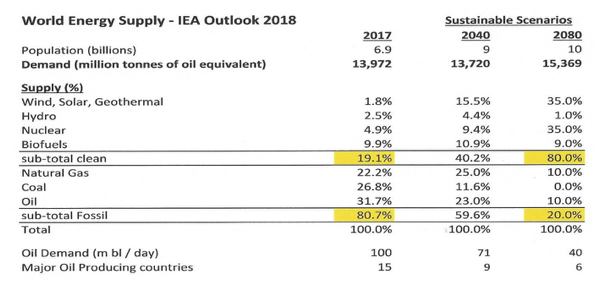
The following data from the International Energy Agency’s Global Outlook 2018 shows that to reach a sustainable future, the global energy supply must shift from 80 per cent fossil fuels to 80 per cent clean energy. As most transportation is electrified, global demand for oil will gradually decrease from 100 million barrels per day to 71 in 2040 and 40 in 2080. The shift has started and will accelerate rapidly.
The life of a country’s “proven” oil and gas reserves is calculated by dividing the amount of proven reserves by the amount produced per year. At current production rates, “proven” global reserves of oil and gas will last about 50 years. But they will be needed longer for the most difficult applications.
“Proven” is defined as having at least 90 per cent probability of being technically and economically accessible, based on established geological and engineering analysis. There are additional reserves in the 50 per cent to 90 per cent range of probability that “might” extend the life of finite global oil reserves by another 10 years.
With only 0.4per cent of the world’s population, Canada is #3 of 15 major oil-producing countries with 10 per cent of the world’s proven reserves. Canada is #17 of 25 major natural gas-producing countries with 5 per cent of the world’s reserves. As smaller reserves of oil are depleted, Canada will be one of only 10 oil-producing countries by 2040, and one of only six by 2080 (Venezuela, Libya, Canada, Iran, Iraq, Saudi Arabia). The Middle East has been embroiled in almost continuous turmoil with over 40 major conflicts since 1800. The Middle East Oil Embargo of 1973 caused a global energy and economic crisis. Canada’s oil will be critical to minimizing the possibility of an energy shortage on top of a climate crisis.
The chart below shows the emissions coming from Canada’s oil and gas sector that have grown since 2010 and now contribute 27 per cent of Canada’s total emissions. Since the 1970s, producers dramatically reduced the emissions per unit produced, but production has increased. It must be noted that 78 per cent of our oil production is exported to the US, and that the producing/exporting country must count the emissions from production, while the importing country gets a free pass on emissions from production.
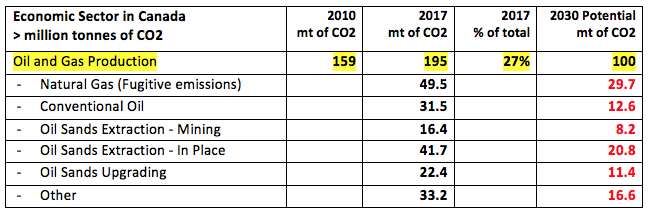
However, Canada can achieve our 2030 emissions goal while supplying needed energy to the world by making significant reductions in all parts of the sector.
Emissions from natural gas production are mainly “fugitive” emissions escaping at wellheads and pipeline pumping stations. Natural gas emissions are 50 per cent methane that stays in the atmosphere 20 times longer than CO2. It should be achievable and profitable to reduce fugitive emission leaks by 40 per cent. However, Canada can achieve our 2030 emissions goal while supplying needed energy to the world by making significant reductions in all parts of the sector.
Emissions from conventional oil come mainly from burning natural gas to provide heat at refineries. 66 per cent of Canada’s 1,907,600 barrel per day refinery capacity resides in four locations (Edmonton, St John, Sarnia and Levis). Installing Small Modular Nuclear Reactors (SMRs) to co-generate clean electricity and heat at those four locations could reduce refinery emissions by 60 per cent and would increase profits.
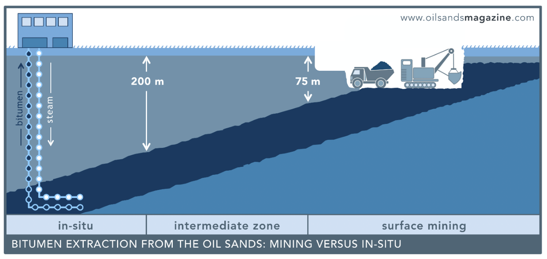
The surface mining of oil sands gets all the media attention but only 7 per cent of the oil sands are shallow enough to be mined from the surface. The remaining 93 per cent must be extracted in-situ (in place) by injecting steam to melt the bitumen, with minimal impact on surface areas. Emissions from oil sands extraction come from burning natural gas to provide steam to melt the bitumen for both surface mining and in-situ extraction. Although oil sands extraction operations are scattered, installing an SMR at two or three of the biggest production sites could provide needed clean saleable electricity to the area and emission-free heat that could reduce the cost and emissions from burning natural gas by 50 per cent or more.
Large-scale nuclear reactors are ideal for producing reliable base-load electricity, but emerging Small Modular Reactors will be much better suited for supplying both power and heat across a broad spectrum of industrial applications. Since SMRs are about 10 years away from commercialization, several other technologies are now helping to reduce oil and gas emissions. Some locations are using solvents to make bitumen pumpable without burning natural gas to make steam. Carbon Capture and Storage (CCS) can avoid releasing emissions to the atmosphere in locations where depleted oil and gas wells are close by.
But SMRs will provide the optimum solution and some producers are already working with Terrestrial Energy of Oakville Ontario to develop specific oil sands applications (see references below). With SMRs, the world’s third largest proven reserves of oil can be cleaner, safer and more secure than deep shale deposits, ever-deeper offshore and Arctic Ocean deposits, and deposits in perpetually unstable regions with little or no environmental regulation.
Canada’s abundant oil and gas reserves have been a mixed blessing. They have been an important source of our energy and prosperity but, have also become a source of international criticism. In this series of four articles, I have tried to share some information, without getting too technical, that shows that Canada can indeed achieve our greenhouse gas emissions target for 2030. It is clearly possible. Will it happen? Will Canada be a leader in the battle to mitigate climate change? Building public understanding to muster political will is the key factor.
I want to thank Doppler readers for their many questions and comments. They have all helped to make this a more meaningful exercise.
This is the last of a four-part series focusing on SOLUTIONS that Canada could adopt to reduce emissions that contribute to climate change.
Read the series here ~
Part 1, Addressing climate change: Emissions from transportation
Part 2, Addressing climate change: Emissions from electricity and buildings,
Part 3, Addressing climate change: Industry, agriculture, construction, waste ~ Hugh Holland
Hugh Holland is a retired engineering and manufacturing executive now living in Huntsville, Ontario.
Don’t miss out on Doppler! Sign up for our free newsletter here.
Some References about Small Modular Nuclear Reactors
Oakville’s Terrestrial Energy developing small modular molten salt reactor – July 2018
https://www.terrestrialenergy.com/
Terrestrial Energy USA to make hydrogen
https://mailchi.mp/34c269ba7012/terrestrial-energy-usa-partners-with-leading-energy-company-national-labs-to-produce-economical-clean-hydrogen-with-generation-iv-nuclear-energy?e=f89c527c2b
Terrestrial Energy material testing news
https://mail.google.com/mail/u/0/#inbox/FMfcgxwBVWPFNmqSnpWtXJnCVbnlDbjz
Terrestrial Energy forms work group in Canadian Energy Industry
https://mail.google.com/mail/u/0/#inbox/FMfcgxwBVgmpVTvpMGLWxFThRfRFTsvd
TE AIMS FOR FIRST COMMERCIAL REACTOR IN 2020s – Global energy market is $5 trillion per year
TARGET APPLICATIONS – Oil extraction and refining (oil sands and shale), Hydrogen production, Water desalination
https://www.forbes.com/sites/rodadams/2017/04/05/terrestrial-energy-describes-progress-towards-commercializing-advanced-small-modular-reactor/#51405fcb6cd4
Terrestrial advances to next stage at CNL site – Feb 19, 2019
https://mail.google.com/mail/u/0/#inbox/FMfcgxwBVgvrhkgPhmXDJKRxnmzlXTMW
Terrestrial Energy to build at Chalk River Test Site
https://mail.google.com/mail/u/0/#inbox/FMfcgxwBVqTcgFKDrPqMMRzrdvQrptTp
Terrestrial joins International Gen IV reactor team – May 13, 2019
https://mail.google.com/mail/u/0/#inbox/FMfcgxwCgfwmPpNJxgMkXKJHMkDfZLrQ
OPG joins Terrestrial’s SMR work group – May 15, 2019.
https://mail.google.com/mail/u/0/#inbox/FMfcgxwCgfxwzpXcHlnjvBbvfRlBpxGd
Video – Dr David Leblanc on molten salt reactor
https://www.youtube.com/watch?v=LERLuH7kWVs&feature=player_embedded_uturn
Terrestrial Energy USA headed by experienced nuclear power executive – June 13, 2019
https://mail.google.com/mail/u/0/#inbox/FMfcgxwChJdDqKmQlltMkSMLpQPBBmQg
Terrestrial Energy in the Oil SANDS
https://albertanuclearnucleus.ca/2019/03/27/spotlight-terrestrial-energy-inc-2/
Thanks very much, Hugh!
Hugh…interested in your thoughts on this article by Gwyn Morgan:
https://business.financialpost.com/opinion/gwyn-morgan-here-are-a-few-climate-change-head-scratchers-for-canadian-voters-to-ponder
For the record, I’m employed by a Provincial Oil and Gas Regulatory Agency and I consider myself fairly well informed about the state of the oil and gas industry in Canada.
Peter
Rob, here is an attempt to answer your questions:
1. Too simplistic? – Not really. They burn natural gas to heat water to make very hot steam to melt bitumen. After the melted bitumen is pumped to the surface, the water is removed and recycled. Most Oil Sands are harvested that way.
2. Canada’s target is to reduce total GHG emissions by 30% from 2010 to 2030. That target was set by the Harper government and adopted by the Trudeau government. It is consistent with the target of many other countries. The ideas covered in this series of 4 article lays out how Canada’s target can be achieved.
3. How is CANDU spent fuel stored safely? – Overseeing all of Canada’s nuclear activity is the Canadian Nuclear Safety Commission. The Nuclear Waste Management Organization (NWMO) is responsible for managing radioactive waste. For now, all levels of nuclear waste are kept on-site at the plant that produces it. Spent fuel spends 10 years cooling down in water pools before being put into 20-inch thick steel-lined concrete containers that are welded shut. These containers are placed in long-term underground storage. Each container is numbered and fitted with a tamper sensor that is monitored by the International Atomic Energy Association (IAEA). The total amount of nuclear waste produced in Canada at 5 sites over 60 years would fit on a single hockey ice surface. The NWMO is researching permanent storage ideas, but there is potential to use up existing stored waste as fuel for new reactors that can extract much more energy from the so-called waste.
Re talking about 2030 and 2080. – It took far too long to develop a critical mass of people who accept the expert information on climate change, but now that we can see more evidence in our own daily observations, we must make changes as fast as possible for the sake of our grandchildren. To do that, we must have long range goals and plans because these kinds of large-scale changes take a lot of time and money. It took 50 years to spread electric lights across most of the world. It took 50 years to convert from horse-drawn transportation to internal combustion engines. We need to start with what we know today and continuously update the plan to adopt new ideas as they emerge. Business and governments must invest in proven ideas. They cannot invest billions in unproven dreams, but they must adopt new ideas (dreams) as they become proven.
Thank you for the series, Hugh, and I have 3 queries:
.
1) It sounds too simplistic, but can water be heated to a high enough temperature to melt the bitumen?
.
2) What is Canada’s GGE target for 2030 (and was it determined internally or externally)? Won’t it be negatively affected by Canada experiencing more rapid temperature increase than most countries (due to polar and sub-polar ice melt)?
.
3) How is the CANDU spent fuel “safely stored? Is it encased in concrete and buried? How does that ensure its safety against seismic activity?
.
Personally, I find it somewhat specious to talk about 2030, 2040, and 2080. By 2030, we’ll be hiding in our homes to escape the intense heat, and stealing food from our neighbours (assuming that they even have any).
This all sounds great but i’m not fully convinced yet but I’m not saying it’s wrong just I don’t know but at any rate i’ll never have to worry about it I’m to darn old. As far as global warming is concerned I don’t believe we can stop it no matter what we do we might be able to slow it and prolong the agony but that would be it.
Ray, like medicine and climate change, nuclear power is a very complicated subject that takes a lot of time and effort to understand. The choice is to take the time to read the massive amount of available information, or to accept what the qualified experts tell us. I have chosen to study enough to give me confidence in what the qualified climate and energy experts are saying. I am happy to share a summary of what I have learned with anyone who is interested.
Current CANDU reactors have served us well. Nuclear power has taken zero lives in Canada. The waste from generating electricity by burning fossil fuels is many times larger in quantity and more damaging to individuals and the environment than nuclear waste.
“If every person in Ontario used only nuclear power for their entire life, their individual share of the nuclear waste would be about the size of an ice cube. Spent fuel from 50 years is safely stored on current reactor sites and there is provision for the next 50 years to be safely stored.”
Routine radiation testing shows blood radiation levels among people within 25 kilometers of current nuclear plants is no higher than the general population.
According to the International Energy Agency, the amount of new global electricity capacity required to replace fossil fuel plants, to eliminate emissions from transportation, and to satisfy the growing population simply cannot be supplied without nuclear.
But the future is Small Modular Molten Salt Reactors that offer:
• Passive safety – They shut down without human intervention in the event of unsafe temperature or pressure, or loss of control power.
• Lower cost, risk and time required to build – Small size enables economics of mass production of standardized designs.
• More efficient reaction from using liquid fuel (dissolved molten salt)
o Enables extraction of a much higher percentage of the energy from the fuel compared to solid fuels
o Results in much less waste volume to store and reprocess
o Reprocessing of waste is much less expensive.
o Potential to use up existing spent fuel from earlier reactors
• Much smaller footprint on land than equivalent solar or wind energy.
• Widely deployable – Reduces transmission cost and enables surplus heat to be used for industrial processes and district heating of buildings.
• Easy to replace – Small size enables a reactor exchange program so that maintenance and decommissioning can be done by experts at a central location.
I enjoyed reading this but I worry about the use of even small nuclear reactors they seem safe and clean but as far as i know we still have no way of disposing of the spent fuel cells. I’m not educated about this stuff so maybe they are safe I just don’t know.