
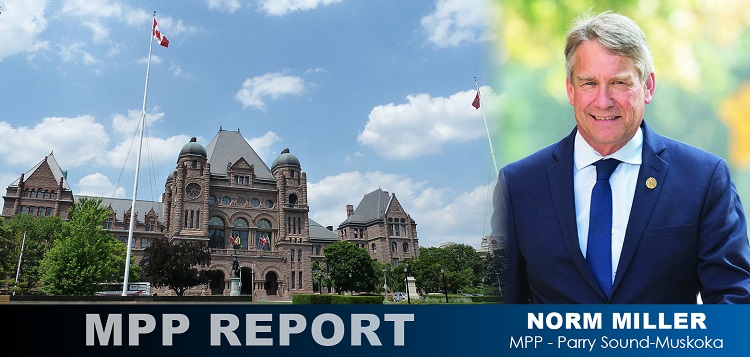
By Parry Sound-Muskoka MPP Norm Miller
June is National Indigenous History Month and June 21 is National Indigenous Peoples Day in Canada.
It is especially important that we recognize these events this year after the uncovering of the remains of 215 children at the residential school in Kamloops, BC. Sadly, we know that this site is not the only place children were buried in unmarked graves. The Truth and Reconciliation Commission (TRC) estimated that at least 426 children who attended Indian Residential Schools in Ontario are known to have died, while an unknown number are still missing. The remains located in Kamloops serve as a reminder that we need to work together to address the recommendations of the Truth and Reconciliation Commission.
Premier Doug Ford and Minister of Indigenous Affairs Greg Rickford have committed $10 million to support an Indigenous-led process to identify, investigate, protect, and commemorate burial sites at former residential schools across Ontario. Ontario will also provide provincial resources such as the office of the Chief Coroner and support First Nations communities with culturally appropriate mental health supports.
Locating and commemorating these burial sites is one of the calls to action in the report by the Truth and Reconciliation Commission. I took some time to look back through the other calls to action and I want to highlight a few other things Ontario is working on.
The first few calls to action were with regard to reducing the number of Indigenous children in the child welfare system, ensuring there were Indigenous-led child welfare services, and ensuring that child welfare workers would be sensitive to the history of residential schools. Through Ontario’s Child Welfare Redesign Strategy our government is addressing the overrepresentation of First Nations, Inuit, and Métis children and youth in the child welfare system.
Locally, on April 1 of this year Ontario announced that Niijaansinaanik Child and Family Services had been designated as the province’s 13th Indigenous children’s aid society. The official designation will enable Niijaansinaanik Child and Family Services to provide culturally based services and supports to Indigenous children and families in the Districts of Nipissing and Parry Sound, and the City of Greater Sudbury.
Ontario is also working to protect vulnerable populations including Indigenous women and youth. Our government’s Anti-Human Trafficking Strategy includes Indigenous-specific resources and increased funding for the Anti-Human Trafficking Indigenous-led Initiatives Fund. We have also established an Indigenous Women’s Advisory Council to provide culturally relevant advice, expertise, and input on issues such as human trafficking and child, youth, and family well-being.
In response to Call to Action 57, Ontario has been providing Indigenous Cultural Competency Training for members of the provincial civil service. As of December 2020, approximately 70 per cent of Ontario Public Service employees have been registered in the program. As well, the Community Safety and Policing Act, 2019 mandates human rights, systemic racism, diversity, and Indigenous training for new police officers, special constables and police service board members.
There are a number of calls to action with regard to ensuring the healthcare system respects Indigenous cultures and traditions and that Indigenous individuals receive equal access to health care services. In line with the province’s Roadmap to Wellness: A Plan to Build Ontario’s Mental Health and Addictions System released in March 2020, Ontario is funding culturally appropriate mental health and well-being services and supports for Indigenous individuals and communities across Ontario. Specifically, Ontario has committed more than $12 million annually to expand services to address the mental health and addictions needs of Indigenous people, families, and communities.
Our government has been working hard to increase opportunities for employment among the Indigenous community and has started to implement resource revenue sharing with Indigenous partners, including in the mining, forestry, and aggregates sectors.
Ontario has invested $37.5 million in funding for 2020-21 in projects that support economic development for Indigenous people. The programs support training, job creation, community infrastructure, and consultation capacity in communities. And just last week the Minister of Labour, Training and Skills Development announced an investment of $500,000 in a one-year program to be run by the Organization of Canadian Nuclear Industries and the First Nations Power Authority to train Indigenous individuals for in-demand careers in the skilled trades such as boilermaker, electrician, and welder.
Again, the uncovering of the burial grounds in Kamloops has reminded us all of our responsibilities and accountability to the Indigenous peoples of this country. It serves as renewed call to honour our commitment to implement the calls to action. The work towards reconciliation is far from complete but I am pleased that our government is investing in responding to the calls to action, in particular the call to identify and commemorate the unmarked graves of children who never came home from a residential school. I am committed to listening and learning about the impacts that residential schools have had on First Nations communities and I will encourage our government to continue work to address more of the calls to action.
Photo of MPP Norm Miller is courtesy of his office. Queen’s Park photo “June 2012 Ontario Legislature Toronto” by Priscilla Jordão, via Wikimedia Commons, is licensed under CC BY 2.0 / Cropped from original.
Don’t miss out on Doppler!
Sign up here to receive our email digest with links to our most recent stories.
Local news in your inbox so you don’t miss anything!
Click here to support local news
I would just like to that the people that responded to my comments without condemning me. One other thing I would like to mention that I have very little knowledge of is around the same time a lot of orphans from Europe were being sent over here and went to live on farms some were treated good others were treated like slaves and I’m thinking a few of them died as well. All I’m trying to say is views were a lot different back then than they are now not that it is any excuse for what took place. I do think the intention of our Govt was to educate the native children so they could fit into our way of life easier and be able to read and write English Or French. Problem was it never worked and should have been stopped long before it was. But hindsight is always a lot better than foresight. I just hope something we do helps with the healing.
Mr. Miller; your government’s recent concern about Indigenous history belies any consistency with the DF Conservative actions to cancel the scheduled teacher continuing education sessions on Indigenous issues. An aim of these inservices was to educate and raise awareness of teachers, thereby supporting them to implement the Provincial revised standards of education curriculum on Indigenous issues.
DF did not think education on Indigenous issues was His issue of concern. He was concerned with the number of Toronto city counsellors, reducing the public health budget, decreasing the number/comprehensiveness of LTC home inspections, and of course, the all-important anti-carbon pricing stickers on gas pumps.
Are we to believe that your party has “seen the light”? There is a Dudley George legacy from the MH years that should have been a filter in DF’s decision-making about the education in Indigenous concerns.
Mr. Vowels, my intention was not to “give you flack”, only to provide you with what I am learning about this issue myself. The good thing is, we are having these discussions and willing to help ourselves become more educated about the topic. I too did not hear/learn about this growing up in metro Toronto in the ’50’s as a child. However, because it was not a part of my past learning does not mean that I cannot learn Now.
Mr Vowels:
The Government and The Catholic Church were indeed, hellbent on giving Indigenous children an education – A ‘White Man’s Education’. They ripped the children from their family, friends, home (language, traditions, diet, livelihood training by parents and community etc.) and proceeded to try to indoctrinate them with White Man’s Ways. A belief in Jesus Christ/God was not a component of Indigenous people’s spirituality. Yet, it was shoved down the throats of the children of residential schools. Did the intentions of The Government and The Catholic Church come from a place of kindness and love? Clearly not. I will go so far as to say that The Government and The Catholic church indisputably played a role in fostering and supporting White Privilege. I am not giving you “flack” Mr. Vowels but information that makes some people uncomfortable and defensive. We can’t keep ‘passing the buck’.
Anna-Lise Kear I knew i would get flack for what i wrote but I’ll stick to my guns and say I was born in 1940 and growing up in the 40’s 50’s and even later I never recall ever hearing anyone say anything bad about the residential schools so maybe some had heard of what was going on but I don’t think the general public had any idea of what was taking place. I have never read up on any of the history of them but I think the idea was to give the children and education so they could fit into society better be able to read and write English and be better equipped to get a job. Now in hind site we all know what really happened and someone should be held responsible. I’m not sure just who because most of them have passed on.
.
Mr. Vowels; here is a link you may find interesting:
https://fncaringsociety.com/sites/default/files/Dr.%20Peter%20Henderson%20Bryce%20Information%20Sheet.pdf
Dr. Peter Henderson Bryce: A Story of Courage July 2016 Introduction Dr. Peter Henderson Bryce was a Canadian doctor and a leader in the field of Public Health at the turn of the 20th century.
fncaringsociety.com
Mr. Vowels; the Canadian government initiated the schools – under both Conservative and Liberal leadership – and were involved in the oversight to these residential schools. They did worked within their beliefs about Indigenous people – residential schools were an attempt to assimilate the Indigenous culture into the “Canadian culture”(primarily of British-Eurocentric roots).
For me, the statue removals are less problematic than they used to be for my sensibilities. I have only to imagine myself as being a granddaughter of a person who managed to survive the abuse of that system. How might I feel when having to continue to see the statue of an early supporter of the system on full public display – an idol, on a metaphorical and literal pedestal? Not great.
If you are interested, one positive agent of change, check up on Dr. Peter Henderson Bryce, first federal Public Health Officer, Dept. of Interior and Indian Affairs, under Laurier government. His focus was on the health of children residing in these schools.
I wish I could put down the way I feel without being criticized to much. What was being done in those schools is nothing short of criminal. But to blame the Govt of the day in my opinion is not really fair. The catholic church or the priest’s and Nun’s that ran the school’s are to blame no one else. I would bet that none of the population of Canada at the time had any idea of what was really going on. They thought the children were there to learn to read and write just the same as all schools. I don’t feel that taking down a statue of anyone will change things and might only help to ea-race the past and that is never a good thing. History is written so we can learn from it nothing more but it all should be taught so bad mistakes will not be repeated and good things can be remembered. My feeling are no one in the Govt. of the day ever intended those schools to be run in the manor that they were. I cannot believe that people knew about the things going on . the sexual abuse and beatings how anyone could treat children that way is beyond me and if any of them are still alive they should be punished to the full extent of the law.
May I suggest that the most meaningful action on June21, and perhaps one of the most difficult, is for non indigenous leaders, to listen. Hear those who were never heard, see those who were always invisible, those like my Auntie who made it home from the school, but only in body.
There is a sacred teaching in our culture, humility. Now might be the time