
Let the buyer beware. The performance of governments is seldom as good as the government claims and seldom as bad as opposition parties claim. Balancing the budget with the ever-changing needs of a growing population, a growing economy, and an explosion of new technologies is a very difficult job. Everyone wants a balanced budget – – until it affects them personally. Every one of Ontario’s previous seven governments (three Liberal, three Conservative, one NDP) in the 31 years since 1988 have added to Ontario’s debt.
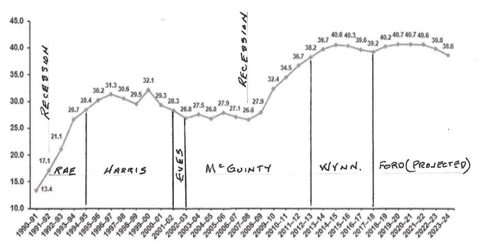
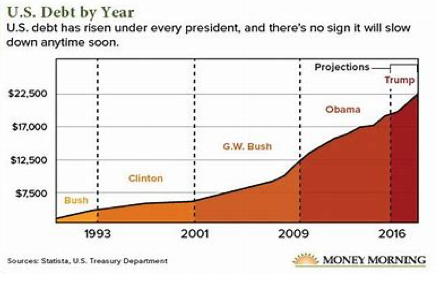
The following chart from Statscan and the Ontario Ministry of Finance shows the trend of the Net Debt to GDP ratio during the last six governments in Ontario. The next chart shows the trend of US debt.
Of course, debt is a serious concern. However, to be accurate and fair, one must consider many surrounding trends and factors when evaluating and comparing the fiscal performance of a government:
- Impact on trade and tax revenue of global and national economic trends and conditions
- The costs of health care and education continue even when revenues are in recession.
- The cost of social assistance increases during recessions.
- Should governments try to cushion the impact of recessions on vulnerable people?
- The policies and assignments of preceding governments (What level of government does what?)
- Infrastructure conditions and needs
- Ontario population forecasted to grow by 30 per cent from 2017 to 2041 – GTA to grow 41 per cent
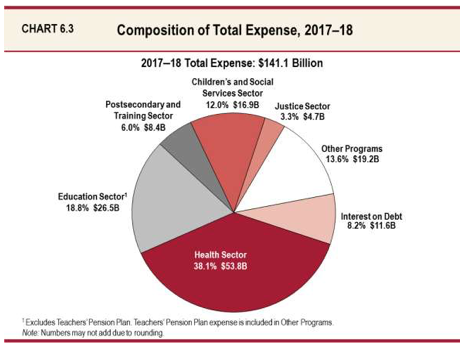
- Society priorities – Health Care, education and training account for 63 per cent of Ontario expenditures and continue to grow relentlessly due to new technologies that everyone wants. But these priorities are the keys to ensuring our economy grows on pace with our population. Our health care system is not perfect, but as I watch the US struggle to fix their less effective and much more expensive system, I am increasingly thankful for our Canadian health care system.
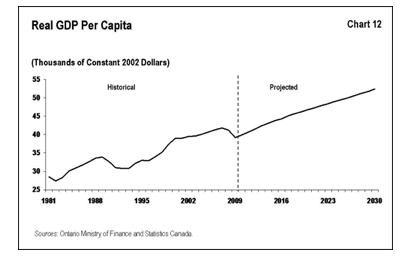
It is difficult to find data earlier than 1988, but times were good then, and earlier governments were able to balance. Here are some historical facts around the seven governments of Ontario from 1988 to 2019:
- David Peterson (Liberal / NDP coalition) 1988 to 1990
- Banned extra billing by doctors and ended health insurance premiums
- Ontario debt increased 8.1% from 35.5 b to 38.4 b over 2 years = 4% per year
- Debt / GDP in 1990 was 38.4 b / 395 b = 9.7%
- Bob Rae (NDP) 1990 to 1995
- 1992 category 4 recession – Decreased revenue and increased cost of social services
- Rae days introduced to try to minimize layoffs – Lost union support
- Introduced casinos to produce revenue
- Ontario debt increased 136% from 38.4 b to 90.7 b over 5 years = 27.2% per year
- Mike Harris (Conservative) 1995 to 2002
- 30% tax cut and 21% cut to social assistance, health care, and education
- Cancelled infrastructure projects including the Eglington Subway funded in 2016 by Wynne
- Downloaded responsibilities for several services to municipalities
- Eliminated grade 13
- Privatized Highway 407 (Later criticized)
- Ontario debt increased 45.6% from 90.7 b to 132.1 b over 7 years = 6.5% per year
- Debt / GDP in 2002 was = 28.3%
- Ernie Eves (Conservative) 2002 to 2003
- North America hydro blackout
- Ontario debt increased 0.3% from 132.1 b to 132.6 b over 1 year = 0.3% per year
- Dalton McGuinty (Liberal) – 2003 to 2013
- 2008 category 4 recession (caused by US banking practices) decreased revenue and increased social service expenditures
- Cancelled some Harris tax cuts
- Uploaded some services that were crippling municipalities
- Transferred gas tax to municipalities to help pay for downloads
- Instituted full-day kindergarten to help working families
- Green Energy Plan (Left Ontario with arguably one of the world’s most modernized and resilient electricity systems. Many other jurisdictions have yet to make those investments.)
- Ontario power plant scandal (Mississauga was the optimum location for the gas plant, but opponents succeeded in getting it moved to Nappanee which increased infrastructure costs to move western gas farther east, and electricity back west to the GTHA where needed)
- Ontario debt increased 78% from 132.6 b to 236.2 b or 78% over 10 years = 7.8% per year
- Debt / GDP in 2013 was 38.2%
- Kathleen Wynne (Liberal) – 2013 to 2018 –
- Revenues continued to be impacted by manufacturing jobs lost during 2008 recession
- Toronto becomes North America’s fourth largest city (Very important but densely crowded)
- Invested $30 b for needed infrastructure including the Eglington subway cancelled by Harris
- Privatized Hydro-One (Later criticized)
- Privatized some beer and wine sales
- Free prescription drugs to youth under 25
- Ontario debt increased 30% from 236.2 b to 308.2 b over 5 years = 6.1 % per year
- Debt / GDP in 2018 was 39.2%
- Doug Ford (Conservative) – 2018 to 2019
- Minor cuts to some budgets
- Re-organized Hydro One resulting in substantial penalty clause charges
- Withdrew from climate change accord and cap and trade initiative
- Cut Toronto councilors from 47 to 25
- Ontario debt increased 5.5% from 308.2 b to 325.0 b (projected) over 1 year = 5.5% per year
- Debt to GDP is expected to peak at 40.7%
Hugh Holland is a retired engineering and manufacturing executive now living in Huntsville, Ontario.
Don’t miss out on Doppler! Sign up for our free newsletter here.
REFERENCES
Ontario GDP – 2000 to 2017 ~ https://www.statista.com/statistics/577539/gdp-of-ontario-canada/
According to investors, Ontario debt is not as bad as it looks ~ https://globalnews.ca/news/2845864/reality-check-is-ontarios-debt-really-that-bad/
Christopher, you make a very good point. Similar detailed lists could be made for the other six governments. It was not my intent to minimize the damage done by the Ford government. My intent was to show that none were perfect by highlighting some of their key actions.
Mr. Holland has listed six actions by the Ford government which he characterizes as minor cuts.
May I suggest the following is a more complete list of the cuts and cutbacks and may I further suggest that calling them minor cutbacks is perhaps somewhat less than candid:
Cancelled Cap and Trade
Ended electric and hydrogen vehicle incentive program
Cut 700+ green energy projects
Shut down Prince Edward County White Pines Wind Project
Proposed cuts to protections of species-at-risk
Removed electric vehicle chargers from GO station parking lots
Slashed 50 percent of flood management funds given to conservation authorities
Eliminated funding for 50 Million Tree Program
Ended Drive Clean, a mandatory biannual emissions test program for vehicles and light-duty trucks more than seven years old
Axed the Green Ontario Fund, which provided funds through cap and trade to help make properties more energy-efficient
Canceled free prescription medication for those under 25 through the Pharmacare program
Canceled the opening of new overdose prevention sites
Cut the Liberals’ promised $2.1 billion over four years for new mental health funding to $1.9 billion over 10 years
Revoked current and future funding for the College of Midwives of Ontario
Dissolved Local Health Integration Networks and merged them under one new umbrella body called Ontario Health
Slashed the number of paramedic service providers from 59 to 10
Proposed ending OHIP’s medical emergency coverage for Ontarians traveling outside the country
Planned to cut $200 million from Public Health services, impacting 35 health units. Toronto Public Health would have seen a reduction in provincial funding by $1 billion over the next 10 years. That translates into cuts in school breakfast programs, daycare and restaurant inspections, water-quality testing, pre- and postnatal care for single mothers, and detection of emerging threats to public health. (While, the government reversed retroactive cuts, but future cuts remain)
Scrapped funding for three supervised drug-use sites (two in Toronto, one in Ottawa)
Trimmed $1 million in funding from Leave the Pack Behind, an agency that helps young people quit smoking
Rolled back sex-ed curriculum
Removed $100-million budget for school repairs
Canceled Ontario’s first planned French-language university
Removed $25 million from the Education Programs-Other (EPO) Fund, which will limit grants available for school programs like after-school jobs for youth in low-income neighborhoods; tutors in classrooms; leadership programs for racialized students; daily physical activity for elementary students and more
Dropped financial assistance for college and university students by more than $300 million
Removed free tuition for low-income students
Cut tuition fees by 10 percent
Scrapped over $300 million in funding for three satellite university campuses
Increased class sizes, potentially resulting in over 3,400 lost teaching jobs over the next four years
Canceled three summer curriculum-writing sessions, including one that was mandated by the Truth and Reconciliation Commission and two others relating to American Sign Language and Indigenous languages for kindergarten students
Shutdown the Harmony Movement, which provides diversity, equity, and inclusion education
Scrapped the Ontario College of Trades
Fired the following government watchdogs:
Privatization Officer
Chief Scientist
Investment Officer
Environmental Commissioner’s Office
Ontario Child Advocate and
French Language Commissioner.
Offered Voluntary buyouts offered to thousands of Ontario public service workers
Reduced legal aid by 30 percent
Disbanded Anti-Racism Directorate
Withheld $14.8 million in promised funding from existing and new sexual assault centers
Dissolved Ontario’s Criminal Injuries Compensation Board, the tribunal that has awarded financial assistance to crime victims since 1971, as well as the law that provides financial aid to the victims of violent crime
Planned to cut funds to repair social housing
Asked municipalities and school boards to find 4 percent in “efficiencies” (i.e., cuts) to services
Retroactively slashed $5 million from the Ontario Arts Council. This has resulted in the suspension of five programs including National and International Residency Project, Ontario Dances, Publishing Organizations Projects, Theatre Training Projects, Travel Assistance: Ontario Contact/Contact Ontario’s
Canceled the Indigenous Culture Fund
Dropped grants for the Ontario Music Fund by more than 50 percent
Reduced funding to regional tourism organizations by $17.5 million
Announced the termination of the Beer Store contract, jeopardizing 7,000 jobs
Cut $9.5 million from Tourism Toronto (25 percent of funding) and $3.4 million from Ottawa Tourism
Celebrate Ontario, which provides funding for music and arts festivals across the province, lost $7 million from its annual budget
Cut $1 billion from social services across the board
Scrapped Basic Income Pilot Project
Canceled $1 increase minimum wage
Cut Workplace Safety Insurance Board payments to injured workers by 30 percent
Killed Bill C-148, which provided part-time workers the same pay as full-time workers, guaranteed 10 days off (2 days paid) and more
Removed rent control for new units
Severed library services funding in half
Ended the Roundtable on Violence Against Women
Slashed $84.5 million funding for children and at-risk youth, including children’s aid societies
Cut $15 million from the Ontario Trillium Foundation
Cut funding to MaRS Discovery District
Eliminated funding for public policy think tanks such as the University of Toronto’s Mowat Centre, which conducted research on Ontario’s role in Canada and the world, as well as the Institute for Competitiveness & Prosperity, launched under former PC premier Mike Harris
Cut funding to two artificial intelligence institutes by $24 million
Canceled a technology accelerators program of $9.5 million, a college-based applied research projects worth $6.7 million; $5 million in funding to the Institute for Quantum Computing; $1.5 million in funding to the Lazaridis Institute, and $750,000 for bio-industrial innovation.
Pared $5 million in funding for stem cell research
Eliminated funding for Gambling Research Exchange Ontario
Cut all funding for Ontario Centre for Workforce Innovation, a pilot program led by Toronto’s Ryerson University to collate research on employment and training
These are real cuts that dramatically affect real people in the real world. And calling them minor is just insulting.
May I finally suggest that an examination of the cuts shows the vast majority of them are aimed not at trimming back the lifestyles of the wealthy and the upper-middle classes but are aimed squarely as removing assistance from those most in need of it.
Society’s are judged in history by how they treat their most vulnerable. Societies which provide tax cuts to the most wealthy, subscribing to a 1920’s Austrian economic theory which triggered two world wars and destroying the hopes of those seeking to better themselves or at least survive until next month simply don’t last.
Mr. Ford’s vision of this Province and his attempts to solve the debt inbalance on the backs of the poor is obscene.
Mr. Ford’s government failure to provide the sort of leadership initiatives this province so needs to turn us around does not need columnar tergiversation apologists but real action, real leadership. And apparently, we must look at places other than Etobicoke’s suburbs and to its former drug dealers to provide it.
Hugh , the Liberals and Conservatives could not solve their payroll issues for 30 years, Billions wasted needlessly. Then we subsidized the destruction of two innocent people’s lives, Senator Mike Duffy and Vice Admiral Mark Norman . And now our tax dollars have to pay for this injustice. How can Canadians have confidence in a government that can not negotiate a software contract and pay billions of dollars needlessly. Now here is something are Prime Minister should be apologizing to Canadians for. Allowing a new software system to be activated before it was tested. And to make matters worse they had no back up plan according to CTV. Why do these people run for politics if they lack the ability to think?
Jim, reducing the federal budget to help the provinces is a questionable idea. Combined spending by the provinces is already about 140% of federal spending. The division of responsibilities is clear.
The provinces cover health care, education, and social services as well as policing, transportation, infrastructure, resources and environment within the province.
The Feds cover foreign affairs and trade, national security, immigration, and interprovincial transportation, infrastructure, resources and environment. The feds set national standards for health care and provide equalization payments to help level economic circumstances between provinces.
That system seems to be working relatively well. At the federal level, the net debt to GDP ratio has been reduced from 68% in 1992 to 30% in 2018. That is now the lowest in the G7 and about 1/3 of the USA. The biggest factor in Canada’s improvement was the GST brought in by the Mulroney government in 1992. That cost them their job but was the right thing to do. Harper’s GST reduction was a popular but questionable move. You get what you pay for.
I had an interesting talk with a US friend last winter. He asked me how much sales tax we pay in Ontario. I used the example of a family making $100,000 that would pay 13% on about half of that or $6,500 (Many things are exempt from sales tax). I asked him what he paid for health insurance for his family of four. He said $1,800 per month or $21,600 per year.
I have never voted Tory in any level of election (including municipal, where we really know the political stripe of all candidates). Even so, I was thrilled to see Rod Phillips become Ontario’s Minister of Finance, as a result of the most recent cabinet shuffle. This is the post which he should have occupied since the inception of this government. It would have given the government instant credibility; and likely avoided a great deal of the disastrous, initial budget. Hope springs eternal.
Thank you Hugh for your thorough analysis. It begs the question, how much Government is affordable or sustainable. How can Canada justify a bloated federal beauacracy when the Provinces and lower tier municipalities provide all the services we depend on. A reallocation of wealth by cutting the Federal budget and redistributing it across the Country would solve all the provinces and territories fiscal imbalances. Or we could keep pretending that our problems will just mysteriously disappear if we allow the status quo to continue. Sadly, More politicians is not the answer. But if we keep up on our current trajectory we will go broke.