
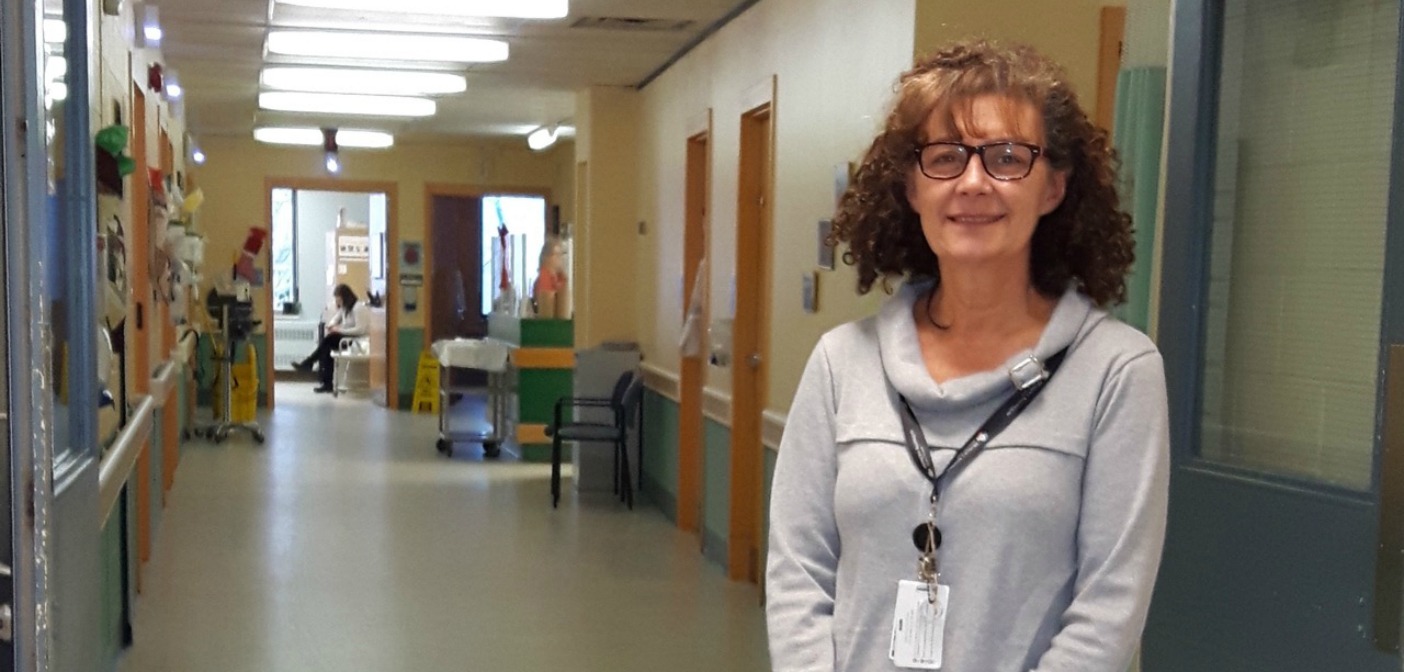
When people come into the hospital with a physical trauma quite often their emotional traumas are triggered. We’re here to support people in those circumstances.Karen Hamra, Spiritual Care Practitioner for Muskoka Algonquin Healthcare
When people enter one of Muskoka Algonquin Healthcare’s (MAHC) hospital sites, it’s typically due to a physical injury. However, recovery can require more than just medical attention. Sometimes spiritual care is necessary, too. That’s where Karen Hamra, a spiritual care practitioner (chaplain) at MAHC, and a number of volunteers step in and help.
“Spiritual care supports people with what gives them hope, meaning and strength in the particular situation that they’re in,” said Hamra. “If you have a faith background, that could mean supporting you within your faith background. It could be prayer, meditation, or many other things. What happens more often, even with people who do have faith, is that people need someone to hear them, hear what’s causing them the pain. Yes, they may have a broken femur or they may have had a heart attack, but what is the thing that is really troubling them at that moment? Quite often it’s more than the physical ailment. It could be a broken relationship, or they’re grieving the loss of a loved one. So when people come into the hospital with a physical trauma quite often their emotional traumas are triggered. We’re here to support people in those circumstances.”
That includes staff at MAHC who may require help through dealing with trauma at work, such as the loss of a patient.
Hamra is employed part-time through MAHC and visits each hospital site once a week. Her position is funded by MAHC, the Muskoka Chaplaincy Association and private donations. The association is hoping to educate the community on the spiritual care services offered at MAHC to help garner more donations, which would allow Hamra to visit patients more frequently.
It’s a valuable component for patients, their family and staff, in order for patients to heal properly and for staff to feel supported so they can do their job well. So if it’s in place, ideally then all the components are being addressed and we’re working as efficiently and effectively as we can. Right now we’re not because we just don’t have enough support. We don’t have enough support because we don’t have enough funding.
Karen Hamra, sPIRITUAL CARE PRACTITIONER FOR MUSKOKA ALGONQUIN HEALTHCARE
Karen Fleming, Chief Quality and Nursing Executive at MAHC, said information about spiritual care services is provided to inpatients at both sites. She said the direction of the spiritual care committee, however, is under review.
“The purpose of the spiritual care committee was originally intended to facilitate process discussions around the community clergy function within MAHC,” said Fleming. “Currently, the group is revising its terms of reference to clarify its role and purpose.”
Hamra would like to see spiritual care incorporated into regular care within the hospital structure as an overall part of the team. But she recognizes there are challenges. “It’s a matter of funding, and it’s a matter of we can only do so many things so where do you prioritize the dollars,” she said.
Donations can be made by contacting the chair of The Muskoka Chaplaincy Association, Wilf Flavell, at [email protected].
Don’t miss out on Doppler! Sign up for our free, twice-weekly newsletter here.
Several points are worth noting here.
Spiritual Care is for BOTH patients with faith and for patients without faith. This is a very important aspect not to be under emphasized as it places the Spiritual Care Practitioner in a very unique and critical position.
Entering a hospital for physical care can be a very stressful and anxious time. Not only for the patient themselves but also for their extended families and even for the health care providers. For health care to be complete in its totality all elements of the human make up should be addressed including our spiritual beings.
It astounds me to hear there is ONLY ONE Spiritual Care Practitioner (SCP) for BOTH regional hospitals here in Muskoka. As well, current funding only allows Ms. Hamra to attend and provide her services to each hospital for only ONE DAY a week…really? I’m sure this tiny amount of time allocated for spiritual care can barely even scratch the surface of what is needed.
We can all agree that health care funding is at a premium these days, it has all been documented too well, however, we clearly need to increase funding for the Spiritual Care Practioners so that this vital and essential program can be taken off of life support itself.
Emotional and spiritual councilling is, l feel, a vital part of hospital care. I still clearly remember the visit that l had thirty-two years ago by the hospital chaplain in Sudbury after being in a serious accident on the highway near there. Her kind and thoughtful presence was invaluable to my peace of mind and consequently to my healing. Just a thought!