
By Michael Walmsley
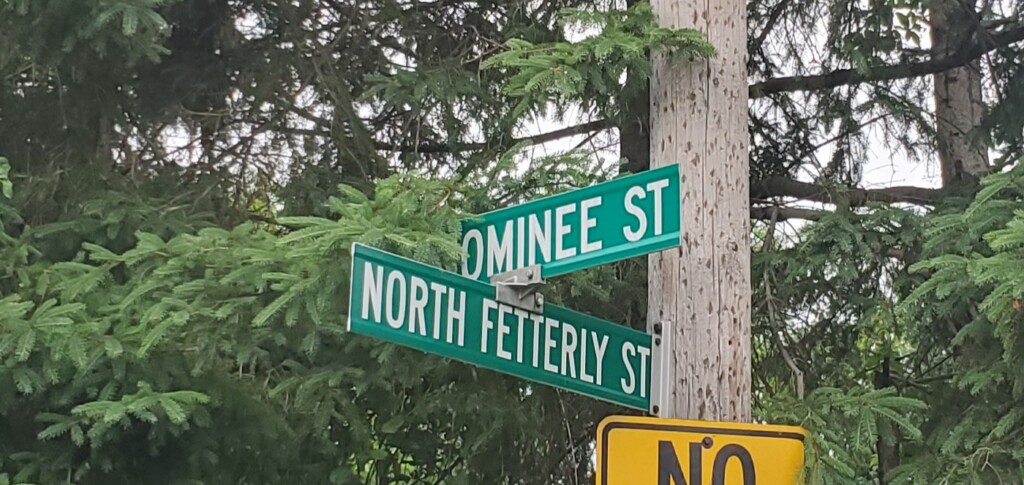
Fetterly Street runs S-N off Manominee Street.
To trace the origin of the name given to Fetterly Street we have to dip way back in Huntsville’s history.
In fact, the person after whom the street is named is the Huntsville resident whose roots go further back in the area’s history than any other resident whose name appears on one of our street signs.
Let’s begin this journey in Albany, New York when, in 1786, a man by the name of Philip Fetterly was born. The very next year, another Albany family, the Ouderkirks, welcomed a new daughter by the name of Magdalena (“Laney”) into the world.
Eventually, Philip and Magdalena married one another and made their way to a backwoods emerging community that would eventually have the name of Huntsville, Ontario. The reason for the move seems to be connected to Magdalena’s relative, William Ouderkirk, who had set up residence along Huntsville’s Muskoka River under a squatters’ right.
Philip and Magdalena raised eleven children including a son, John Peter Fetterly, who was born in the year 1807 in what would become Huntsville.
At some point, the Fetterly family resided in Willamsburgh, Ontario and it was there where young John met Anna Hanes who was born in Williamsburgh in 1813. John and Anna were married in Anna’s birth town in 1830 but must have decided that the potential for a good life resided along the shores of the Muskoka River because they relocated to John’s birth place and followed John’s parents’ propagation journey by raising eleven children of their own.
John Fetterly had a hand in building Muskoka’s first water-powered sawmill in Bracebridge. He then applied his construction skills in the building of a water-powered mill at the current location of the Brunel Locks. The Locks Mill was completed in 1871 on land that Fetterly owned.
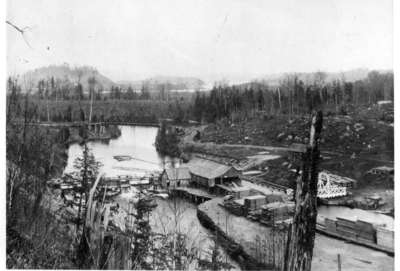
Above: The Locks Mill was constructed in 1871 by John Fetterly who sold it to the Cottrill family in 1907. It closed in 1954 when part of the mill foundation collapsed. It was the longest operating waterpowerd sawmill in Muskoka. After the mill closed, the Department of Public works took over the site, making it into a park. (Photo and details courtesy of Muskoka Digital Archives. )
John’s philanthropic nature came to Huntsville’s assistance when he offered a piece of land on his Huntsville property to the Methodists for the placement of the Methodist Cemetery which is now known as the Locks Cemetery. John Fetterly, in 1876, was a trustee of the Methodist Church.
John passed away in Huntsville in 1891 with Anna living only one year longer.
See more Saturday Streetscapes here.
Michael Walmsley is a retired elementary school principal who resides in Huntsville. He enjoys looking at things with a bit of “outside-the-box” perspective and totally believes in living today with a hand on the past and an eye on the future. He has published articles in Kanawa and Adventure Kayak magazines and has recently published a book entitled The Joy of Kayaking – Including the Kayak Quiz.
During this past year, as president of the PROBUS Club of Muskoka North, he has written a weekly article to the club’s membership which has included a focus on Huntsville’s streets. These articles have been combined into book form which will be published in the summer of 2021.
Don’t miss out on Doppler!
Sign up here to receive our email digest with links to our most recent stories.
Local news in your inbox so you don’t miss anything!
Click here to support local news
Thanks for sharing my great great-grandfather’s story (John Peter Fetterly).