
This is the second in a two-part series on the good, the bad and the ugly at Rio 2016 from a Canadian perspective. If you missed the good and the bad, read it here.
With any Olympic Games, there usually becomes a story that symbolizes the achievement of an entire nation, and resonates in our collective memories as the defining moment of the competition.
We prefer to remember the good. Ask any Canadian about the Vancouver Games in 2010, and most will tell you exactly where they were and who they were with when Sidney Crosby scored the golden goal in an emotion-filled overtime final over the United States. In 2012, it was balancing the good with the bad, checking the pride of winning our first Olympic medal in women’s soccer with the knowledge that the chance to play for gold was brutally ripped away by terrible officiating. In 2014, it was again the double gold success of the men and women’s ice hockey teams, who both survived one-goal games against our arch-rivals south of the border (although in this town, those Olympics will forever be remembered as Dara Howell’s rise to stardom).
As years go by, forgotten among the success stories are the unfortunate, embarrassing and tragic moments that inevitably accompany each rendition of the Olympics. The good sticks out in our minds while the bad, such as the death of Georgian Olympic Luge slider Nodar Kumaritashvili at the Whistler Sliding Centre in 2010, or the disqualification of the Canadian men’s 4x100m relay team due to a technicality in London, or the abysmal conditions of the athlete’s village in Sochi, fade into the background.
So how will we remember the Rio Games? Likely it will once again be the performances of our athletes, like Penny Oleksiak and Andre De Grasse and the entire women’s soccer and rugby teams, for their accomplishments in the field and the Canadian pride they inspired back home, and rightly so. But there is another element to these Games, an ugly one, that could very well enter into the conversation when we look back at the 31st Olympiad in years to come.
For an event inundated in controversy before the opening ceremonies even began, the last two weeks have seen a steady barrage of negative commentary surrounding Brazil, with much of it coming from the notorious online platform – Twitter.
Gone are the days when a well-worded editorial letter, or a strongly written public address at a town hall meeting, were the best ways of expressing your opinions to your peers. In this day and age, these thoughts can be expressed in real time, arranged into 140-character bundles for all the world to see. And for an international event with the goal of uniting all people and building bridges between all cultures, much of the Twitter commentary has been reprehensible.

Gabby Douglas has had to endure online racism, misogyny and hate throughout the Olympic Games, despite being a repeat gold medalist for Team USA
The most obvious example of this has been the slandering of American gymnast and gold-medalist Gabby Douglas, who was widely criticized for not smiling or holding her hand over her heart during the American national anthem. The bullying continued after photos emerged of Gabby watching her teammates perform with a neutral expression on her face, inspiring the hashtag #CrabbyGabby, and prompting Gabby’s mother to implore the public on national television to treat her daughter with respect.
Hitting a little closer to home for Canadians were the hateful messages directed at the ‘multinational’ couple of Ashton Eaton (Decathalon gold medallist, representing USA) and Brianne Theisen-Eaton (Heptathon bronze medallist, representing Canada). The Eatons cheered each other on passionately during their respective events, as good spouses do, while internet trolls on both sides of the border called out the athletes as ‘traitors’ for rooting for a country other then their own, and cheering for their partners over their compatriots. The constant vilification and trash-talking incited Ashton to send out this statement from his personal Twitter account:
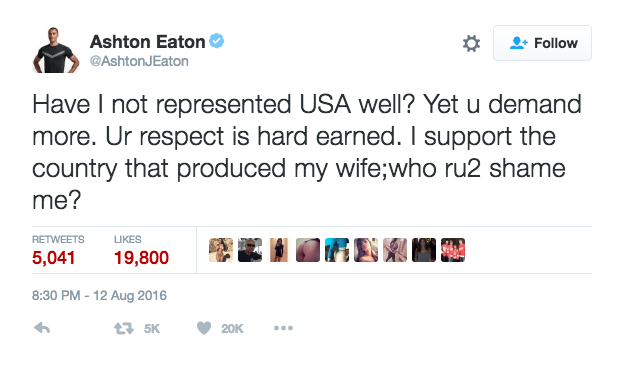
Ashton Eaton responds to online critics through his Twitter account
On a more personal level, I was deeply saddened with the amount of criticism directed towards broadcaster Elliotte Friedman, after the Hockey Night in Canada icon confused American swimmers Ryan Lochte and Michael Phelps in the men’s 200m Individual Medley swimming final. Having met Elliotte on several occasions, including a Q&A session while I was in journalism school in Toronto, I have come to the understanding that not only is he a consummate professional who puts the utmost amount of time and attention into his work, he is also a proud Canadian who does a tremendous job representing our country while abroad. To see him torn down by so many nameless, faceless critics (and furthermore, to see so many media outlets including several major networks here in Canada pick up this “story” and drag him through the mud for the sake of clicks) will certainly stand out to me as one of the low points of these Olympics.
But of all the ugly headlines and uncomfortable moments, perhaps what will be remembered as the worst story of all to come out of Rio is the one that turned out to be a giant lie.
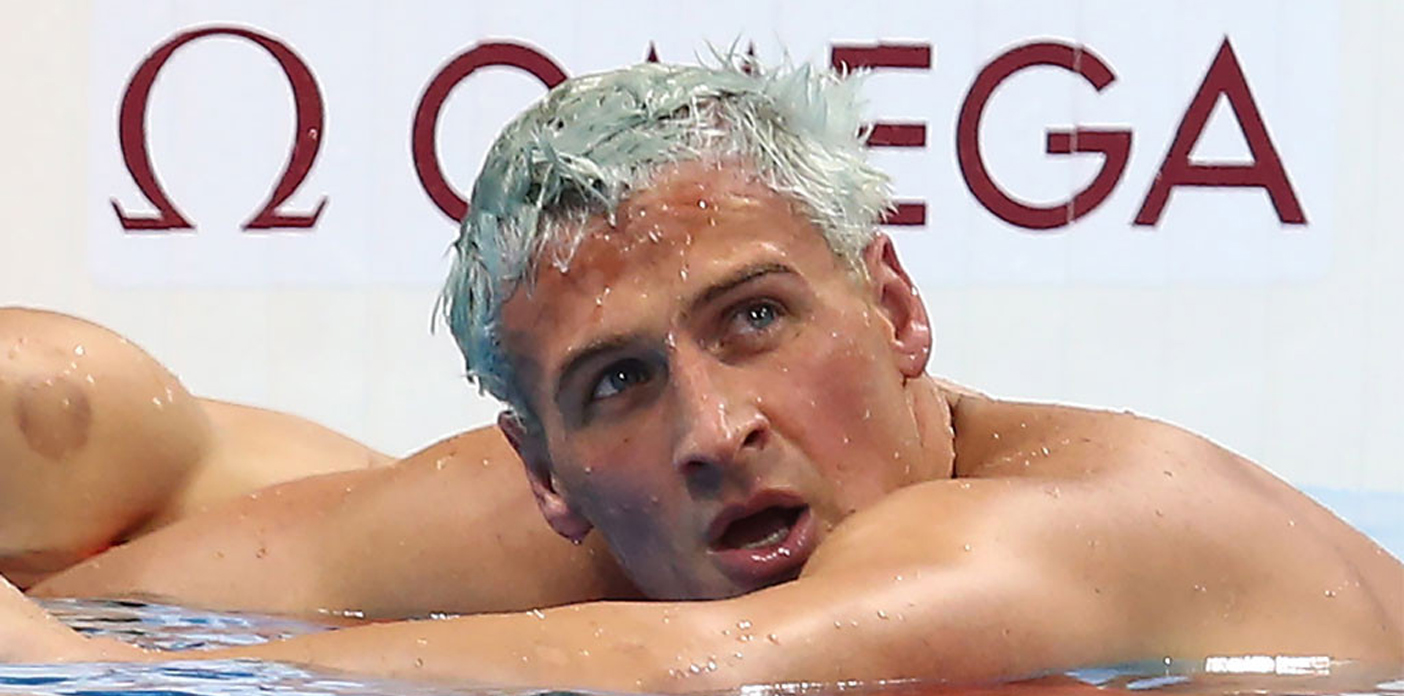
Ryan Lochte has done everything in his power to cement himself as the biggest villain of the Rio Games, as his party-like attitude and lack of moral compass have once again landed the American gold medalist in hot water. At this point, everyone knows the story; that Lochte and his teammates were supposedly robbed at gunpoint by men dressed as police officers. Only, as further details continued to emerge in what was already a very unusual tale (given the fact that all four men retained their cell phones, watches and IDs throughout the ordeal), it turned out that it wasn’t a robbery at all. Instead, the four men were returning to the Olympic Village from a late night party when Lochte childishly vandalized a local gas station bathroom, and were subsequently detained by security before negotiating a cash payment for the damages.
But what should have died then and there, as a non-story about a couple of guys having too much to drink and acting like idiots in a foreign country, instead became national headlines later that morning when Lochte reported to police that he and his teammates had actually been mugged.
In an interview with NBC News, the US swimmer fabricated the details from the scene, describing how one of his attackers “pulled out his gun, he cocked it, put it to my forehead, and he said, ‘Get down,’ and I put my hands up. I was like ‘whatever.’ He took our money, he took my wallet — he left my cell phone, he left my credentials.”
The picture Lochte painted that morning of an innocent group beset by one of Rio’s notorious criminal gangs fit right in with much of the media coverage depicting Brazil as a dangerous and unstable country, right down to the corruption element of being attacked by people wearing police uniforms. It perpetuated the horror the international community felt when mutilated body parts washed ashore near Olympic venues before the Games even started, and further strengthened the position of those who said Brazil was too insecure and risky a location to host an event of this magnitude. It tarnished the efforts of tens of thousands of dedicated volunteers and officials, and the reputations of millions of Brazilians, who had worked tirelessly to host a safe and secure Olympics, all because a 32-year-old swimmer and his friends didn’t want to own up to their own drunken antics. And unfortunately, for many people it will end up being the first story to come to mind in years to come when looking back at the Rio Games.
Don’t miss out on Doppler! Sign up for our free, twice-weekly newsletter here.
Well said, Jacob! Personally, I am against social media being so accessible. I am not an elitist, but perhaps one should have to apply for a broadcaster’s licence before disseminating absolute drivel. With complete impunity, they denigrate whomsoever they feel like at the moment. What gives them the right? Why should people whose worst sin is representing their country endure these hurtful comments? Athletes in the future may well think twice before exposing themselves to the international spotlight: and all of us, including the athletes, will be the poorer for it.