
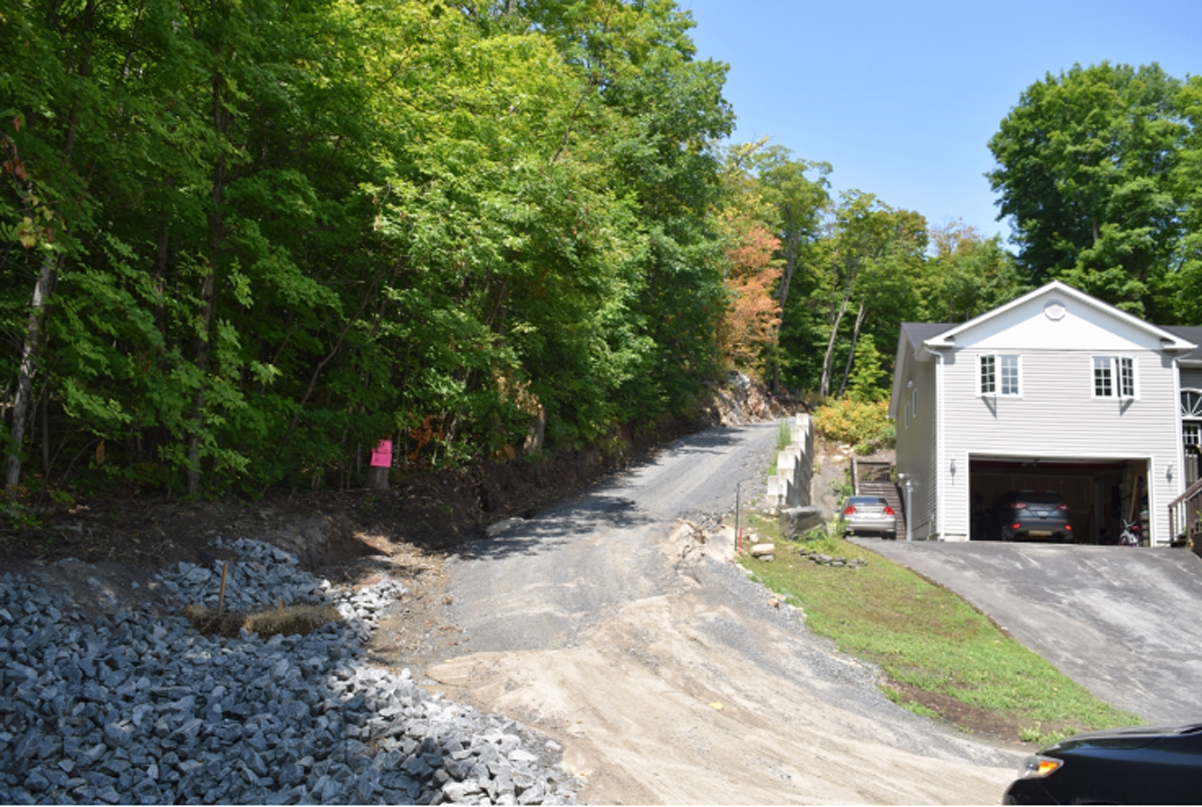
A property owner at 410 Indian Trail was before Huntsville’s Committee of Adjustment on Aug. 15, asking to be given permission to proceed with the development of a single residential home on a vacant lot without having to connect to costly municipal water and sewer services.
The vacant lot is approximately 3.27 hectares in size with 62 metres of frontage on Bayshore Boulevard. The lot has a flat building area in the centre and then slopes steeply to the front and back lot lines. It is accessed through a registered right-of-way over 400 Indian Trail, explained Huntsville Planner Curtis Syvret.
In this case, although full municipal services are located nearby, there are extreme slopes on the north side of the lot abutting Bayshore Boulevard and the distance to install pipes from Indian Trial to the proposed dwelling location is considerable (122 metres).Huntsville Planner Curtis Syvret
Committee also heard that there have been repeated attempts to develop the property by different owners and that it would cost the current owner an estimated $180,000 to hook up to services.
The District of Muskoka has granted the owner an extension to mandatory service connection to July 10, 2028, although it is not clear what would happen after that point. Deputy-Mayor Karin Terziano asked whether in ten years the applicant could then apply for yet another extension. Syvret said he wasn’t sure as granting extensions are a fairly new process at the District.
“The Official Plan and the District bylaw allow for situations where it’s uneconomical to provide municipal services to the lot. As such there’s ample space on the lot for a well and septic system,” John Gallagher, planning consultant for the applicant told committee.
Huntsville staff recommended approval for the development to proceed on private services on the condition that the applicant gets an entrance permit for the driveway, which has been in place for about 12 years.
Committee members wondered how trees had already been cleared for a building envelope without any approvals being in place. They were reminded by staff that Huntsville does not have a tree-cutting bylaw.
Two neighbouring residents were before committee expressing concerns about run-off from the development impacting their property and committee entertained the idea of requiring the applicant to provide a storm water management plan.
Gallagher told committee that the applicant had already spent $10,000 on engineering for the driveway to ensure runoff would be diverted. He also said the cost of improvements to the driveway would be anywhere from $80,000 to $100,000. “We all know that the houses at the bottom are at the bottom of a hill and it currently drains that way,” Gallagher explained. “What we’re saying is that with the engineered design that we have of the driveway, we’re picking up additional runoff and directing it down the driveway and over along the west boundary of the right-of-way there, away from the residents.”
“My client has done a fair bit of engineering already and to request a storm water management (plan) on a single family dwelling of about 2000 (square) feet on eight acres, I’m pretty sure any engineer would say that it wouldn’t be warranted given that we’re not planning on paving eight acres of land and increasing the intensity by putting up a single family dwelling with an attached garage at the top of the hill,” said Gallagher, reiterating that the drainage would be directed down the sides of a ditch on the west side of the driveway.
Committee heard that through the building permit process staff would be looking for an engineered drainage plan, which is typically the runoff from the building itself, while a plan is already in place for the runoff from the road. If the Chief Building Official determines at that point that a building permit cannot be granted without a storm water management plan, then one can be requested.
“And we’re setting up something to protect the neighbours that way,” added Terziano.
In the end, committee approved an exemption to the comprehensive zoning bylaw allowing for the development to proceed on private services, conditional on an entrance permit being issued for the lot.
Don’t miss out on Doppler! Sign up for our free newsletter here.
Sometimes, Planning Committee astounds. They make a correct decision regarding the innate stupidity of a water/sewer hook-up: but then they proceed to their own potential stupidity of requiring a stormwater management plan. As the Law of Riparian Rights grants the property owner residing on higher land, the inexorable right to drain to adjacent owners residing on lower land; that problem is obviated. The only exception is when stormwater is channelized (in this case by the entrance/ditch); but as it has been routed away from the adjacent owners, some token erosion protection should suffice.
.
But then to require an “engineered drainage plan” for the building runoff; while still retaining the stormwater management plan requirement in your back pocket is beyond belief. This is a relatively modest home. Why should the owner be liable for costs approaching the cost of the residence? He should just let his gutter downspouts drain to an underground cistern…end of story.
.
I’m sorry, but this is an outrageous example of government run amok.