
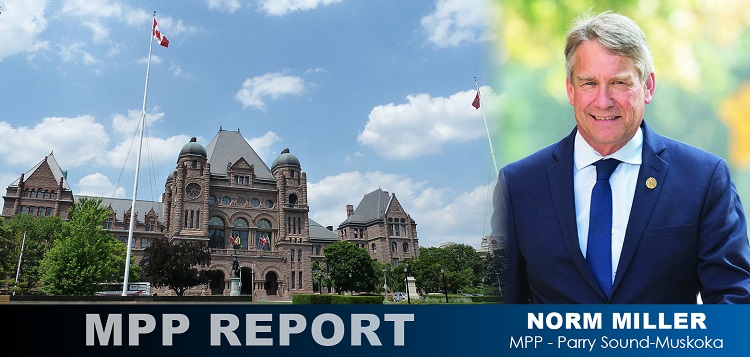
By Parry Sound-Muskoka MPP Norm Miller
While acknowledging that the pandemic is not over, with more than 83 per cent of eligible Ontarians fully vaccinated, it is time to focus on Ontario’s economic recovery. The unprecedented spending over the past 18 months now presents Ontario with a unique set of fiscal challenges. Our government remains committed to an economic and fiscal recovery that is fueled by economic growth, not painful tax hikes or spending cuts.
In the Speech from the Throne that opened the current session of Parliament earlier this month, the Lieutenant Governor of Ontario, Hon. Elizabeth Dowdeswell, explained that we owe Ontario’s businesses stability, so the government is committed to fiscal recovery and long-term economic growth driven by investment. The government is pursuing this goal by investing in infrastructure, supporting the tourism sector, and encouraging external investment in Ontario.
Investing in infrastructure
Locally, there are many new and ongoing infrastructure projects that will create jobs and build up our communities, including:
- The new Bracebridge Multi-Use Community Centre, boasting a 1,000 seat arena, a modern public library, a shared community hall, accessible indoor multi-use field house, and more, planning stage to be completed September 2022.
- The Huntsville Golden Pheasant Wastewater Treatment Plant upgrade project to be completed in 2021.
- The construction of 12 affordable housing units geared towards homeless individuals at 49 Pine Street in Bracebridge to be completed January 2022.
- The expansion of St. Mary’s Catholic Elementary School in Huntsville, planning stage to be completed December 2021.
- The expansion of Gravenhurst Public Elementary School, planning stage to be completed January, 2022.
- The bridge rehabilitation project on the Highway 11/South Junction Muskoka Road 3 interchange and the Muskoka Road 2 underpass, planning stage to be completed October 2022.
As we near the end of the pandemic, investing in infrastructure creates an environment that supports growth. Rather than reducing spending, investing in these critical projects creates jobs and promotes long-term, sustainable progress.
Supporting the tourism sector
We all know that tourism is a big part of our local economy. The government is investing further in the tourism sector to help key businesses survive the end of the pandemic and thrive long-term.
The tourism sector was hit heavily by the pandemic closures and restrictions, so the Ontario Tourism Recovery Program was announced to stabilize the industry and encourage growth.
In this program, the government is investing $100 million to help for-profit tourism businesses that had to fully or partially shut down during the pandemic, including accommodations, attractions, and transportation businesses. The grant will help these businesses re-open safely, create and retain jobs, and develop innovative tourism experiences to rebuild the sector even stronger and encourage further economic growth.
Eligible businesses are invited to apply for the grant between October 13 and November 10, 2021. Awarded funding can be applied to expenses like staff salaries, operating costs, costs related to strengthening health and safety measures, marketing and website development, and tourism experience improvements. By investing in the tourism sector now, the government is taking a proactive approach to rebuilding Ontario’s economy, allowing investment to be the driving force in creating growth.
Encouraging external investment in Ontario
Finally, our government is working to attract investment to Ontario. Last week, Minister of Economic Development, Job Creation and Trade, Vic Fedeli, launched Unleashing Ontario, which details the benefits of locating businesses in Ontario.
Nationally, Canada is an incredibly stable and competitive business environment. In order to attract more businesses to Ontario, the government is lowering the cost of doing business in our province. Some of the steps we have taken to make our province more attractive to international investment include:
- Reducing Workplace Safety Insurance Board premiums by 47 per cent for an annual savings of over $2.2 billion without any reduction to the benefits.
- Introducing a capital cost allowance to permit Ontario businesses to write-off new equipment, in-year, resulting in almost $1 billion in annual savings.
- Creating various red-tape and burden reduction programs, generating $330 million in savings annually.
Overall, our government has reduced the cost of doing business in Ontario by $7 billion a year to create an environment that not only supports Ontario’s existing businesses through the end of the pandemic, but encourages long-term growth and future external investment. Recognizing the impact that COVID-19 has had on our lives and communities, the government is committed to fiscal recovery that is driven by investment, allowing the businesses that call Ontario home to thrive in the future.
I understand the pandemic has created financial challenges for many families. All these steps are designed to create jobs and drive economic growth that should help families, businesses, and the province as a whole recover from the economic impacts of COVID-19.
Beyond these steps the government is taking, there are two things you can do to help our economy recover. First of all, get vaccinated if you have not already and continue to follow public health advice like masking and washing your hands frequently. Secondly, as much as you can, support your community by purchasing locally-made products from local businesses.
Photo of MPP Norm Miller is courtesy of his office. Queen’s Park photo “June 2012 Ontario Legislature Toronto” by Priscilla Jordão, via Wikimedia Commons, is licensed under CC BY 2.0 / Cropped from original.
Don’t miss out on Doppler!
Sign up here to receive our email digest with links to our most recent stories.
Local news in your inbox so you don’t miss anything!
Click here to support local news
Well said Mr. Logagianes!! It is unfathomable that there was no mention of increasing supports to our Health Care System. Always, just take aways!!
But on top of that, to strip the Workplace Safety Insurance Board of $2.2 Billion of income, and to say “without a reduction of benefits” means the deficit has just grown another $2.2 Billion. And for what, to attract international business, and what about existing businesses? If this ploy is as successful as “Mission China”, we can look forward to more job losses!
After cancelling 732 renewable energy projects when you got elected, why didn’t you keep those projects from a multitude of international businesses! Plus what international business wants to do business with a Province who at any moment cancels projects.
Finally, “red-tape and burden reduction programs” without saying what those programs are, leaves me to think… farmland or wetland protections (from Highways like the proposed 413 and Holland Marsh Hwy), waterfront protections or some labour related protections. Who knows?
Mr. Logagianes, Very well stated. 100% agreement from me.
Many of the decisions of the MH government in the ’90s have had devastating effects in the long term for health and education.
DF government is predictably blinded by the same miasma. After all, DF has been tutored by MH, what could we expect?
Conservatives have and continue to Sell anything owned or operated under public aegis: farm land for highways, Home Care, LTC homes, OLG, Hwy 407, you add to the list. Several healthcare services run for-profit with taxpayer money.
The other message I am hearing from Federal Conservatives (as a whole), is that the needs of individuals/communities are ignored to protect the “individual rights” of those MPs who will not disclose their vaccination status. They seem to be More Equal than others, definitely More than the common man, woman, and child in our country. What a shame.
I think this list of spending priorities overshadows the problems facing all rural residents of Ontario. Replacing crumbling infrastructure is all well and good if healthcare was not facing a crisis of immense proportions. The rationing of healthcare is having a devastating effect on the overall health of the province as we are witnessing first hand. All hospitals in rural Ontario lack diagnostic equipment and trained staff .
Where are the necessary investments in Rural Ontario Hospitals and Long Term Care facilities across the province? Homecare in Muskoka does not have the manpower or the resources to address the needs of its residents. How will the province address staffing shortages in our strained care systems created by the mandatory vaccine protocol ?
Access to healthcare needs to be addressed now more than ever are lives depend on it.
Rationing healthcare has had a devastating effect on people suffering with health related issues. We enforce cruel and inhumane punishment when it comes to animals should that not also apply to people? Subjecting people to a series of tests stretched out over months to determine a course of action only to be put on a wait list to see a specialist can be devastating if your health is compromised in any way. Tests that can be completed in a day at a properly staffed and equipped hospital facility. (ie. BTW that refers to most of the Hospitals in the GTA).
Waiting months for a prognosis is wrong in so many ways from a mental and physical perspective. We all deserve better but we lack the leadership needed to tackle a problem that has been years in the making.