
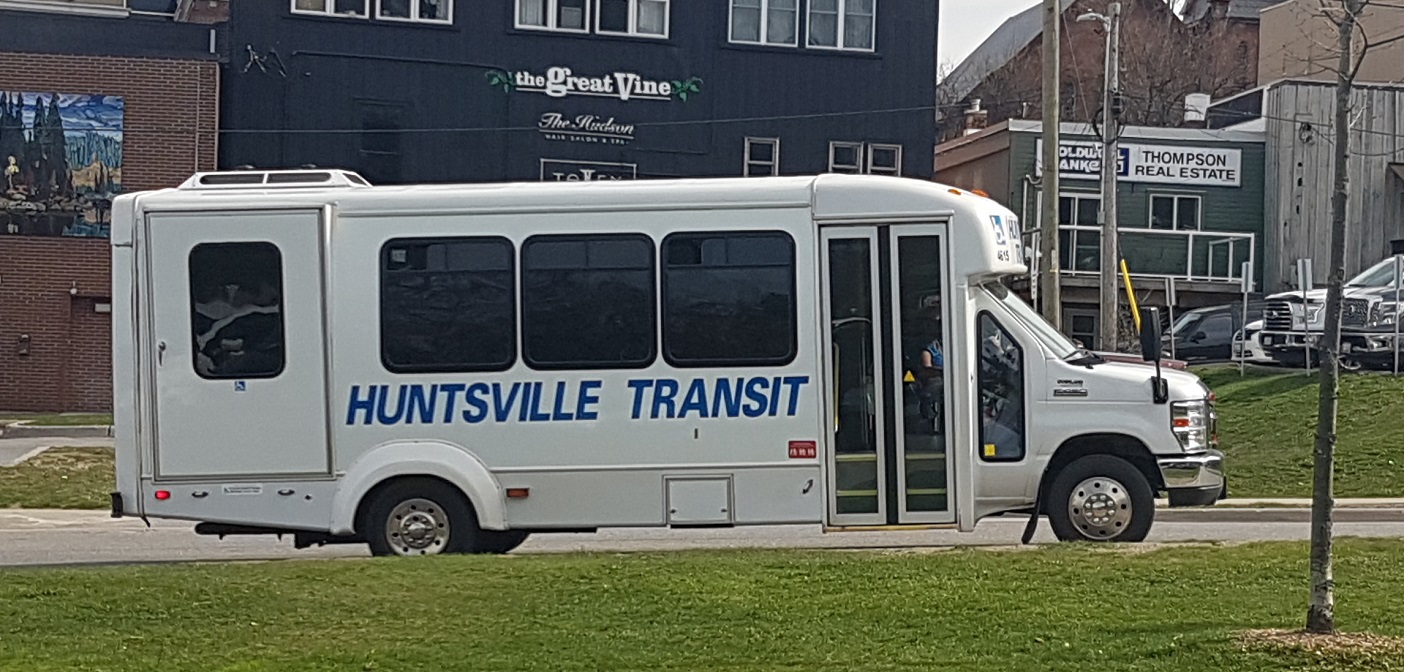
More frequent and expanded transit service that would have made the system more convenient for riders was scheduled to begin in September, but the need for an additional $100,000 to run the service has put those plans on hold.
The Town of Huntsville’s Director of Operations and Protective Services, Steve Hernen, broke the news to the Operations and Protective Services Committee on July 24.
In its 2019 budget deliberations, Huntsville Town Council had approved the creation of two transit routes, each on a one-hour loop for in-town service. The service coverage was to also expand to include Muskoka Road 3 North and Hidden Valley with each of those areas having transit service every two hours. Huntsville Transit’s specialized service—which will pick up riders at their door with 24-hours notice—was to be expanded to match this change to the regular service.
The updated service was projected to cost an additional $140,000, but an increase in service hours and a proposed increase in the contractor’s hourly rates have added another $100,000 to that total. That brings the annual cost to taxpayers to roughly $360,000 after fares and grants are accounted for. The actual cost to run the system would be just over $700,000 each year, noted Hernen.
Hernen said that he checked with other service providers and the contractor’s rate is “more than competitive.”
One of the complaints made by transit riders in a survey that was part of a transit needs assessment conducted in 2018 was the unreliability and inconvenience of the current system. The Huntsville bus runs on a two-hour loop, a long wait-time for riders. On Saturdays, the regular bus runs the specialized service as well, which means it can be late arriving at its regular stops, making it a poor option for anyone trying to get to work or to an appointment on time.
“Through all the consultations that took place, people said that if it was not on a two-hour loop, if it was on a one-hour loop, they would use the bus,” said Hernen. “If [we] build it will they come? We don’t know. But we certainly heard from the user groups that are using it, that was their frustration with it.”
Councillor Tim Withey asked if the proposed service upgrade was an all-or-none proposition, or if the one-hour loop could be implemented without the expansion to Muskoka Road 3 and Hidden Valley.
“To get the one hour loop in town, we are going to need two buses,” explained Hernen. “But because there is some down time on those two buses we are able to expand the route… If we cut those two areas out we would still need two buses in town to do a one-hour loop unless we tighten that loop really up. So we’ve got to look at other options.” Hernen noted that staff are also looking at other options for the specialized transit service.
Councillor Dan Armour wondered if it made sense for the Town to operate its own transit system with its own staff, rather than hiring a contractor.
“We have asked ourselves that question too,” said Hernen, adding that the capital cost of purchasing and maintaining a bus “is huge.”
For now, staff have been directed to put the service expansion on hold and to look at other possible options. They will report back to committee with their findings.
“I hope we find a way to figure this out,” said Withey. “To me this is one of core reasons municipalities exist, and essential to a town’s life.”
Don’t miss out on Doppler! Sign up for our free newsletter here.
Check out the most recent Transit Study on the town’s website. It sets out a five year plan for cost and changes to transit. Worth reading whether you end up agreeing with it or not. Given that transit had not changed (route and fare) since 2006, it was high time for an update. Missing from the article is mention of the province’s subsidy based on ridership that the town receives.
When one looks at the numbers, very briefly and in a sort of cursory manner I admit, I have to wonder about the bus service.
First off, I know it gets used but very often I see that bus running with just one or two people on it.
This prompts the question of would it maybe be possible to have a taxi company contract with the town to handle calls within a defined area for a fixed price, the customer to pay a fee similar to bus fare and the town to pick up the balance???
This would have the advantage that the customer could go direct from one location to the destination without having to travel the “bus route” and they could go essentially when they needed to go, again without waiting for the bus.
If the taxi contract was discounted from the regular fare, as it would be due to the volume and guaranteed usage, this cost might be less than that of bus service.
If no customers nothing has to run anywhere and one can run a small taxi a lot further on a liter of fuel than a bus of course, so maybe there would be a fuel and thus a carbon saving as well.
I know there would be a bunch of questions to answer but maybe this is worth looking at???
Would it be possible to tighten up the in-town loop; and use school buses or taxis for the extension? Another possibility would be to use electric scooters for the in-town loop; and to use one additional bus for the extension. Calgary has been very successful with their 1000 scooters (increased this year from 300). Their current rate is $1.00 per trip + $0.30 per minute. This could possibly be temporarily subsidized;and maybe the per-minute cost could be changed to per-kilometre to prevent dangerous driving.
.
It seems a shame to devote a large portion of our budget to a relatively small demographic (ballplayers); and to ignore seniors, tourists, and others who just have to get around town. The former solution would appease the taxi drivers for lost fares: The latter would ameliorate our seasonal parking problem.