
By Hugh Holland
The good news is that finally, after three decades of warnings by the world’s top climate experts, most citizens and leaders understand that climate change is today’s biggest global threat. Average global temperature is rising 10,000 times faster than can be attributed to the earth’s natural cycles. Left unabated, climate change would impact every aspect of life on the planet. But many are still trying to understand how to best mitigate the problem. Hopefully this article provides clarity on some questions.
What is the root cause of today’s climate change?
Before the industrial revolution of the 1800s, there were one billion people using mostly renewable energy with few harmful emissions. The industrial revolution provided major improvements in quality of life and life expectancy. As shown below, that resulted in exponential growth in population, energy consumption, and emissions. Simply put, there are too many people using too much of the wrong stuff. Resulting emissions are accumulating in the earth’s atmosphere and trapping heat like a greenhouse.
How big is the problem?
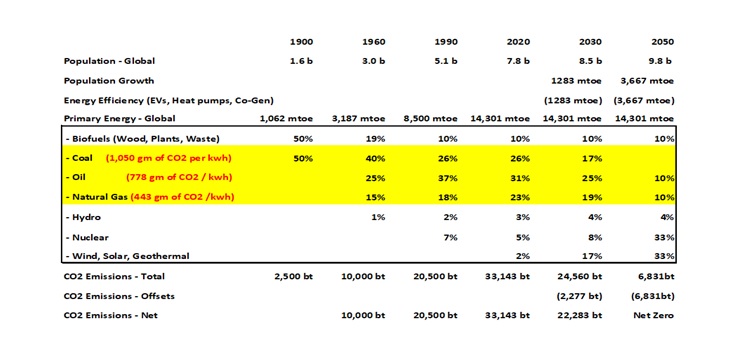
The chart below shows the enormous size of the problem. By 1960, global population had tripled from 1800, and energy consumption had risen to 3,187 mtoe (million tonnes of oil equivalent) with 80 per cent coming from fossil fuels. Sixty years later, we are consuming 14,301 mtoe, 80 per cent is still coming from fossil fuels, and emissions have reached 33,143 billion tonnes per year.
Will replacement of fossil fuels alone solve the problem?
An energy revolution is essential. Fossil fuels have been the mainstay of the world’s energy supply for 100 years. But they are finite resources.
We now understand that we must aggressively transition to clean energy to achieve net-zero emissions by 2050. And we must scale up on new energy before we run out of the finite old energy. Cutting off fossil fuels before they can be replaced would create an energy shortage with a disproportionate impact on the most vulnerable people in every country.
As shown on the chart, we must at the same time deploy more energy-efficient technologies. Battery-electric vehicles reduce energy consumption by cars and light trucks by 70 per cent. Heat pumps, and co-generation of electricity and heat will reduce energy consumption for heating by 30 per cent. It is unlikely we can completely replace oil and gas by 2050, so as shown on the chart, we must offset emissions from the remaining 10 per cent of oil and gas consumption by capturing their emissions and turning them into useful products such as carbon-fiber materials and carbon-neutral liquid aircraft fuels. Canada will be needed as one of only five countries that can supply that last 10 per cent of oil and gas.
What are the pros and cons of counting on renewable energy?
Hydro and geothermal potential is limited by geography. Every year there are advancements in wind and solar power, but the basic limitations remain. Solar power output is equivalent to 10 hours per day in June in Madrid, but only one hour per day in December in Toronto or Berlin. In Canada, wind power output is three times higher in January than in June. Wind and solar energy have become low-cost where they can be used when they are producing at capacity (e.g. to supply mid-day peak demand, or for making clean hydrogen fuel), but they become high-cost when their output must be stored or backed-up for up to 85 per cent of the time. Some experts are predicting that the massive recycling costs for solar panels and wind turbine blades will double or triple the levelized lifetime cost of wind and solar power.
The use of shrinking agricultural land near growing high-population areas is a major limitation. While some people are opposed to the proposed short 2,000-acre Ontario Highway 413 bypass, they have not done the math to understand the amounts of land required for various sources of clean energy.
- 225 MWh from the Westinghouse Small Modular Reactor (nuclear) takes 15 acres (six per cent of one farm)
- 225 MWh from solar takes 17,325 acres or 70 farms or 1,155 times as much as the SMR
- 225 MWh from solar windows and roofs takes 2,475 acres or 165 times as much as the SMR (depends on spacing and orientation of buildings, latitude, seasons,
- back-up, storage, and cost)
- 225 MWh from wind impacts 27,778 acres or 112 farms (but crops can be grown around turbines)
- 225 MWh from a hybrid wind-solar farm impacts 11,363 acres of “non-agricultural” land
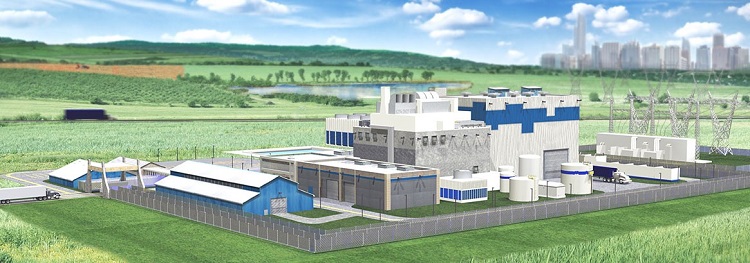
225 MWh Small Modular Reactor by Westinghouse on 15 acres of land suppling a city of 225,000 homes.
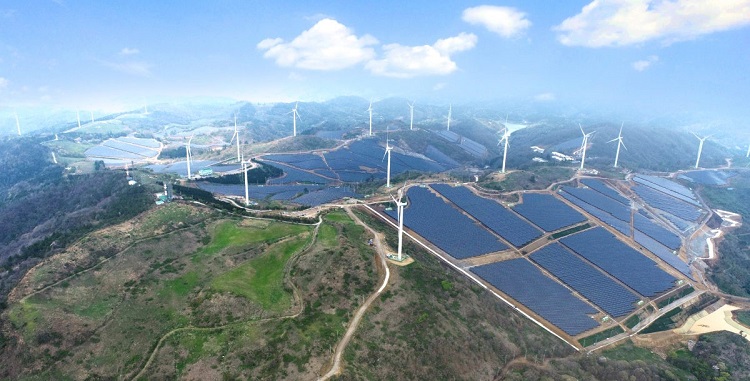
133 MWh Hybrid Wind-Solar plant on 6,716 non-agricultural acres supplying 133,000 homes in South Korea. When more wind and solar is used, more costly gas back-up and storage is required.
Wind and solar energy might some day suffice in a few high-sun and high-wind areas, but it is highly unlikely that wind, solar, hydro, and geothermal alone can replace fossil fuels over the next 30 years.
What are the pros and cons of nuclear energy?
- Existing large-scale nuclear reactors. These reactors have by far the best land use efficiency when compared in terms of kwh per square kilometer. They provide the lowest life-cycle cost for a reliable continuous supply of energy. They have multiple layers of safety features. A study by the WHO and the US CDC shows that existing large-scale reactors provide by far the safest form of energy when compared in terms of deaths per trillion kwh.
- The risk of radiation leaks or a reactor meltdown. There are 455 reactors currently operating safely in 25 countries. In 60 years of nuclear power there have been two meltdowns resulting from poor designs that are now well understood and preventable. Regular monitoring of people working and living within 25 kilometres of Ontario’s nuclear plants shows no impact on human health.
- The added potential of emerging small-scale nuclear reactors. There are some 40 projects underway to develop small modular nuclear reactors (SMRs) in 11 countries with decades of positive nuclear experience. Those projects are based on proven technology and are designed to be inherently fail-safe, to not require weapons-grade materials, and to use up existing stockpiles of partially spent fuel from earlier reactors. Their small size will enable them to be factory-produced for consistent quality, safety, lower cost, and rapid and wide deployment. They are expected to pass the extremely rigorous regulatory process and to be ready to commission in the mid to late 2020s.
- The risk of a growing amount of nuclear waste. If a resident of Ontario used nothing but nuclear energy for their lifetime, their personal volume of nuclear waste would be the size of an ice cube. Ontario has stored nuclear waste without incident for 50 years. Since most of the advanced reactors now under development will extract 80 per cent of the energy from their fuel vs five per cent from earlier reactors, the new reactors will re-use existing waste as fuel and dramatically reduce if not eliminate the amount and toxicity of nuclear waste requiring safe storage.
- The risk of nuclear fuel being side-tracked to make more nuclear weapons. Enriching uranium to the level required for nuclear weapons is not easily done. It requires expensive sophisticated equipment and scarce expertise. For 67 years since 1954, the Vienna-based International Atomic Energy Agency (IAEA) and the 1970 Treaty on the Non-proliferation of Nuclear Weapons (NPT) have kept the world’s nuclear weapons confined to only nine of 200 countries, while recognizing the right of countries to develop nuclear energy for peaceful purposes. In an ideal world, security conditions would enable existing weapons to be decommissioned to provide fuel for nuclear power plants.
Every source of clean energy comes with pros and cons and risks, but we will need all we can get from all of them. Much will be learned between now and 2030.
We must install every “practical” megawatt of hydro, geothermal, wind, and solar energy by 2050. But after Germany’s valiant 20-year attempt to replace nuclear power with wind and solar, fossil fuels still make up 77 per cent of their energy supply. The International Energy Agency is cautioning Spain to avoid following that path, even though solar is 50 per cent more productive in Spain than in Germany or Canada. The real-world evidence tells us it is highly unlikely that renewable wind, solar and hydro alone can get us to net-zero emissions by 2050.
The evidence also tells us that after 2030, advanced small modular nuclear reactors will be the safety net to fill the inevitable shortfalls, provided the risks of using more nuclear energy remain less than the risks of missing emissions and climate targets.
Don’t miss out on Doppler!
Sign up here to receive our email digest with links to our most recent stories.
Local news in your inbox so you don’t miss anything!
Click here to support local news
Mr. Holland, always great to learn something from your articles, much appreciated.
Good article Hugh. The bottom line is that when you add up all the costs, including the duplicate on demand backup power, a larger/more complex grid, shorter life span, huge waste disposal, then remove all the large state green energy subsidies, wind and solar are much more costly energy sources.
China dominates their global supply chains too, unlike nuclear, where Canada is self sufficient.
Too bad most media reporting doesn’t report most of these important facts.
Good article Hugh. I am a proponent of nuclear not only for base load but renewable energy along with hydro. The concern I have is what happens to these solar panels when their contract life cycle is done. We have a 10KW system with 52 panels that is getting near the end of use as well as the diverters that are beginning to break down. Battery storage for us is not a economical option. We use a place in North Palm Springs and I visit their massive wind farm out of curiosity each trip and am mind boggled at the amount of maintenance that is required to keep them going, especially the older ones. I would like to see the business case, if there is one. Not convinced that wind or solar is the way to go. Not only is it a blight on the landscape but the farm near us on Lake Erie has more wind downtime than uptime.
Good question Bill. According to Environment Canada, the sources of Canada’s emissions in 2017 were: 27% from oil and gas extraction and refining, 24% from transportation (buring oil), 12% from heating buildings (burning gas), 10% from electricity (mainly from burning coal in Alberta and Sask.) 10% from heavy industry (mining, steel, cement, chemicals), 10% from Agriculture (5% from growing plants to feed animals and humans and 5% from methane emissions from animals and manure), and 6% from light industry (manufacturing, forestry, and construction). We know how to elimiate or offset all of these emissions. We just need to get at it. That will cost a lot of money but will provide lots of good jobs.. It will ulimately cost a lot less than not doing it.
Hugh ,how about checking out the amount of greenhouse gas being released into the atmosphere by Giant , and I stress Giant , corporate meat packing farms ?
You might find their release even higher than those from carbon fuels !
P.S.: I am NOT talking about Family Farms !!!!