
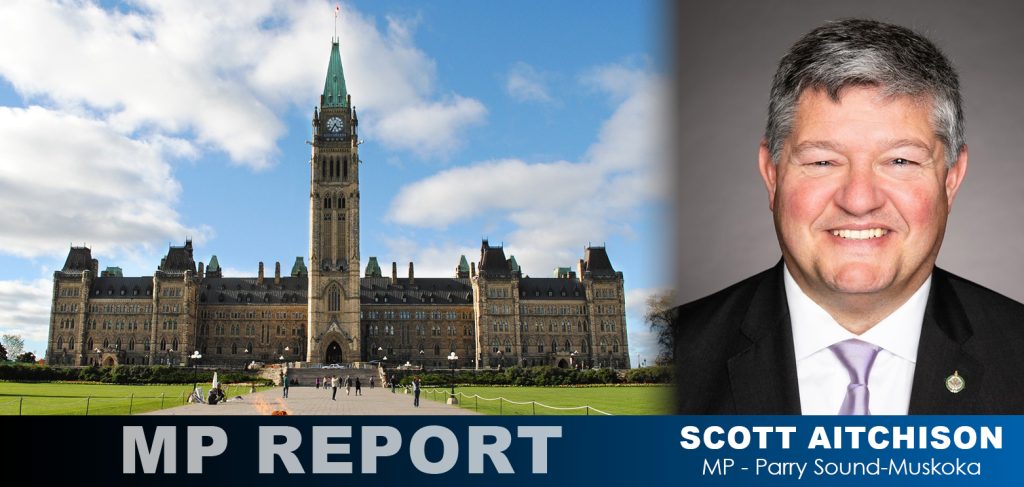
By Parry-Sound Muskoka MP Scott Aitchison
One of the most important things about our current public health crisis is maintaining good mental health.
We, as human beings, are social creatures by nature, so the lockdowns and personal isolating resulting from the COVID-19 pandemic have knocked a lot of us off our feet.
Mental health experts tell us that in times like this, people are more vulnerable to feelings of depression, anxiety, or even suicide. Workers have lost jobs, businesses are struggling to stay afloat, and families can’t pay their bills.
Meanwhile, many parents are facing the twin challenges of working from home, as well as having to home school their children.
At top of everything else, there is widespread fear of the unknown. What does the ‘new normal’ look like? What does the future hold?
Some of us are frustrated and even angry. Why does there seem to be one set of rules for some people, yet a different set of rules for others? We’ve all heard the stories of the families who were not able to be with a loved one when they died. Yet thousands can gather in our streets—seemingly with the tacit approval of some politicians and authorities.
These are certainly challenging times, my friends.
Last month in this space I called on folks to be kind. This month I am asking folks to think twice before judging someone. Think about the personal or professional challenges they might be facing. Think about how they might be struggling to get through this crisis.
We have strong mental health supports and resources in Parry Sound-Muskoka. We need to continue to build on our strengths and invest wisely in the future. Today’s public health crisis has proven things can change quickly, and dramatically.
One way to address this would be better coordination between the federal and provincial governments in terms of local mental health funding and service delivery. I also think we should look at breaking down silos locally.
I am also mindful of the mental health of First Nations residents in the Riding. We know from research that mental health needs are significant in First Nations communities.
Again, there is great work being done by physicians and counsellors in First Nations communities. Now is the time to build on that effort, by making strategic investments in psychiatric services and treatment.
I believe the worst is behind us. As individuals, and as a community, we are on the verge of starting to get on with our lives—albeit modified to adapt to the ‘new normal’ post-COVID.
While the current crisis has intensified and created additional mental health challenges, they won’t just disappear overnight. We will need to deal with the fallout, and we will need to invest in longer-term mental health supports to help folks get back on their feet.
Let me conclude by saying if you need help, get help. Depression and anxiety are illnesses, not weakness.
Reach out to the Muskoka-Parry Sound Chapter of the Canadian Mental Health Association at mps.cmha.ca for resources. If you can’t find help, give us a call (705-789-4640). We’ll go to bat for you and your family. We may not have all the answers, but we can certainly help you try to find them.
(Photo of Parliament Hill by festivio on Pixabay. Photo of Scott Aitchison courtesy of Scott Aitchison.)
Don’t miss out on Doppler!
Sign up here to receive our email digest with links to our most recent stories.
Local news in your inbox three times per week!
Click here to support local news
Good message, Scott, thank you.
Thank you for speaking up for those of us with mental health disabilities. It occurs to me that it’s not only those with chronic disabilities, or perhaps, periodic disabilities owing to the pandemic who have been affected. What about those who navigate the shutdown, and then are hit with PTSD? Fighting this disease is not unlike fighting a war; and we know that a lot of veterans suffer from the stress AFTER the immediate trauma has ended.
Thanks, Scott, for these good and kind thoughts on the psychological health of our riding.
Very good also for living long-term during the new normal will be government leadership and support at all levels in diversifying our economy – on the ground – in green and resilient ways: soft tech, cottage industries, local agriculture and small-scale processing, wasteless primary use value-added products, railway supply chain and passenger service, affordable housing, local practical education programs, business planning mentorship, continuing health network consolidation, Land Value Taxation and Guaranteed Basic Income for poverty relief, and green energy production.
In re-assessing our areas of weakness these days, we have a unique opportunity to radically adjust how we approach life together. Leadership toward revisioning and making strategic changes is vital to building new, and now essential resilience into our communities.