
By Ross Maund and Dave Wilkin
As the COVID-19 pandemic continues, unprecedented spending by the federal and provincial governments has steadily mounted. For the federal government, inflation adjusted, spending is topping amounts last experienced during World War II.
Ontario’s debt as of fiscal 2020/21 is estimated by RBC Economics at over $397 billion. To put that figure into perspective, in 2000/01 the debt stood at $132 billion, meaning debt growth of $265 billion in just over twenty years.
To understand this with a little more clarity, Ontario’s debt to GDP ratio has risen from 29.3 per cent to 47.0 per cent and the debt per capita has increased from $11,300 to $27,000—every Ontarian has seen a doubling of their share of provincial debt in just two decades. Additionally, the Federal Government debt is tracking to exceed 50 per cent of GDP next year, $30,000 of debt per person. This means a family of four has a combined federal and provincial government debt share of $230,000.
What is the point in raising these observations about financial circumstances and economic health other than to provide some understanding of the escalating debt both in real dollars and statistically? Well, over time the current financials and continuing deficits forecasted in the two years ahead will be such a financial albatross that we will have to adjust our expectations of government services, healthcare included, in the decades ahead.
This is certainly not a criticism of the ballooning expenditures necessary to combat COVID-19 and support Canadians, but it is important to understand that the reality of provincial and federal spending capacity will require significant rationalization downstream to manage debt servicing costs and reduce the accumulated debt.
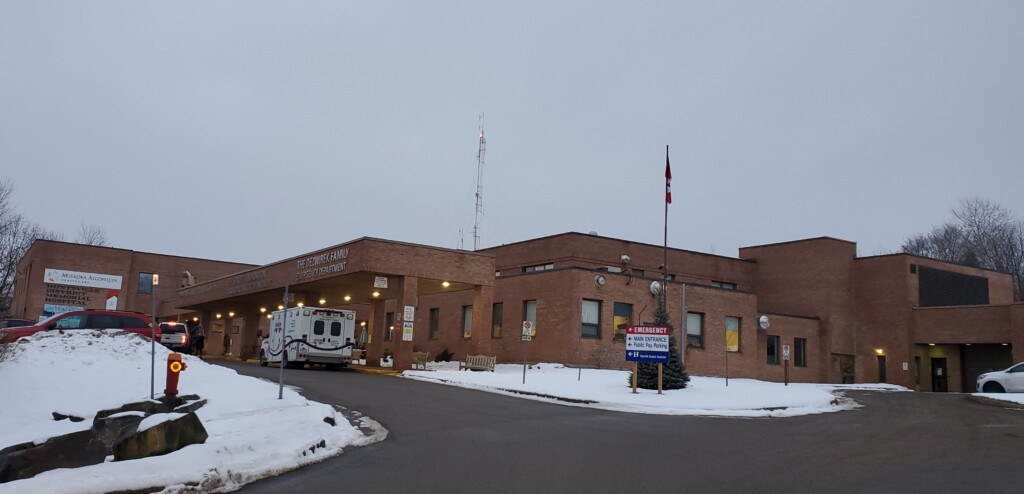
Why then would our Chief Executive Officer at Muskoka Algonquin Healthcare (MAHC) in recent articles continue politicking for two new hospitals in Muskoka? This posturing seemingly makes the case that COVID-19 in part justifies the organization’s plan submission that will cost upwards of $600 million before it’s completed, to replace Muskoka’s two hospitals, whose combined average age is at the provincial hospital average age.
On many levels, this thinking seems deaf to the reality of these times and environment in which we find ourselves today and into the foreseeable future. Many people, including us, over almost a decade of MAHC’s struggles in planning the hospital’s future, have advocated for a more pragmatic, timely, and affordable solution to meet the long-term interests and needs of Muskoka hospitals users. MAHC’s grandiose plans to build brand new are surely now over. The province’s hospital capital capacity was insufficient before the pandemic hit, now it’s far beyond reach to indulge this level of commitment.
Our hospitals need to be renovated with additional space and capacity to accommodate patient services now and for demand growth in the decades ahead. A renovated existing hospital solution is faster in bringing the much-needed upgraded facilities on-stream and would keep costs significantly lower, while aligning to and being respectful of Ontario’s fiscal reality. A more statespersonship approach by MAHC leadership would demonstrate to the provincial government that the organization is tied to the strategic realities of our times and that they fully understand the dilemma in which we now find ourselves. Advice to anyone in a senior officer role of a provincially funded entity is to operate today planning realistically for the future—be a cooperating partner of the province and not become an irritant.
It is inappropriate to leverage COVID-19 as additional justification for such a massive capital spend, especially when our region has to date, thankfully, been largely spared the high COVID-19 patient loads, both in real and statistical terms. It comes across as crass opportunism, unacceptable from publicly funded leaders.
COVID-19 has exposed many shortcomings in our healthcare system. Top among them are the large long-term care gaps and the importance of resilient domestic vaccine, drug, and PPE manufacturing and supply capacity. So too is the need for expanded front-line healthcare staff capacity, all fairly compensated and equipped with the best equipment and technology possible. Brand new replacement hospital builds are well down that priority list.
Leadership aligned to the environment and realities of our time should be a maxim for public comments and musings.
Ross Maund, retired career senior executive in health services
Dave Wilkin, retired senior IT executive, active consultant
Both are past MAHC board members and Huntsville residents
Don’t miss out on Doppler!
Sign up here to receive our email digest with links to our most recent stories.
Local news in your inbox three times per week!
Click here to support local news
Ray Vowels hid it wright on!
The specialty of our Hospitals should be identified.
We have Major Hospitals to support the Medium Hospitals with all there specialties.
The Medium Hospitals to support the smaler Hospitals .with there specialties .
No Hospital can be good at all things.
The function of a Hospital should be clearly identified with the back up system following it.
It is the responsibility of the Ministry of Health to identify the structure of our Health System .
Any other way , we are throwing our support into the wind .
If we were not supporting a Federal govt and a ,Provincial govt and a District govt and several municipal govts we would have the money to address our health care needs in Muskoka. So what we really need to consider as a region is how too make the best use of our tax dollars during these difficult times. Sadly the financial burden placed on our region supporting all these levels of govt is in my opinion unsustainable.
Too address the problems facing LTC and Healthcare we are going to need a lot more money. Having more political representation does not improve our ability to provide services in the region as we have all witnessed. Tough times call for drastic measures. The District and the town cannot even agree on how to share snow removal responsibility, and costs associated for the last 25 years.
Can we afford to support the District and all the Municipalities as well as address our overall health care needs? I personally believe it is not possible. More govt or adequate healthcare funding you can’t afford both any longer .
For clarity, let’s understand the scope of the challenge we are talking about here on aging hospital infrastructure. It’s not just 2 mid-sized hospitals in Muskoka and a small “0.15%” of Ontario’s total debt to replace them. That comparison is a very meaningless & very misleading way to characterize it. As pointed out, our 2 hospitals are average aged in the province. There are 232 other hospital sites around the province that have varying infrastructure needs and issues, some much worse than ours. If say just half of them were to be replaced with brand new facilities, at the latest build and space standards (as in MAHC’s plan), the total cost exceeds $90B in todays $ ( excluding certain higher future inflated hospital construction and equipment costs). That’s almost 1/4 of Ontario’s massive $400 B debt, and it’s 150 times higher that the 0.15% mentioned in a comment above.
Additionally, although aging hospitals are the largest, they are far from the only part of Ontario’s (& Canada’s) large infrastructure backlog and deficit. Transportation and schools aren’t all that far behind. Don’t believe me? Check out the 2020 Ontario FAO report released last month focusing on this issue: https://www.fao-on.org/en/Blog/media/MR-provincial-infrastructure .The numbers speak for themselves.
Further, this report doesn’t cover long term care (LTC) either (90% privatized). If new, thinly stretched infrastructure capital is found, addressing the LTC deficiencies (that only worsens in the decades to come) laid bare by COVID should have priority. Thank goodness the new Fairvern nursing home facility planned for Huntsville continues.
Every person in the province would love to have brand new infrastructure paid for by governments. The simple reality is we have hit affordability limits. Too many seem to forget it’s not ‘someone else’ who will eventually have to pay for it. It’s all of us, through much higher taxes and arguably worse, our kids and their kids too left to deal with the huge debt burden we handed them. To quote from a famous Stone’s song…”You can’t always get what you want…”
I think it’s about time we realized that we can not have everything at our finger tips and this goes for health care. We are so lucky in this country to have the kind of health service that we have but we keep wanting more and more then complain about the high taxes we have to pay. I’m old enough that most likely I’ll not live to see what we decide about a hospital but no one can tell me that it would be cheaper to build a new one than to just add an addition on the one we have . Has anyone looked at the price of land around here that alone will be enough to stop a new build when we have lot’s of room where the hospital is now.
Thank you, Hugh Holland.
Certainly Covid-19 will make it harder to find $600 million for new Hospitals in Muskoka. And certainly, it is always good to have a Plan B. But $600 million amounts to 0.15% (about a tenth of 1%) of Ontario’s projected debt. People and their governments must have felt totally hopeless after 30 years of WW1, Spanish Flu, and WW2. But they did not give up and they rebuilt better.
Covid-19 is making people increasingly aware of the need to follow the advice of scientific experts in the mitigation of the world’s two biggest challenges: pandemics and climate change. If we don’t get those two right, nothing else will matter. Canada was recently ranked as #1 in Quality of Life which means Canada and Muskoka will continue to grow. Smart re-building to mitigate the impact of future pandemics and climate change offers great opportunities along with great challenges.
Covid-19 underscores the need for very different facilities for infection control in our hospitals. It is possible that new builds will turn out to be cheaper, more effective, and much less disruptive than renovating old facilities. Can you imagine what it would be like to be in the middle of a disruptive renovation when hit by the next pandemic? There are many things we can afford to give up before we give up on best possible health care facilities and mitigation of climate change. We should not give up on Plan A for two new hospitals.
Answer to John I’m afraid if you think we should have one hospital your going to have to wait for a long time. As far as having to travel to Barrie or New market is concerned even if we had a great big new hospital some things you would still have to go south for that is never going to change and if this is a great worry or hardship for you then I would suggest maybe moving to a larger center. WE simply cannot afford a new hospital and the one we have with a few upgrades will serve us just fine. It’s not just the hospital that make the specialists don’t wan’t to come here there simply is just not the demand for there specialty up here so they stay in the big cities . Like everything else in this day and age it’s all about the money.
Mr. Slater is right. With our 2 antiquated hospitals in Muskoka, we will never get the kind of doctors we need for special procedures locally. People are so worried that a trip to Bracebridge or visa versa to Huntsville will be the cause of undo hardships and death. But as it stands now, for anything more than a nosebleed (I’m being facetious) we have to travel south(hundreds of KM) to the big centers in Barrie and further for treatment. With the major population moving to our area are retirees we will need specialists in senior services ie. joint replacements, heart and cancer, etc. We will never get these specialists with the out of date hospitals we have now. I realize that the loss of a hospital to one our communities will be a major blow financially, but the existing hospitals can be turned into senor living centers, etc. We have to make this work and soon.
To Bob Slater I don’t know if you have ever been admitted to our Huntsville hospital or not but I can tell you we get wonderful care as it is now . Do we need more room for sure and we need more staff as well especially if the town keeps growing. A couple of years ago my wife had to go to southlake hospital in Newmarket for heart surgery. It was not really that big a deal it was winter and we had one bad trip but other than that it was not that bad . I’m not sure even if we had a great new hospital that it would make a lot of difference we would still need the right staff and thats the main problem the great Doctors do not want to come work in small hospitals in small towns.
We .. Bracebridge and Huntsville have missed the boat!.. The ship has sailed! We will continue to live in a time warp and let emotion drive decisions for the well-being of the entire community! We, no matter how you want to slice and dice it …will remain when it is all said and done with 2 very old facilities and ‘same old same old’ for decades to come. New expansion and new housing, people moving to the area etc etc will not stop and yet the people who make the decision continue to support the political correct response to the issue of the hospitals for the area. Did you see the facility built in Vaughn? We will continue to need to travel down south to Orillia and RVH and further south for new procedures and services. WHY? Because they will not simple be available in our very old facilities. With a new hospital with proper planning and community agreement/support could have been delivered for our area. It takes 10 +plus to get shovels in the ground and do a new build. But, WE will continue with our very short sighted, emotional, non-solution to the problem and continue to live in a ‘time warp’ and totally ignore consequences and impacts long term to the area and ALL current and ALL new citizens!
BJ: Well stated. And, Huntsville does need its own hospital (i.e. located in Huntsville). It’s unrealistic to expect residents to travel out of town. Our population has noticeably increased and will continue to increase. Services such as sewer and water treatment, medical resources, hydro and such need to adequately meet the needs of our growing population.
I know very little about the Bracebridge hospital but there is plenty of room for the Huntsville hospital to expand without a total new build . Seems to me that upgrades and expansion would be a lot cheaper and serve us just as well as a total new building. Sometime in the near future we are going to have to tell Govt thats enough if you keep running us farther and farther in debt we will never be able to pay our way out . Maybe we may have to slow down the growth of Huntsville and start putting a limit on building being an old construction worker I hate the thought of that but I’m not sure we can keep this growth rate up for much longer.
The arguments regarding the lack of funds for building two new hospitals in Muskoka are valid and well explained.
However, so is also valid the argument for the necessity of expansion of general medical facilities, including larger hospitals in order to serve the ever-increasing population of newcomers, mainly seniors, from the South of the province coming to retire in Muskoka.
The proof of the growing populations in the near future is the number of recently approved and issued building permits for the development of sizeable condominium and single-family dwelling estates. The money will have to be found somewhere in order to afford medical facilities to the expanding population. The money will have to be found also for the necessary upgrade of other infrastructures, such as sewer and water treatment.
Promoting and facilitating the growth of the population in Muskoka must include plans for the necessary expansion of medical facilities, hospitals, and general infrastructure.