
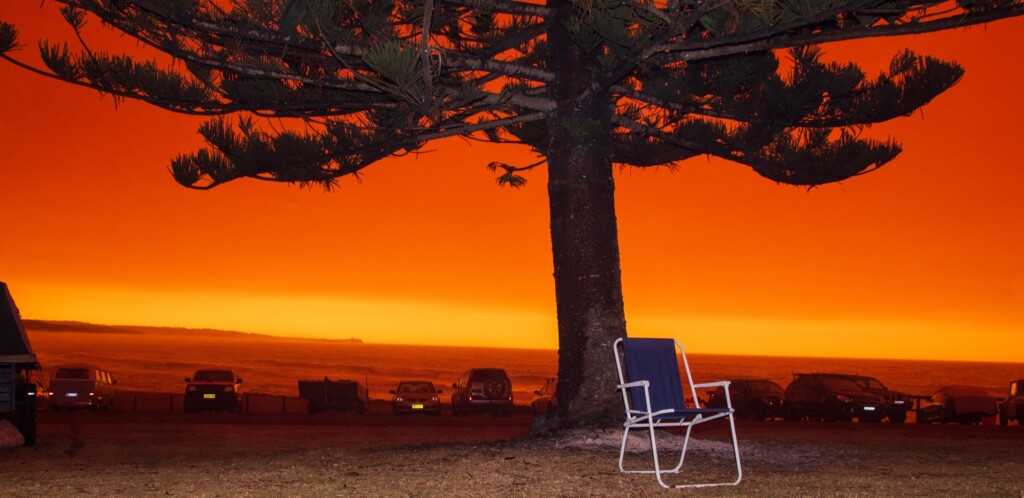
Main image: People flocked to the shoreline in their cars in Narooma, NSW, Australia during the days when they were told to evacuate. (Photo: Allison Aitken)
By Susan Pryke
I was asked to tell you what it was like living through the bushfires in Australia. I expect you will want a longer answer than: “It was hell.”
 I live in Narooma on the far south coast of New South Wales. To our west there are mountains, on our doorstep the sea. The bush in between is mostly inaccessible, which is why Australians fight fires with aerial water bombing equipment. They also build containment lines by bulldozing the vegetation in front of the fire to remove the fuel load.
Australians are very good at dealing with fires. They have fire plans. They prepare their homes. They have the confidence to stay and defend their properties. But that was then, and this is now.
Ours was one of the last areas to be impacted by the fires, which started in Queensland and reached northern NSW in September. We had time to see the crisis building. By November 1 there were 100 fires burning in NSW. These were not ordinary fires. They came so fast and with such fury they burned the very air in front of them. People reported fire dropping from the sky, heat so intense that cars exploded before the fires even hit.
They consumed homes and businesses, decimated stock and wildlife, killed people who realized too late they could not defend their homes. By the time the fires reached our municipal boundary, officials said that unless it rained there was no way to stop them. They would burn to the sea—the Great Eastern Containment Line.
We were protected by the wonderful volunteers in our rural fire brigades; but they did not have the equipment or the numbers, locally, to be effective on their own.
In late December, the Badja Forest Road fire appeared on the Fires Near Me app. When I went to sleep on December 30, it was about 50 kilometres away and relatively benign. By the time I woke up, it had wreaked havoc from the mountains almost to the sea. The sky turned black at 10 that morning. The little town of Cobargo just south of us was burning. The seaside town of Bermagui was in its path.
Our town was full of evacuees that no one was prepared for. They parked at the sports ground, on the golf course, on the headlands. I saw vehicles inching through the smoke with their worldly goods in trailers behind them. I saw a Land Rover with its four-way flashers clearing a path for a girl riding her horse to safety. I watched as the day turned to night, feeling too alone, too small in the face of something catastrophic.
At times I felt that January was never going to end. Five times that monster came for us, and five times we survived. Between each fire event we cleaned up the ash and choked through days so smoky you couldn’t see the house next door.
Our service club donated a shipping container to the fire-ravaged village of Nerrigundah, whose residents had nowhere to store donated goods. On the day we delivered the container we were horrified to see the destruction. The bush was nothing but black sticks. No birds. The crumpled remains of homes still smouldered in the village.

The view from the Prykes’ front window at 10 a.m. on Dec. 31, 2019. (Photo: Susan Pryke)
Apparently, there is a new phenomenon called eco-grief. It is defined as: the grief felt in relation to experienced or anticipated ecological losses, including the loss of species, ecosystems and meaningful landscape due to acute or chronic environmental change.
In truth, my emotions were grief-like. I went through stages of fear, disbelief, then sadness. In the end it was the anger that surprised me most. I was angry that three years ago the State government had gutted the National Parks and Wildlife Service within whose ranks were professional firefighters and managers who knew the forests and how best to protect them.
I was angry that the air tankers Australia needed to fight fires were not ours but leased from the northern hemisphere and that we only had seven at the onset of the fire season.
I was angry that months before the fires, a delegation of high-ranking fire officials asked to meet with Prime Minister Scott Morrison and were refused. They wanted to warn him that bushfires had stopped being something that Australians could take in their stride. With the prolonged droughts and rising temperatures, bushfires like these were real evidence of climate change.
After all that has happened, I thought people would finally embrace change. Instead the naysayers (and there are many) doubled down in their belief that there is nothing they need to do about climate change. Their opinions have hardened not softened. They are, in my opinion, wilfully stupid. They know the facts, they should believe them, but they refuse.
They blame the fires on the Greens of all people, a political party that is not in power and has not formed any legislation. They say the fires were all started by arsonists. This misinformation was reported as the truth by very popular, albeit biased, media outlets, especially by the commentators at Sky News.
So, Canada, what lessons can you learn from our experience? Value media sources that have balanced reporting, vote for politicians who have a sound climate change policy, fund your fire services and ensure they have the equipment and resources they need. Most of all, embrace your community and work together.
After that first chaotic event on New Year’s Eve, the powers-that-be made sure we were not caught off guard again. Resources were brought in from across the country. On February 1, our last fire emergency, we had fire trucks and firefighters everywhere. We were finally fully ready and the fire was three kilometres away.
Although we had excellent professional help to fight our fires here in Narooma, even some tactical support from Canada, I have no qualms saying Australia was, in the main, saved by volunteers. Volunteers fought the fires, manned the evacuation centres, fed the evacuees, delivered goods to victims, opened their homes to those in need.
Our community is stronger after the fires. The crisis has brought us closer and made us better people. In that there is hope.
Susan Pryke is the author of several books of Muskoka history, including Huntsville: With Spirit and Resolve. She was the mayor of Muskoka Lakes Township from 2000 to 2009, when she and her husband Dave moved to Australia to care for Dave’s mother.
Don’t miss out on Doppler!
Sign up here to receive our email digest with links to our most recent stories.
Local news in your inbox three times per week!

It’s too bad that you weren’t here, Susan, to hear Trump opine about wildfires. “A tree falls in the forest and turns into a log. The log dries up and eventually there’s a fire. But nobody knows what causes it.”
OMG! Personally, as a Canadian, I don’t think that I could live through another four years. I realize that the possibility is remote; but I’ve seen the Democrats wrest defeat from the jaws of victory too often, e.g. 2016, and 1980.
Hello Susan,
I’m sitting in a cottage at Sparrow Lake simply amazed at all your accomplishments and experiences.
I had hoped to find you on the internet and there you were. Australia wasn’t what I had expected, but I wasn’t surprised that you and David had returned. I wish conditions were less dire and I commend your courage.
Your warnings about global warming are so important and with our fires in B.C. and Alberta, we are very aware.
Sparrow Lake is serene today and the colours are still spectacular. I wish that you were here to chat about Lexington school days and all that you have done since.
Wishing you all the best.
Sandra Roy
Brian, thank you for your comments. Like you I have watched how two different emergencies have been handled here in Australia. The first was the bushfires, the second the pandemic.With the bushfires crisis, so many people, especially politicians, did not want to listen to the scientists and others who pointed to climate change as the culprit. With the pandemic, they are listening to scientists. They have to. While I was harsh in my evaluation of how politicians handled the bushfires, I will say I am really impressed with how they are handling the coronavirus pandemic. All sides of politics are working together. It is lovely. Many people here are wondering if, having listened to scientists on the pandemic front, will politicians now actually listen to scientists on the climate change front. Only time will tell.
Susan, a chillingly detailed story. My Cousin lives in Mitagong and his story is a lot like what you have posted.
One would think that those that deny climate change is happening would be tiny minority by now but such seems not the case. We may not know exactly what is causing the change and there may be some argument in that area but nobody can possibly deny that things are changing and fairly quickly too.
Going forward, “business as usual” will not work well and we all need to do some re-evaluating of our lifestyles, consumption habits and things like this. Maybe this virus will force us to take the time to think about this and practice some new living techniques. and this may be a good thing that comes out of this pandemic.
I find it kind of ironic and instructive all at once that at the recent climate change summits all the world leaders said that there was “no way” they could achieve even a zero growth to carbon dioxide emissions by 2030 (10 years) and here we are with a tiny little virus managing to achieve a sizeable reduction, world wide in just two weeks!! If it did not have the unfortunate side effect of killing a lot of us we’d probably view this virus as a “good thing”.
Our Township motto of “reduce, reuse, recycle” is a good start but we need a lot more of the “reduce and reuse” and we need to actually make the “recycle” work as all three of these things are more a “feel good” political phrase than a reality for most of us.
Yet another well written article Susan, and you have depicted the situation accurately (something that didn’t always happen throughout our devastating summer.)
“Unprecedented” became the word of those months. Our beautiful home town of Narooma was spared – more than once – during that deadly month. Meanwhile I have three children in my Year 2 class whose families lost EVERYTHING in January – their home and all its memories. Can we learn, or just be lucky again, or be among those suffering next time? Our communities remain very fragile – they didn’t need Covid 19 after the summer they suffered- we ALL need to care.
Thanks Ben. I appreciate hearing your comments.
Hi Sue !Thoroughly enjoyed your article regarding the infamous Australian fires. I am relieved to see that you came through it with emotional scars that will diminish slightly as time goes on . You write about the Australian -Climate Change-deniers. I am sure you are aware that this type of individual exists in North America–you go on to say that they are willfully stupid our neighbours to the South even elect him as President and he has many followers. Above all stay safe and hopefully we will all overcome our most recent world wide disaster –Covid 19– also a product of blatant stupidity.
All I can say is WOW what a thing to have lived though. I can not think of anything that would be as terrifying as having a forest fire within a couple of kl. and heading toward you.
I’m not sure I believe all the doom and gloom about global warming but there is no doubt that things are getting warmer most everyone over 50 knows that weather is different than it used to be that being said I remember my grand parents saying that winter was nothing like when they were young so this is nothing new been going on for hundreds of years likely thousands so my opinion is we are not going to stop it the best we might be able to do is slow it down but that will just make it take longer with the same end results.
My thinking is we better learn to adapt to this and find a way to cope with the disasters that seem like happen more often and get worse. Our farmers are going to have to learn different ways of doing things to better preserve moisture in there fields or plant different crops going to be all a matter of adopting.