
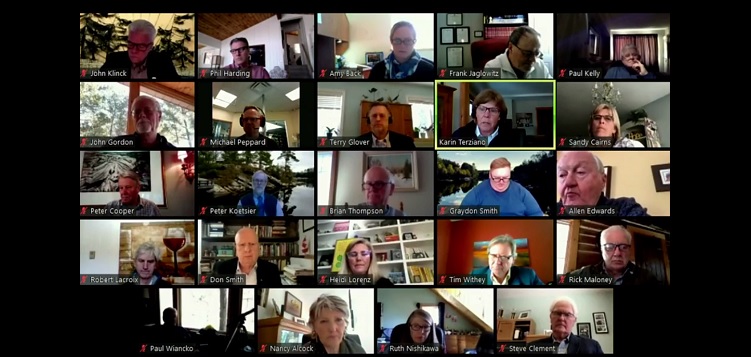
An attempt by Bracebridge councillors Don Smith and Rick Maloney to borrow from a District tax stabilization reserve to bring the tax rate down to zero, while “noble” as one councillor described it, did not make it past the District council table.
The Bracebridge and District councillors put the motion before District council at its March 15 meeting and would have seen approximately $1.63 million transferred from the reserve in order to decrease the proposed District tax rate from 2.05 per cent to zero. The motion also recommended that the funds withdrawn from the reserve be replenished over a period of five years.
“I believe through this proposed budget amendment we have the opportunity to reach out to all Muskoka ratepayers and provide a bridge that gets us over, gets them over, a financially difficult valley that confronts so many of them,” said Smith.
“If there is a time when we need a tax rate stabilization, this is it,” he added, referring to the impact COVID-19 is having on many households.
District chair John Klinck asked CAO and finance commissioner Julie Stevens to weigh in. Stevens said while the decision ultimately belongs to council, “what I will say is that it will put a really significant burden on next year.”
She said the proposed transfer would provide an annual tax break of roughly $17.57 for a house assessed at $300,000 and $43.91 for a house assessed at $750,000.
“If we look right now, we’re at a 2.05 per cent [District tax] impact, that’s what the taxpayers are feeling. Next year, assuming relatively the same information, that will be 4.26 per cent, so you’re going to have a really significant increase and that’s after growth,” said Stevens, referring to things like inflation on the services the District currently provides as well as wages and benefits, a 0.41 per cent increase on the levy when the first installment of $326,000 goes back into the reserve, and the impact an anticipated reduction in provincial childcare funding will have on the budget next year.
The “tax stabilization reserve is a long-standing reserve and has not been used unless there has been extraordinary events. Historically, it was used to smooth out fluctuations in the tax rates year over year. We do not have annual contributions into this reserve. Instead it is a safety net for unusual events,” said Stevens in a follow-up email to Doppler. “In 2020, council approved loaning $750,000 to Muskoka Futures to provide loans to businesses that are not eligible under other provincial and federal assistance programs. Council also approved $74,000 and $50,000 in 2020 and 2021, respectively from this reserve, for programs and other costs related to the Muskoka Economic Recovery Task Force.”
Huntsville Mayor Karin Terziano said she did not think doubling the tax increase next year made a lot of sense. “We should’ve been reducing the budget by reducing expenditures this year to take it down to a less impactful increase than to borrow money from a reserve because the money has to be put in it back and it’s going to be a double impact to the taxpayers over time,” she said.
“I appreciate the idea that we have a lot of people struggling right now. My biggest fear is that 2022, people are going to be struggling even more,” said Muskoka Lakes Mayor Phil Harding, referring to the possibility that programs and benefits currently available from senior levels of government will be exhausted. “That’s when the real impact is going to hit for this and yes we might help a few people right now, but when we have to put a 4.5 per cent increase on a budget next year when they’re really, really struggling, I’m not sure that I can support this at this particular time, though I want to help everybody as best we can. I just think we might be a little bit too early in this because I don’t think we have really seen the true impacts of what COVID is going to do to people over the next year, or two years and three years, even.”
Other councillors seemed to agree. In the end, council defeated the motion to reduce this year’s tax increase by transferring funds from the reserve and instead stuck to a 2.05 per cent increase for 2021 on the District portion of the property tax.
Related: Huntsville council approves a 0.35 per cent tax increase for 2021
Don’t miss out on Doppler!
Sign up here to receive our email digest with links to our most recent stories.
Local news in your inbox three times per week!
Click here to support local news
0 Comments