

Main photo: Protesters hoist a placard depicting Justin Trudeau in Vancouver on June 18, 2019.
(THE CANADIAN PRESS/Jonathan Hayward)
By
Director, Queen’s Institute for Energy and Environmental Policy, Queen’s University, Ontario
On June 18, the government of Canada declared a national climate emergency. The next day, the same government approved the Trans Mountain pipeline expansion (TMX), which will be able to move almost 600,000 barrels of oil per day from Alberta to the Port of Burnaby in British Columbia.
If this seems like a contradiction, you are not alone.
To date, Canada is the largest single jurisdiction to have declared a national climate emergency, following nations like Scotland, regions like Catalonia in Spain and cities like Vancouver and San Francisco.
Climate emergency vs. state of emergency
Altogether, 83 million people, living 623 jurisdictions, are now living under a state of climate emergency. The vast majority of these declarations have occurred in the last six months. The term climate emergency intentionally evokes a state of emergency — and implies imminent action on the part of the government.
Declaring a state of emergency gives governments the powers needed to respond to the emergency, from closing roads or bridges in the case of flooding to calling out the army to manage security threats.
By comparison, the declaration of a climate emergency is far less powerful. While governments may commit to actions when declaring a climate emergency, these actions usually amount to creating plans and engaging with their citizens. Yet this is not what concerned citizens and non-governmental organizations expect in response.
Read more:
Language matters when the Earth is in the midst of a climate crisis
They demand radical action: the dramatic reduction of greenhouse gas emissions, commitments to keep fossil fuels in the ground, the end of subsidies to fossil fuel producers and support for the rapid expansion of renewable energy. The TMX approval suggests that radical action is off the table — at least for now.
The climate lens approach
Governments can take a more pragmatic approach when facing a climate emergency. They can apply a “climate lens” approach to vet future policy decisions.
A climate lens forces government to address the environmental impacts of their decisions. For example, Infrastructure Canada now uses a climate lens to assess both greenhouse gas (GHG) mitigation and climate change resilience associated with any new project.
Using a climate lens approach, every investment should get you closer to a cleaner future. Does this logic hold up with the approval of the Trans Mountain pipeline expansion?
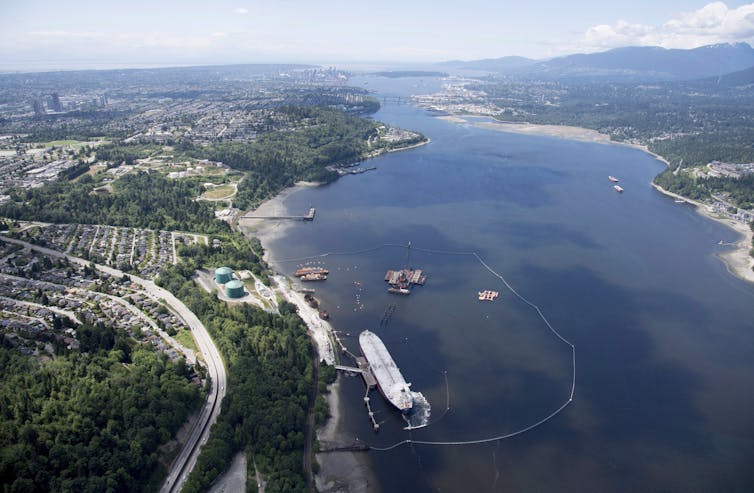
An aerial view of the Trans Mountain marine terminal, in Burnaby, B.C. (THE CANADIAN PRESS Jonathan Hayward)
In his announcement, Canadian Prime Minister Justin Trudeau pledged every dollar in federal revenue derived from the Trans Mountain expansion project to investments in clean energy and green technology. He was, essentially, making more than $500 million a year in taxes available for these types of projects as the pipeline becomes operational, which is expected in 2022.
This level of investment may help reduce greenhouse gas emissions and increase Canada’s resilience to climate change, allowing the government to safely claim some progress. It remains to be seen, however, if Canadians will accept this offer as a good deal.
A good deal for Canada?
There are many reasons that Canadians may balk. It is not a particularly large amount of money; Canadian subsidies to the fossil fuel sector total $3.3 billion annually, almost seven times greater than the government pledge.
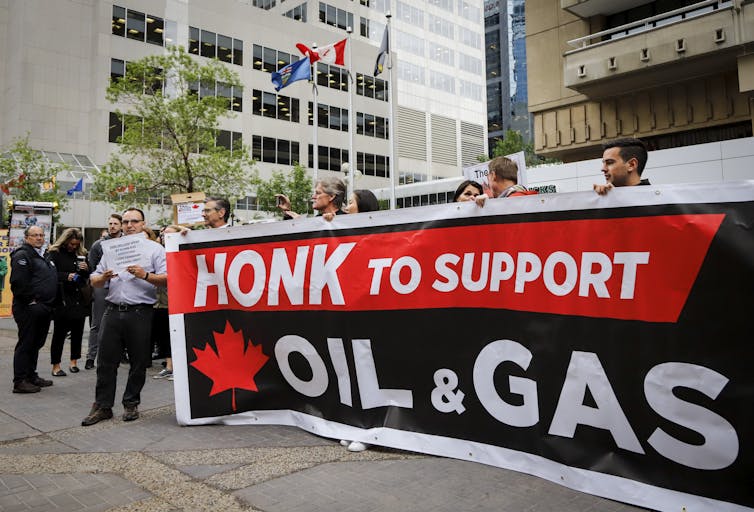
Oil and gas industry supporters rally outside the venue where Finance Minister Bill Morneau addresses an Economic Club of Canada in Calgary on June 19, 2019. (THE CANADIAN PRESS/Jeff McIntosh)
Read more:
Trans Mountain ruling: Victory for environmentalists, but a setback for action on climate change
It is also not necessarily a competitive offer: the additional carbon emissions from the production of oil to fill the new pipeline are estimated to be between 14-17 million tonnes per year. This means the government is pricing its taxes at the equivalent of about $29 per tonne of carbon, considerably less than the $50 per tonne target price.
Canadians are also highly aware that greening the world’s economy will mean dramatically reducing the country’s greenhouse gas emissions. This doesn’t mean that oil must be completely phased out, particularly in the short term, but carbon constraints, including taxes and regulations will change the way oil is produced and used.
Canadian oil will be subject to significant scrutiny by prospective buyers around the world, who have to meet increasingly stringent carbon rules. The risk of stranded assets in the Canadian oil and gas sector is real and significant: if the country is going to build a pipeline, it should also take steps to ensure that the product that flows through it is what potential customers will demand.
Canada’s options moving forward
There is a major disconnect between declaring a climate change emergency and approving a major oil pipeline. The government could address this in one of two ways.
It could use carbon taxes (not corporate taxes) to support a low-carbon economy. The carbon tax raised more than $2.6 billion in 2018-19, and this will likely grow to more than $5 billion as carbon prices hit $50 per tonne in 2022. If the carbon price attached to every barrel of oil was invested in GHG emission reduction and climate mitigation, this would make a major difference — on par with current government subsidies for the fossil sector.
Another approach would be to ensure that every barrel of oil that goes into the new pipeline meets stringent regulations on greenhouse gas emissions intensity — the amount of carbon dioxide equivalents released in the production of each barrel. Canada introduced the Clean Fuel Standard in 2016 to incentivize the domestic use of low-carbon fuels. A similar policy could regulate the emissions associated with fossil energy production, forcing industry to adapt, yet safeguarding an important economic sector from global change.
Read more:
Liberal environmental contradictions could pave way for Conservative win
Many Canadians are struggling with the federal government’s actions over recent days. It may be that the pro-environment and pro-industry sides are too divided to find common ground.
We need policies that acknowledge the urgency of the climate emergency and work to address the critical issues that have led to this emergency — a solution that works for all.
Disclosure statement –
Warren Mabee receives funding from NSERC, SSHRC, and the Canada Research Chairs program. He actively works with renewable energy start-ups and with large energy industry players, but does not receive funding from these partners.
This article is republished from The Conversation under a Creative Commons license. Read the original article.
Don’t miss out on Doppler! Sign up for our free newsletter here.
after reading all these comments my first response was to beak off about the way that everyone is complaining about how the federal Liberals let everyone down with the double whammy announcements. Maybe not the same folks but folks of a similar stripe are also complaining that the economy needs stimulus and that well paying jobs are created. The climate emergency addresses neither but the TMX does both in spades.
As Mr. Holland states, we should be investing in the newer, technologically advanced, reactors using previously spent fuel. The pipeline, which we all own by the way, is at best a stop gap for the environment but one that will spur the economy in ways that cannot be imagined; we cannot have it both ways.
Let us please get over the partisanship and get on with the easing of problems on mother earth.
I don’t pretend to be an expert or have all the answers, but I do enough reading and research to know that all the concerns put forward by scientists and those involved in the environmental field, are pointing to the earth, our home we share in common, as being in a crisis.
Twenty-four hours after the Liberals declared a climate emergency, their decision to go ahead with the pipeline expansion was a shock and a disappointment to me. The cries from many quarters: the indigenous people and their own land, the tar sands producing what’s known as “garbage” crude oil, experts saying that there is no guarantee that the project will be financially viable, and chemicals added to the oil to thin it enough for easy flow without evidence as to how it may affect the environment and wildlife if there is a spill, are all concerns.
Although these are major issues, the one that stands out most significantly for me is the fact that the experts tell us that we need to be completely off fossil fuels by the year 2050, only 30 years away. It is now that we need to be decreasing fossil fuel not ramping it up. The rational that we are going ahead with the pipeline in order to save jobs, and then make millions of dollars to put back into helping restore the environment that we have already destroyed, to me is irrational.
I have grandchildren and great grandchildren, and I feel a sense of responsibility to them and all those children yet to be born, especially those in less privileged parts of the world. What will it be like for them? Do we need to panic? According to David Wallace-Wells, author of Unihabited Earth: Life after Warming, says yes. If we don’t act now, what use will money, jobs and education be if by 2050 the earth is uninhabitable.
We need hope for the future, but we also need a plan; one where all government parties come together collectively to dialogue and put aside partisan views. This is an opportunity to work with one another and the people for the sake of our earth home and all those who inhabit it and the future human race. It is now that we need to invest money to discover other sources of energy. This will tap into the creative minds of the youth, create jobs, help our economy, clean up the environment and make our earth a safer place in which to live.
I, and others, had hopes that Canada could be a leader on the world stage in terms of the environment. This decision has been a setback, which shows how easily we can lose power over decisions made by one party. We need to express our voices, because this is an election year, and next time it may be even more difficult. If the environment is ignored, it will be at our peril.
Liberals are attacking the demand side with a tax on carbon. Conservatives want to attack the supply side with regulations on big emitters. They are both right and we need to do both to achieve our emissions targets. If we attack only the supply side and demand goes up we will fail, and vice versa. Solving the global emissions problem by creating a global energy shortage doesn’t work either. There are solutions but the logic is complicated and may seem like cognitive disodence to those who do not think it through. The bottom line is we need a transition from fossil fuels to much more nuclear, wind and solar energy, but with a timeline that reflects an appropriate sense of both urgency and realism. There is no magic. Last week, the government of Canada took two good steps, but there is much more to do.
Anybody have any thoughts on the viability of electricity being used for heating – and air conditioning – homes and factories? like it was before the push to natural gas for residences, et al. back in the late 1900’s.
I don’t know how much Carbon comes from ‘clean’ natural gas heating units on 5000 or whatever homes. Multiply that by however many structures have clean heating furnaces in Muskoka, or Ontario or Canada. Surely it adds up?
Equate this to using small nuclear gensets, wind solar etc. like Hugh H. suggests
Whatever happened to the so-called ‘scrubbers’ that were to be used on smokestacks, didn’t that pan out?
Now if Canada were to put in place and lead the way in this idea, it needs money. Build the pipelines, export the oil, Canada gets the funds, sells the means and ( waiting to be discovered) technology to subsidize China and other countries to quit using coal. The world still needs plastics but not the disposable single-use stuff.
One little p.s. here. Quit spending trillions of dollars on truth and reconciliations and land rights treaty grabs and subsidize research for a cancer cure. Enough is enough.
The Alberta electrical system operator says Alberta needs more capacity, particularly in the north. Terrestrial Energy of Oakville Ontario is supported by both the Canadian and US government to develop next generation small modular nuclear reactors that are fail safe, cheaper (mass produced) and can use up the so called waste from earlier reactors as fuel. The emissions from oil extraction comes from burning natural gas to melt the bitumen. Alberta should use these new reactors (with components made in every province) to replace their coal based electricity and use the surplus zero emission nuclear heat to replace heat from natural gas. Bingo. Clean electricity and emission free oil extraction. Terrestrial energy is already working with oil sands producers who are very interested. The world will need Canada’s oil long after the smaller proven reserves are depleted. So this is a win win for all concerned. Proven reserves in all but 10 countries will be depleted in 30 years or less. It will take longer than that to replace all uses of oil.
Thank you for your measured response, Ms. Kear: You totally stole my thunder. It is patently unrealistic to think that the world can be weaned from fossil fuels overnight. I have always considered TMX to be a transitional initiative; and as such; it provides employment and the environment is protected to the greatest extent possible. Yes, climate change is the interim loser; but TMX cannot be condemned so summarily until the long-term returns are in.
.
It may interest some to realize that all Council decisions are also regarded through the lens of the environment. Given the current urgency, that could possibly be updated to the lens of climate change. If an individual can make a change, imagine what the Town could do.
We need a National transition plan, especially related to oil and fossil fuels, to adapt to climate change, in my view. This is not an easy issue to change at the drop of a dime. I will believe the federal, conservative party has a viable plan ONLY when I see something substantial from the Ontario conservative government. At present, DF conservatives are fighting a carbon tax, and have removed cap and trade; they have withdrawn funding from a non-profit tree planting program (which the federal Liberals have saved), as examples. I am not aware of any Ontario MPP having any science background, let alone earth/climate science (please correct me, if I am in error about this).
We certainly need to listen to the concerns of Alberta, Saskatchewan, indigenous folks, and remember the internationally agreed carbon targets. A long term strategy, without Kenney and Ford nipping at the heals of the carbon tax in the courts would be best.