
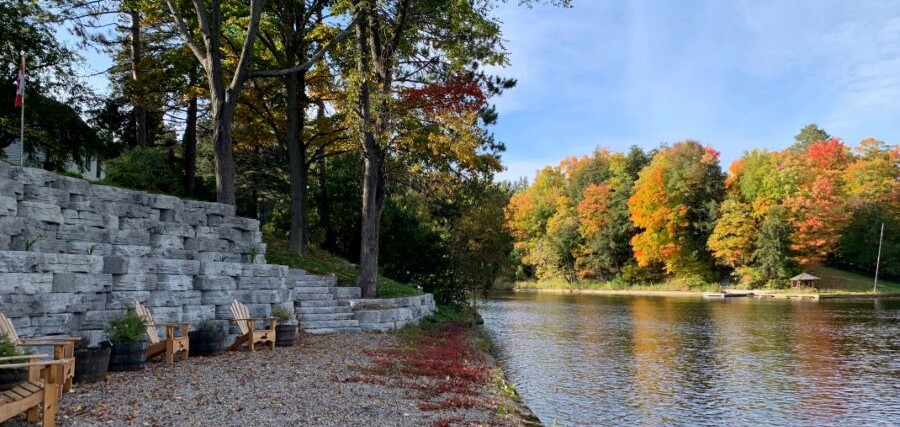
Things did not go well at a Huntsville committee of adjustment meeting on October 13 for the owners of a riverfront property on King Crescent.
The applicants were before the committee trying to get a retaining wall, referred to as egregious by the chair of the committee, recognized as a minor variance. They were also seeking relief from the requirements of the comprehensive zoning on the property to increase the allowed accessory lot coverage from 5 to 5.13 per cent for a floating dock.
Planning staff were recommending that the applicants be allowed to increase the accessory lot coverage for the floating dock only if they removed the retaining wall, revegetated the shoreline buffer area within 15 metres of the Muskoka River shore, and consulted with the Ministry of the Environment, Conservation and Parks (MECP) about requirements surrounding “Butternut Trees potentially impacted as a result of [the] retaining wall construction.”
Graeme Huizinga, planning consultant for the applicants, told the committee that his client had hired a contractor/landscaper to do some work on the property which has experienced “a lot of erosion activity from both the streetside and also from wake from boats coming through the channel. As I’m sure you all know, some of which don’t respect the slow speed recommendations through that section of the channel. So he’s been experiencing a lot of wake action running up on the shoreline…”
Huizinga also said storms are affecting the property on the streetside and the municipality has a drainage easement that runs very close, and in some instances on, his client’s property and also contributes to erosion.
He said the retaining wall system was built not as an aesthetic pursuit or as a way to reorganize the shoreline but rather to “stop this historic pattern of erosion and soil loss the property owners have been seeing over the past few decades.”
He said his clients consulted with the Town but something seemed to get lost in translation. “The Town had advised the property owners’ contractor that landscaping would not require any special approvals. Of course, the Town was not aware that they were referring to landscaping in the nearshore area when that advice was given so it’s an unfortunate miscommunication, but it’s led to the retaining wall being built and being… on the property today.”
Huizinga argued that while he understands that the extent of the retaining wall across the frontage of the property and its depth does not meet the intent of the Town’s Official Plan and zoning bylaw, “I do also have to point out that this is not a paper exercise, of course, we’re talking about something that already exists and denying this variance, unfortunately, would indicate that the Town’s opinion on the matter is that the retaining wall should be taken out.” He added that his clients also have a report from an arborist regarding the Butternut tree and other mature trees on the property indicating that removing the wall would do far more damage due to erosion than leaving it in place and revegetating around the wall, which is what Huizinga was proposing as a solution.
He said erosion would have also damaged the Butternut tree and noted that the applicant would be happy to work with MECP to address that specific tree as well as the municipality to come up with a vegetative plan to make the wall blend a bit more.
The applicant, Doug Wilson, also spoke at the meeting and said over the past 36 years he and his wife have had occasion to do upgrades on their property and have always obtained a permit where required.
He said a load of topsoil still sits in their yard which was meant to be used to revegetate the area. “No direction has been received from the planning department as to what would be satisfactory,” he noted. He said he has contacted the Muskoka Conservancy online and has received a list of potential vegetation for the area, “none of which were in existence prior to now.”
He said the impact of serious erosion on the waterfront can be a significant liability if not addressed. “For example, if your boathouse was at risk as in 2005 (hundred-year storm) or failed due to erosion, who would be responsible for remediation of that?” he questioned. He told the committee that many boaters now give them a positive shoutout when they go by for their efforts. “Hopefully the committee will focus on the positive aspects of this landscaping project and not be inclined to a negative outlook,” said Wilson.
Committee member Kenneth Donald wondered whether there might be an “intermediary step” between the removal of the retaining wall and leaving it as is. “Or are we just going with black and white?” he questioned.
Town planner Adam Ager said in order for the applicant to keep the retaining wall as-is, he would have to apply for a minor variance, which would have to be approved by committee.
“I believe the option was given to the applicant that they could go forward with a minor variance to try to maintain what’s currently existing as-is, save and except for the floating dock addition, but the retaining wall specifically. If they wanted to keep it they need a minor variance [which] would have to go to committee and should that not have a favourable outcome, I don’t know if next steps were discussed, but the direction was given in order to keep the wall as-is a variance would have to be granted,” he explained.
“Mr. Wilson is a respected businessman and a long-term resident of Huntsville. He’s certainly a good citizen,” said Councillor Bob Stone, who chairs the committee. “That being said, this wall is egregious. It flies in the face of our Official Plan. If this were a precedent in any way it would endanger our waterways. Huntsville has been very proactive in maintaining vegetation along the ribbon of life, as what we like to call it, on either side of the shore and therefore our waters here in Huntsville are said to be the best in all of Muskoka because we’ve been doing this for a long time. Personally, we cannot let this stand,” he argued.
Stone said if there is another way to help reduce the erosion of the shoreline, he would be open to looking at it. “But as it stands right now, it simply needs to be revegetated for the health of Huntsville.”
Committee members concurred, and in the end passed the recommendation from staff which calls for removal of the retaining wall.
Don’t miss out on Doppler!
Sign up here to receive our email digest with links to our most recent stories.
Local news in your inbox so you don’t miss anything!
Click here to support local news
I agree with several of the points taken above, such as;
– “the impact of serious erosion on the waterfront can be a significant liability.” (D. Wilson)
– “the town of Huntsville is permitting the destruction of lake and river ecosystems in the area” (R.Keldare)
– “working near the water they need to consult with the environment ministry” (W.J. Brown)
– “presentations to the town to no avail” (C. Kemper)
– “the little guy”/”local residents” relative to “the big wigs, the companies”(C. Maw)/”deep pockets” (A. Markle)
– “an entire hillside was denuded and is now being blasted back to the stone-age”, “as someone strives to save a butternut tree?” (A. Markle)
– “We elected people to form a council; to represent us as citizens and taxpayers. … or find different work.” “you signed up for the job; to serve this community.” (A. Markle)
– sympathize with the applicant” (M. Christenson)
– “enough large trees will have fallen into the river to make it unnavigable.” (M. Christenson)
– RE: “I still think it would make a great little play” (A. Markle), or a ‘NOT SO” little, if you add;
– Nelson Head Nature Retreat
– breached beaver dam, Williamsport Road (Oct.9, 2020) – See Facebook video clip Williamsport Road of Oct. 9, 2020, posted by Barry Groomes
Note: A year later, other than the road and ditches, clean up, restoration … revegetation has not occurred e.g., large culverts, chunks of road, downed trees, debris … remain strewn along the shores of the creek from Williamsport Road to, and into, the Big East River.
Given both Councillor Wiebe’s indication of intent “I agree that a proper cleanup of debris including any damaged culverts must be completed.” and Mayor Karin Terziano’s “I’m not sure how many culverts there are but we will take all necessary measures to ensure all debris that is located will be removed.”, when will this happen? The last I heard Mayor Terziano said clean-up would happen in the “fall”.
Restoration is warranted too, with proper management.
If the Muskoka riverfront retaining wall is “egregious”, what descriptive is fitting for the behavior/conduct/abuse regarding the beaver dam, pond, wetland, creek, Big East River and the acres of land affected at Williamsport?
These substantial environmental losses and damages are in a historically and naturally rich rural area, with diverse flora and fauna, including rare and ‘at risk’ species. The environmental and wildlife damages including erosion and siltation that has occurred is severe and extensive.
This loss and destruction was preventable, and appears to be failed management.
Where were/are theTown of Huntsville (beyond road repairs and ditches), the Ministry of Natural Resources, Forestry (MNRF), the Ministry of the Environment, Conservation and Parks (MECP), Muskoka Watershed Council, etc.?
Instead of valuing, protecting, conserving and restoring “to sustain biodiversity and to provide ecosystem services for present and future generations” (A Wetland Conservation Strategy for Ontario 2017-2030), the Huntsville Town Council has delivered;
1. A “Beaver Dam Bylaw” (2021) with control over beaver dams, ‘nuisance beavers’ and “costs” on the “owner”. Is that applicable in Natural Resource (NR) and significant Natural Heritage areas, with OWES assessment, endangered, threatened and of concern species?
2. A “Draft Community Planning Permit Bylaw” (2021) that is of serious concern and highly objectionable. I find in the draft CPP Bylaw;
(i) Historically and currently zoned “RURAL” land (TOHM) along and in the area of the Big East River is shown, as rezoned to “Backlot WATERFRONT”!
(ii) The Summary of recommended Options suggest
• Option 1: Town-wide CPP Bylaw;
• Option 2: phased introduction such as the WATERFRONT designation; etc.
I am opposed.
There is apparent disregard for The deep historic, “Rural”/environmental roots some of which are listed;
1. Algonquin Park (1893) 772300.00 ha., the first provincial park in Canada and forerunner of Ontario’s extensive park system. (plaque, Visitor Centre)
2. Williamsport Road Built Heritage sites designated – Farm House(1823), church (1895), school (1896), post office (1895-1906), Settler’s Locations,
Big East River Delta log drive (until 1936)
3. Dyer Memorial Estate (1956) – approximately 2 acre landscaped with 155 acres on both sides of the Big East River, 1.5 kilometres of undisturbed shoreline, Muskoka Conservancy (2010)
4. Arrowhead Provincial Park (1971) 1237.00 ha., Classification: Natural Environment
5. When Williamsport neighbours built their log home (1983); we moved to Williamsport (1985), the minimum permitted area for this (protected) rural land was 50 acres (20 hectares).
7. The Muskoka Heritage Foundation – stewardship, protection, conservation, preservation (1987-2012)
8. The Big East River Natural Heritage Area, Big East River Delta Natural Heritage Area designated (1993)
9. Williamsport Road Cultural Heritage sites designated – Church (1895), School (1896), Post Office (1895-1906), Farm House, Settler’s Locations
Big East River Delta log drive (until 1936)
9. Ontario Wetland Evaluation System (OWES) assessment on the beaver dam/pond/wetland property, record existed, but “no record found” yet? (MNR)
10. Big East River Waterway Provincial Park (2000) 1050 ha., the first of Ontario’s Living Legacy’s new provincial parks. Classification: Natural Environment .
11. Big East River crown land
13. Huntsville Official Plan, Muskoka Official Plan, Vision Statements, permitted uses, reports, legislation – provincial and federal, including the Species at Risk Act (2007), etc.
14. Big East River Flood, Floodway, Flood fringe Zones.
– “do we just stumble along moaning about how this and that shouldn’t have happened?” (A. Markle)
Encouraging proactive participation to identify and prevent potential problems.
1. Read the “Draft Community Planning Permit Bylaw” (or parts e.g. waterfront, rural … permitted uses, the definitions – vegetation, woodlot, etc.).
2. Utilize the the interactive map, the precinct(s) where you/your neighbours live, etc. and compare with the current status (TOHM)
3. Refer to Huntsville’s Official Plan and Zoning Bylaws, Muskoka’s Official Plan, etc.
4. According to Report Number: DEV-2020-91;
• Task 4.4 Public Open Houses was to be “in person” and virtual
• Task 4.5 First Public Meeting,
(Note: Public Open House and First Public Meeting combined (only one and NO “in person”), limited to virtually only, Oct. 14, 2021 @ 6:00 PM (public library closed)
• Task 4.7 Second Public Meeting virtually only, Oct. 27, 2021@ 6:00 PM (public library closed)
Accessing information has been very difficult, misleading, with omissions, discrepancies, and/or not available.
“Huntsville has been very proactive in maintaining vegetation along the ribbon of life, as what we like to call it, on either side of the shore and therefore our waters here in Huntsville are said to be the best in all of Muskoka because we’ve been doing this for a long time.”
(Councillor Bob Stone)
Really?
People talking about the town not putting up speed signs and controlling speed on the river, shouldn’t it be the ministry of transport that controls it. And it’s the environment that has the say for building at waters edge and changing it. https://conservationontario.ca/conservation-authorities/planning-and-regulations/conservation-authorities-act-section-28-regulations
Reperian rights don’t seem to have any part in this?
I just enjoyed reading another letter to Doppler by Allan Markle . His comments are always interesting ,truthful and cleverly amusing. Allen keep up the good work. Michael O’Mara
I totally empathize with Mr. Wilson on this issue which has turned into a hassle overall. With a load of topsoil already sitting on his property ready for use, is it possible for higher up block areas of the existing retaining wall to be removed, topsoil inserted in numerous areas above the gravel surface, and the retaining wall turned into a large, attractive rock garden? The home owner has attempted to correct a serious washout issue that the Town has not dealt with severely, concerning speed issues and irresponsible watercraft users, and has stepped in where he should not have had to go in the first place! He has put more than enough cost and effort into trying to retain the existing shore line of his property and his efforts have produced a ridiculous backlash which was unnecessary if the Town had done their job properly. Turn the existing retaining wall into a natural, pleasing area of greenery and let the wall do its job, without any more ridiculous, costly adjustments to this responsible homeowner. If only the watercraft users had this much responsibility…..
As a resident along the Muskoka river as well, I find this decision a head scratcher at least and sympathize with the applicant. The impact of erosion of the river bank is real in large part due to inconsiderate boaters who flaunt no wake guidelines but also because of the 100 years floods that occur every few years now it seems, that cause the river to flow at massively increased rates. Before too long, enough large trees will have fallen into the river to make it unnavigable.
I can’t believe the town planners don’t have the capacity to work with the applicant to find a solution to this other than to simply remove the wall…it smacks of a complete lack of understanding of what river life is like or straight up laziness.
Where are the good playwrights when they are needed? Why, along our Muskoka riverfront of course.
The scene would open with a request being made to rebuild a shoreline: add some Muskoka chairs, a gravel beach. But the information from the Town to that party was not understood (get it in writing?). The party was confused, so they employed a contractor who was also unaware of the the consequences of digging up shoreline!
Once the work was done, (everyone seems to think it is a wonderful improvement), along comes the council and says ‘” HUNH! You can’t do that.”
But it’s already done!
The plot sickens.
Someone is brought in to argue the case for the party who commissioned the work. There is no ‘beg forgiveness”. It seems more like an attack on the gall of the council to question that the work should have been done. There were waves from passing boats. Storms lashing the shore. And there were butternut trees to save!
Yep! Butternut.
A council that never reacted at all when an entire hillside was denuded and is now being blasted back to the stone-age, is going to be brought to its knees as someone strives to save a butternut tree?
You got to admit it would make a fine play.
A short while ago we had an entire barn built before anyone got around to noticing. Now a stretch of waterfront is rebuilt in contravention to the ‘PLAN’. Who is in charge of watching for these infractions? If council wants to make these rule and bylaws, they should supply the means of enforcing them. And be willing to administer the consequences when they are ignored.
Or do we just stumble along moaning about how this and that shouldn’t have happened?
We elected people to form a council; to represent us as citizens and taxpayers. Would our council please enforce the laws they make or find different work.
I know it’s low pay and lots of abuse (if you bring it on), but you signed up for the job; to serve this community. Get it done.
I still think it would make a great little play.
I’d go.
Wait! I’m already here.
The keyword here is “landscaping”… no permit required… had the landscaping contractor added ..landscaping at the river/lake edge then the bells and whistles start going off….and every landscaper knows this…
City/town don’t budge unless there is a complaint….unfortunately deep pockets get away with lots of things…..
I totally agree with Wayne Sinclair & Christine Kemper
I also believe you should have the right to protect your property
I also agree with Susan Godfrey.
The town it seems have no problem going after local residents ( the little guy)
But let the big wigs, the companies that are doing the massive clear cutting (like the one behind what was the university)get way with it. I still can’t believe they let that happen
As a 20 year resident along the Muskoka river, we are constantly being challenged with speeding boats which erode the shoreline. We do not get assistance from the town to post signage for boat speed or to have any other speed detection device (ie flashing Radar speed detection system). I have made presentations to the town to no avail.
I sympathize with Mr Wilson regarding the issue of boat wake erosion caused from speeding boats as there seems to be no assistance offered by the town ie: the town has not been due diligent in effectively assisting residence along the river with regards to this issue.
If this wall could be removed and replaced with an Eco-friendly retaining wall using natural stone, boulders and vegetation it would be acceptable and barely noticeable. If in fact corrosion is to become a concern along the river or is a concern there are many ways to address it properly in tune with the surrounding environment. As a landowner you should have the right to stop your property from becoming part of the river bottom, we need a set of guidelines for the construction of retention walls that look near invisible. The job contractor also needs to be held responsible for this as well, they should know the regulations and should have refused to build it.
Everyone has known for years if they are working near the water they need to consult with the environment ministry. I was told a few years ago by our then mayor doughty that they couldn’t even put sand at Avery Beach to make the beach better for children. This is I see it as blatant disregard of the rules the wall should go, and a fine should be levied.
I see retaining walls like this in many places on the water. Is the town going to police all of them?
It is very sad how the town of Huntsville is permitting the destruction of lake and river ecosystems in the area. Some properties are just totally clear cut as well. More stricter rules / fines should be implemented. We are in a climate crisis – and no wonder!
The same concern and vigilance should have been shown toward Forbes Hill regardless whether there was a tree bylaw in place (which seems inconceivable) in the official plan. Trees also provide a “ribbon of life”.