
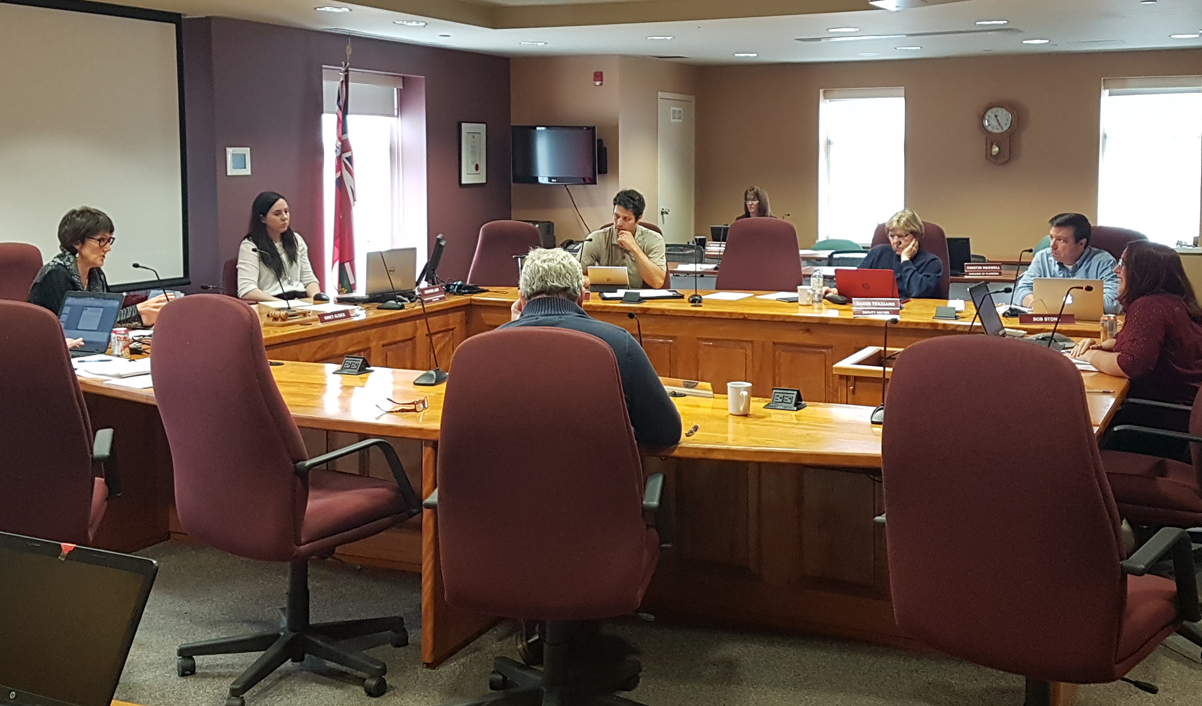
Huntsville’s Planning Committee had a lively discussion at its November 15 meeting about policy directions which staff will use to update the Town’s 2006 Official Plan (OP) with the help of a consultant.
Discussions included secondary suites, affordable housing, height restrictions and whether to regulate Airbnbs.
Currently Huntsville encourages secondary suites and structures mostly in the urban area, but not on the waterfront. Secondary suites are also not permitted in townhouses or semidetached homes and that is something that will be explored further, according to Manager of Planning Services Kirstin Maxwell. Also, while secondary suites are encouraged in the urban parts of Huntsville there are more restrictions in place in the rural area, especially as it pertains to secondary structures, in order to ensure that septic systems and wells are able to accommodate the added living space and to ensure that the natural environment and large natural areas are maintained, explained Maxwell.
“If it ends up being that there’s, in function, two dwelling units on a lot, then in future you have the ability to come in and create a new parcel with a dwelling on each lot and so there’s more long-term implications to that,” Maxwell cautioned.
But making secondary suites more restrictive and allowing secondary structures only in urban areas did not sit well with some committee members who argued that a mix of housing is necessary in order to encourage more affordable and diverse housing in the community.
“I don’t understand how you can create a second dwelling out of a secondary suite,” said Councillor Jason FitzGerald. “Surely we have wording that enables us to maintain a secondary suite versus a subdividable dwelling.”
Planning Committee Chair Nancy Alcock said it is contradictory to try and encourage more and varied housing on the one hand, and then to restrict it in rural areas on the other.
“Why is it okay to have a secondary suite above your garage if your garage is attached to your house in the rural area, but it’s not okay if your garage is 10 feet away from your house… it’s not logical to me,” said Alcock, who argued that the creation of a new lot involves requirements such as proper road frontage and an entirely separate planning application.
If people are concerned that we’re entirely changing the face of the rural area, we can’t do it because there is a limit. So, to me, it’s allowing flexibility and I believe that that’s what we want to do if we want to achieve another really important issue in our Official Plan.planning committee chair, Councillor Nancy Alcock, referring to increasing the supply of housing
While Deputy Mayor Karin Terziano cautioned committee not to open a “can of worms”, Councillor FitzGerald argued that housing, especially rental housing, in rural Huntsville might be cheaper.
“In the urban area are the rents going to be 20, 25 per cent higher than the rural area? More than likely. Is there a need for people to have the ability to live in rural areas with less expense for living? I think there is. And the aging population, what’s going to happen with that? I think to be restrictive of it is a mistake. To not allow it is a mistake and for us not to address it is shortsighted,” FitzGerald said, referring to the ability to create secondary or ancillary housing in rural areas of Huntsville.
“It’s a difficult thing because at the same time as we’re saying we should allow them everywhere, we’re also saying we should limit the amount of development in the rural area so that the natural environment and the large natural areas are maintained…. we’re trying to [find a] balance,” said Maxwell.
Maxwell pulled up the District’s wording on the issue as it too updates its Official Plan. “They’ve recognized that there can be an ancillary structure in any land use designation except the waterfront, and that they can be considered as standalone ancillary structures, like a coach house, in any land use designation except the waterfront as well, provided that they are clearly accessory to the primary residential use,” she noted.
Staff is expected to add a similar definition to Huntsville’s updated OP.
Airbnbs: should they be regulated?
The impact of Airbnbs also got committee’s attention.
“We’re potentially opening up a can of worms and I think it’s important to get around what that could be and what are the measures we could put in place to ensure that we don’t end up going down roads that we didn’t intend to,” said Councillor Jonathan Wiebe.
There are different ways of approaching it but I think it’s not going away, I think it’s going to become a greater factor in the fabric of this community. It’s a tourist destination and with tourist destinations comes the renting of accommodations.Councillor Jonathan Wiebe regarding Airbnbs
Wiebe said he’s not against Airbnbs; in fact he’s in favour of the freedom to rent out accommodations if one is either not there or has a suite in the garage to rent. “But the flip side is can it go too far? Can it have a negative effect on whether it’s the economy or the quiet enjoyment of the neighbourhood, etc.? I think there’s a discussion there.”
Further discussions led to questions as to whether the use should be addressed through the Official Plan, whether it is a bylaw issue or whether it’s a commercial licensing issue.
Councillor Bob Stone who has been pushing for regulation on the issue for some time said hotels have complained vehemently about the practice.
“They pay certain taxes, which Airbnbs do not. They have to have certain licenses, which Airbnbs do not, so we need to rectify that, for sure. I don’t know, again, how and when we’re going to do that,” said Stone.
Alcock said it is a Pandora’s Box that in her mind has already been opened, like the whole concept of accessory units. “Will this exacerbate it? Maybe, but as I said the Pandora’s Box is open because people just renting their rooms is causing a problem, without being licensed or whatever… I think it is a much bigger issue. I think it is a separate bylaw that looks at Airbnb and what other municipalities have done,” she said.
Staff indicated that the issue would be looked at separately, at least from a business licensing rather than a land use planning perspective.
What about the height of buildings?
Deputy Mayor Karin Terziano questioned at what part of the process specific details such as height restrictions get hashed out. “When do we get to that and if we approve the policy now without addressing any of these things, are we still going to be able to do it?”
“Those nitty gritty details will all come up in the first draft of the Official Plan. So when we have the consultant engaged and they’ve started the draft, we’ll bring the first draft through with all those details of how to do things,” explained Maxwell. “We’re suggesting for heights that there would have to be tests that they (developers) would have to meet in order to change the height limitations in much more detail than what we have right now because currently there is only one policy in the urban area that speaks to height.”
Director of Planning Derrick Hammond said there will be height policies which provide a series of tests in the urban centre and a different set of policies applied to the waterfront. He said his hope is to eventually use a digital elevation model to identify areas within the urban centre where height may be able to be increased subject to certain criteria.
Work on updating Huntsville’s Official Plan — which sets out how lands will be developed throughout the municipality — continues. To find more about the OP itself and what is currently being considered, click here.
Don’t miss out on Doppler! Sign up for our free newsletter here.
I have only 3 comments:
1) kudos to Ms. de la Vega for her excellent reportage;
2) why is the 2006 OP still being reviewed in 2017 (the standard interval is 5 years) and why does the review have to include the expense of a consultant?; and
3) free enterprise, combined with Airbnb’s and the influx of immigrants, has driven the price of even the worst rental accommodation in Toronto far beyond the affordability of local, low-income workers: as Mr. Wiebe averred, it is a subject worthy of in-depth consideration in Muskoka.
Please let’s not encourage the kind of growth that people come to Muskoka to get away from.. Remember…Trees Rocks Water…Not clear-cut, blasting and water pollution !
Far more Gov’t control over B &B’s…..Look it up !
I would just like to give my opinion on the subject of Airbnb. I do not have any objection to it as it appears to be more regulated than private Bed & Breakfast establishments which have been around forever. First of all, Airbnb require photo ID etc. and apart from the host having to pay a fee they also have to declare it as an income on their taxes. Most people enjoy the stay at different types of acommodation as opposed to a hotel room. Also in the Muskoka area it brings more tourists in. It would be a shame to deprive tourists of this option.
Sincerely,
J.Walker
The proposed Muskoka OP states that there are 2000 privately-owned cottages being rented in Muskoka, usually through agencies such as Air B n B, Canada Stays, and Trip Advisor and others. Assuming 2.5 bedrooms per cottage, that makes the private cottage rental industry the backbone of Muskoka tourism.
To discuss tourism regulation and planning without including the largest “resort”, -that is the “virtual” resort, – seems to me to be somewhat illogical.
Real estate agents have told me that there are buyers investing in Muskoka cottages in order to run a rental business. Running a business in a residential zone without a business license is often considered to be illegal. So, when does a cottage rental cross the line and become a “business” ? Who has the courage to enforce existing zoning law? What is the legal meaning of the zoning term “residential”? Difficult questions.
Toronto politicians are beginning to address the issues of Air B n B -type rentals. I wonder if the Toronto initiatives have any useful ideas for a rural setting?
The Ontario Chamber of Commerce has published an excellent study on “The Sharing Economy” . I wonder if there are any useful ideas from that study that could help us deal with this extremely difficult challenge here?
Some local leaders, including at least one Councillor, have flatly told me that renting a cottage as a business is illegal in a residentially -zoned area is a violation of the Planning by-laws. In fact , they bluntly stated that, in their opinion it was “illegal”. Strong language for a politician!
In Canada we believe in two basic principles” the rule of law and fair competition. The private cottage rental businesses violate both those basic Canadian principles.
Perhaps committee could consider the rental of seasonal properties as well-I think we’ve all heard of instances where large groups rent cottages or homes for a week or more. How many of those property owners are taking proper care of their septic systems?