
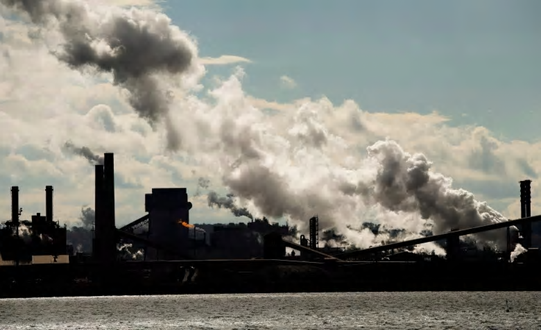
Not a day goes by and I don’t read or hear something about climate change. My concern continues to grow; not so much for me, but for our three grandchildren. Global warming, or climate change, surfaced decades ago as a problem for our future. Al Gore’s documentary, An Inconvenient Truth, created more awareness about the increasing danger. We learned that sea levels would rise and higher temperatures at both poles would cause ice to melt. Higher temperatures and rising sea levels were just a few of the many harmful impacts to life on earth.
These inconvenient truths were all disturbing, but the size and remoteness of the problem wasn’t something most of us could comprehend or do much about. Thankfully, international efforts were stepped up to limit the growth of green house gases such as carbon dioxide (CO2) and methane. The most recent are well documented in the Kyoto Protocol and the Paris Agreement. The latter agreement was an attempt to limit the increase in the global average temperature to well below 2°C above pre-industrial and to make efforts to keep the increase to no more than 1.5°C. These efforts have not achieved what we might have hoped for.
The Intergovernmental Panel on Climate Change, a panel of the United Nations, released a special report in October 2018 on global warming. The report contains a warning that we have to make urgent changes in the next 12 years or face a catastrophic increase in intensity and frequency of extreme events including negative impacts on resources, ecosystems, biodiversity and food security, to name a few.
Recent scientific reports state that Canada’s climate is warming at double that of the average of the world. Temperature increases in the far north now exceed the 1.5°C, resulting in loss of sea ice at faster rates than ever predicted. Researchers are warning us that if the northern-most parts of Canada, Alaska, Europe and Russia continue to warm, vast quantities of carbon can be released from what is now permafrost. It sets up a dangerous loop of more warming, more carbon release which in turn results in more warming.
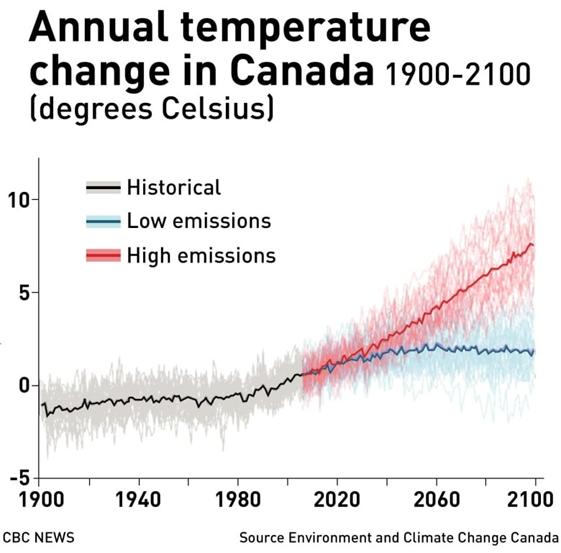
As the average global temperature increases, sea level is projected to rise more than one foot by 2045, putting a fifth of Miami underwater at high tide. Many cities and towns along the Atlantic coast are facing similar challenges, not only to rising sea levels but storm surge. New York and Boston will be the largest to feel the brunt. In 2018, two major hurricanes in the US southeast cost just shy of $50 billion. This is not limited to North America. Severe weather coupled with rising water levels in the Bay of Bengal could result in the death of millions. In a country of 166 million people; most live at elevations at or just above sea level. The cost is not in dollars but in human life.
Extreme weather events are already causing billions in increased insurance claims due to wildfires. In 2018, US wildfires cost $24 billion in fire fighting and damages; in Canada the number was $8 billion. Higher temperatures and less rainfall have aided in making these fires more frequent and intense than in the past. Firefighters in California and BC and Alberta are witness to this.
Temperatures in some parts of the world have been reaching record levels. Last summer airplanes could not fly out of Phoenix because of high temperatures. Record-breaking temperatures in populated areas of India have hit 52°C resulting in loss of human life. Climate change is out of control and getting worse.
What’s upsetting is that Doug Ford and the Conservative Party are fighting an effort to put a price on carbon of four to five cents a litre on motor and home heating fuels. They claim it’s a tax that will put Ontario into a recession. Yet, 90 per cent of the money collected will be returned to the tax payer to spend as they wish. They argue that putting a price on carbon is a matter of provincial jurisdiction. They’ve gone to court to stop the federal government. They claim it has nothing to do with fighting climate change. Why then, did they cancel the cap and trade system? Both systems work to reduce consumption of fossil fuels.
The Conservatives claim that shutting down Ontario’s coal-fired electricity plants years ago is the province’s contribution to fighting climate change. Yes, that was a significant contribution but given the urgency of the situation, we can’t just stop there. On top of this, they cancelled the subsidy on the purchase of electric vehicles.
There are other changes such as dropping the climate change part of the Ministry of the Environment. The former Environmental Commissioner of Ontario, Dr. Dianne Saxe, had primary responsibility for action on climate change. Her role was to act as a bridge between the public and the government on environmental issues. She’s out of a job. The function with fewer employees is buried in the office of the Auditor General. The decision has not been well received. Government accountability on climate change issues will fade into oblivion. Reports on climate change will be a thing of the past.
Newly elected Alberta Premier Jason Kenney won on a platform to kill the carbon tax. And then there’s Andrew Scheer; all I’ve heard from the federal Conservatives is that they want to cancel the gas tax just like Ford and now Kenney. They don’t have a plan, or if they do they haven’t made it public. As Canadians we need to do better. Why would developing countries try to deal with climate change if we’re not?
Global climate change and the associated catastrophic events are on the increase and our governments are fighting over a four to five cent price on carbon. I’m frightened for my grandchildren’s future.
John Crockett and his wife Jane moved to Huntsville 20 years ago, after retiring from the oil industry. John has been involved in various community organizations since moving to Huntsville including Rotary and the Huntsville Hospital Foundation. His grandchildren range in age from two to thirteen.
Don’t miss out on Doppler! Sign up for our free newsletter here.
Jim comparing a computer payroll system initiated by Harper and a climate policy is ridiculous. Climate policy can be introduced by your province. Ford cancelled ours as he is an uneducated person with an agenda not about people or the planet. And guaranteed income we will all need, robots and AI will take 40 percent of the job market, robots don’t spend money nor do they pay tax nor do they receive payroll.
Yes, we have a serious enviromental problem that has to be dealt with.
But how can this or any government return 90% of a carbon tax to the tax payer and do any good with the remaining 10%. Who is fooling who?
Rob, I am not a fan of any political party currently. And I try to lend a voice to those who will be
marginalized by a regressive tax brought upon a population by a regressive Government. That is quite content to pick winners and losers. Otawa is a currently cesspool of incompetence. Sadly. none of you will respond to a simple request. What would a tax of this nature cost Canadians. I am of no political stripe, I am a realist all the data your providing comes from so called experts that are not bias. Ironically the only thing missing from your thorough analysis is the financial impact of this significant proposal. So we should all drink the koolaid and wander off into a future of uncertainty because this is the biggest threat to civilization. When in reality energy poverty may be the biggest threat to civilization in the future. Look at Countries that have sold their utilities off to private entities like they were trying to do in Ontario. You can push me off a cliff of uncertainty,but I will not go willingly.
I just don’t see how it will help or how it won’t impact other pricing on products. I drive up to 100km each day for work and my customers are going to be billed for the extra cost on gas. I’m not going to drive any less or lower the heat in my house. And most certainly not going to look for other sources of insanely expensive heat. I will however spend less at stores to offset my increased cost. Funny how the day after carbon tax was introduced gas prices shot up .20 cents/litre when oil production and price didn’t change.
Jim, no one will be impoverished by the price on carbon. Have you not heard of the tax rebate we receive to help lessen the financial impact? As a single person I just received $196 rebate on my tax return, more than the extra few cents on each litre plus increase on natural gas to heat the house..I drive about 24, 000 km. a year. A family of four, for example will receive a higher rebate.
Many people will be happy with the rebate but also encouraged to reduce their energy use and save even more money, which is a key purpose of putting a price on carbon emissions in the first place. Why NOT make bad things like pollution, that will cost us FAR more in the future, more expensive? ,- such as tobacco? We All pay huge health care costs in our taxes from tobacco use but pay less than we would if there was no tax on tobacco.
We are not in uncharted waters. British Columbia ( along with California, Quebec and several other countries) has had a price on carbon for a decade and the economy there is doing well. The cap and trade system that the Ford government canceled for partisan political reasons was financially beneficial for Ontario. The previous Conservative platform and Patrick Brown were in favour of a price on carbon. The majority of economists including two who just won the Nobel prize for this agree that it is the most efficient and effective way to reduce emissions and reduce the extra costs that you and all of us are paying in insurance, storm clean-up and many other costs…You’ll pay FAR more over the next number of years if we don’t reduce the risks of climate change. Do you have children or grandchildren? Like John Crockett, I’m very frightened for the world they will have to live in, which they will have “inherited”from us. “Mom, Dad, you knew for ages what was going to happen, yet you did nothing.”
Try to see the big picture and think outside the partisan box of all the things the Liberals did that you don’t like.
Congratulations, Jim: we get it; you’re a died-in-the-wool Tory. You’ll get a chance in September to exercise your vote. In the meantime, supporting Premier Ford in his waste of our tax dollars fighting the Feds’ sensible solution to climate change, is patently ridiculous. Not only will there be a rebate of carbon tax monies, but we northerners (who have no alternative to personal vehicles) will receive a bonus rebate.
.
I simply can’t comprehend Doug Ford delegating every duty, for which he’s eliminated the previous position, to the Auditor-General. This individual/department obviously has as much knowledge of climate change, as they do, e.g. about protection of children (in their capacity as Child Advocate). I can only assume that it’s to personally exert maximum influence in these areas.
.
Unfortunately, at this time, nuclear energy seems to be the only solution. Darlington doesn’t use weapons-grade plutonium; so there are no restrictions to proceeding in this fashion for the foreseeable future.
.
Finally, you are not a climate-change denier; but neither the Federal nor Provincial Tories have done anything but criticize the Grits, without offering any alternative. Since 2000, we have experienced 17 of the hottest years on record. However impossible, bi-partisan action is a necessity.
Well said John.
Laurie Christie
Thanks Hugh and John for a very thorough analysis void of any projected financial implications. i
Will caution all who feel the need to venture into unchatered waters overseen by political appointees. How many people are you willing to impoverish to achieve your goal? And You stated earlier that you cared about your families future. But have you considered how many future generations will be marginalized by energy slavery. Come on guys they have spent 30 years trying to do payroll (Phoenix Payroll System). So you two astute gentleman are trying to convince everyone that the Federal Government has the capacity to handle something of this magnitude in a fair and balanced manner. That is the problem, saving the planet is very admirable but not if Ottawa is in charge. Just my opinion.
Jim, you are wrong. The federal carbon tax does not add to the NET cost of anything. What it does do is complement and give more teeth to whatever other ideas the provinces come up with. It is the only thing that can engage and motivate everyone in all sectors to do as much as we can do to conserve energy and reduce emissions. It will stimulate Canada’s economy with innovation and all the new-era jobs that go with it. It will help Canada to get pipelines built so we can get a fair price for the world’s 3rd largest proven oil reserves that other countries will need when smaller reserves are depleted.
Pollution knows no provincial or international borders. Arguing about who should act first in the battle against climate change is as futile as arguing over the best deck chairs on the Titanic. It’s time to put petty politics aside and work together for the common good of Canada and the world. Our grandchildren will not ask what party we voted for. They will ask if we were enlightened enough to do as much as we could, to help avoid the worst effects of climate change. There is a long list of good things we can do.
Jim, We are not the only country with a price on carbon. A quick internet search reveals that a number of European countries have imposed energy taxes or energy taxes based carbon content. These include Denmark, Finland, Germany, Ireland, Italy, the Netherlands, Norway, Portugal, Slovenia, Sweden, Switzerland, and the UK. Non –European countries have as well including Australia, South Korea, and Chile. My source may not be up to date so I may be missing some countries. Apparently many more are planning on implementing some form of carbon pricing.
Even though the administration in the US has not taken action on carbon pricing California has taken the lead with a number of other states following in one way or another. We often point to China as a source of growing green house gases. They are investing on converting to non fossil fuel use. Beijing has a subsidy on electric vehicles of $3,700. By the end of 2020 the number of charging points will increase from 200,000 to 4.8 million
$20 per tonne of carbon or four to five cents a litre is at the very low end and as you point out will increase over time. The price of gasoline in most areas of Europe is over $2.00/litre.
The US will pay in another way. I mentioned the eastern seaboard. For example consider the impact of an accelerated rising sea level will have on the greater New York City metropolitan region. Power generating facilities, water treatment plants and electrical grids located in the New Jersey Meadow Lands are infrastructure that connects to and supports New York. The Meadow Lands are facing an increasing risk of flooding. The costs associated with dealing with the loss or damage to this infrastructure are huge. Cities like Brooklyn are not putting any more money into infrastructure in areas that will be under water in the near future. The US military is calling climate change a threat to military security and is spending billions to mitigate the effects of climate change. The US taxpayer will be paying one way or another.
As a country we could wait until the US, Russia and others move on carbon pricing. It would be like a game of chicken. In the meantime the clock is ticking. We can pay now or we can pay much more later.
So now 36 million people scattered across a vast continent that depends on transportation for everything in their lives. So now we are going to singlehandedly lead the world in a climate change initiative. Even though several governments around the world have made committments without putting policies in place.This vast country of ours is so dependent on transportation it’s our only option if you live in any rural area. So now all necessities of life will become more expensive,ie heat,clothing food and shelter. So once we are all receiving the basic income supplement ,another brilliant Liberal policy, I’m sure things will be fine.
Now this week the Federal Liberals announced funding for a corporate supermarket chain. 12 million to be precise. This company has refrigerated displays throughout the store without doors.
Do any of you leave your fridge on and plugged in all the time? So now we are all expected to subsidize stupidity. This same company has been recently accused of price fixing for a ten year period without repercussions. How much do they contribute to the Federal Liberal party. Show me a twenty five year analysis of the direct impact this escalating tax is going to have on the economy. Are we to believe that the money will not go to
corporations who contribute to political parties, ie SNC Lavilin (let’s sneak a DPA into a Omnibus bill). Moving forward with and initiative of this magnitude without taking into consideration the true cost to every Canadian sounds like a wonderful idea. If your intent is to impoverish the whole nation. Ottawa is going to have to stop lying to Canadians if they want anyone to take them seriously. All the falsified data in the world will not change that.
John…I have been arguing this situation at Council for at least the last dozen years…that we have to start budgeting and planning for extreme weather events…
As Chair of Operations and Protective Services Committee I have asked for a report on weather related events from the last five years and the impact on Operational Budgets.
At our next OPSC meeting in May we will have a report from Director Steve Hernen and OPP Staff Sargeant John-Paul Graham on trends and impacts that climate change might have had. We have already heard from the Insurance Industry and our premiums are reflected by the findings of their actuaries.
Initial reports are disturbing. For instance we know that this year, the season of November 2018-March 31st 2019 we have had a 50 % increase in weather events that required our crews to be out. The number of Spring Freshet warnings since 2011 is also alarming.
Of course, 5 years of data does not necessarily identify a trend, but we also have records going back to the early 70’s and in some cases prior.