
Hugh Mackenzie is on break this week.
By Hugh Holland
Oil is essential to the national security (military operations) of both Russia (one of the world’s biggest oil producers) and the US (the world’s biggest oil consumer). Their ratios of reserves to production/consumption put them both at risk of losing economic and military strength.
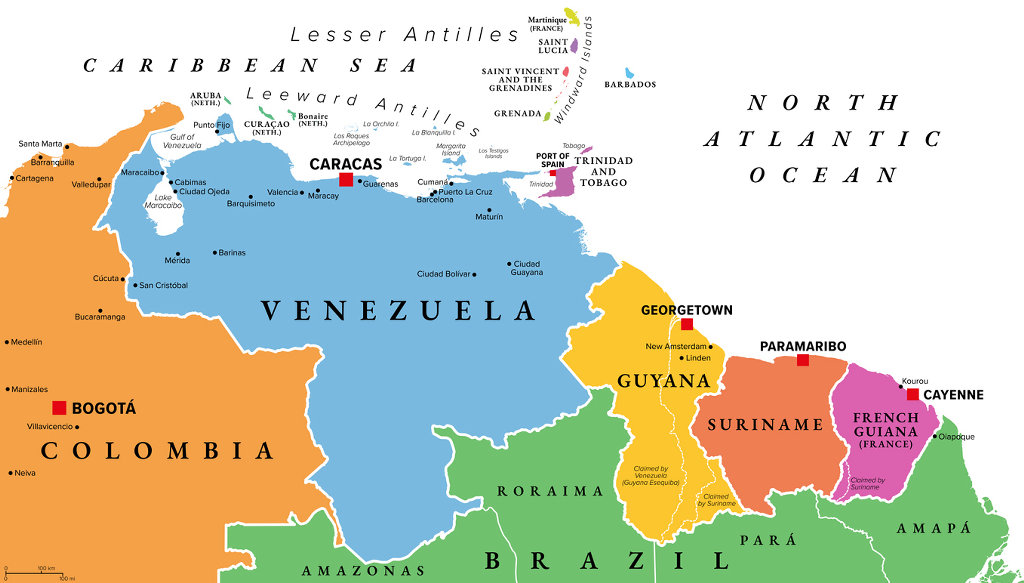
Venezuela, which once welcomed American energy companies, has the world’s largest oil reserves. Venezuela and its oil lie at the nexus of two of Trump’s stated national security priorities: dominance of energy resources and control of the Western Hemisphere. Venezuela has about 17 per cent of the world’s known oil reserves, or more than 300 billion barrels, nearly four times the amount in the United States. And no nation has a bigger foothold in Venezuela’s oil industry than China, the superpower whose immense trade presence in the Western Hemisphere the Trump Administration aims to curb.
Venezuela nationalized their oil industry in 1976. Trump “wants that oil for the United States.” During his first term, he backed attempts to oust Venezuelan President Maduro. After he left office, he lamented their failure. “When I left, Venezuela was ready to collapse,” he said in a 2023 speech. “We would have taken it over. We would have gotten all that oil.”
Trump wrote on social media that U.S. operations there would continue until the country returned to the United States “all of the Oil, Land, and other Assets that they previously stole from us.”
On December 18, 2025, Stephen Miller, the White House homeland security adviser, posted a political manifesto filled with misrepresentations. It was intended as a justification of all that had come before, from the boat strikes to the military buildup to the threat of a blockade.
“American sweat, ingenuity and toil created the oil industry in Venezuela,” he wrote. “Its tyrannical expropriation was the largest recorded theft of American wealth and property. These pillaged assets were then used to fund terrorism and flood our streets with killers, mercenaries and drugs.”
Historical Background
For decades, Venezuela’s oil industry was controlled by international companies (Exxon, Shell, Gulf). They extracted profits while Venezuela received limited royalties. Venezuela was a founding member of OPEC (1960). By the 1970s, OPEC countries were asserting control over oil production and pricing, inspiring Venezuela to follow suit. Rising nationalism and demands for economic independence pushed leaders to ensure oil wealth funded social development rather than foreign shareholders. President Carlos Andrés Pérez sought a moderate form of nationalization, compensating foreign firms while creating the state-owned Petróleos de Venezuela (PDVSA) in 1976.
Before becoming president of Venezuela in 2013, Nicolás Maduro worked as a bus driver in Caracas and later rose through the ranks of politics, serving as a union leader, legislator, and eventually foreign minister before replacing President Hugo Chavez. Maduro inherited the nationalized oil sector, but due to falling oil revenues, could not support the Chavez-era social spending. Trump has a higher approval rating than Maduro, but both are widely unpopular leaders.
In secret negotiations with the Trump administration, Maduro offered to open Venezuela’s oil industry to American companies. But that would have left Maduro in charge. The White House said no deal.
Trump’s 2nd campaign began on Sept. 2, 2025, with military strikes on small speedboats that the Trump administration claimed, without offering evidence, were trafficking drugs. Then the strikes continued, again and again. There have been 26 so far, killing 99 people across the Caribbean and the eastern Pacific Ocean, acts that legal experts say may amount to war crimes.
Then the campaign escalated. Trump authorized planning for covert C.I.A. action and deployed the largest naval force in the Caribbean since the Cuban Missile Crisis in 1962. The military positioned warships off Venezuela’s coast, sent bombers to fly just offshore, and dispatched troops and sensitive radar equipment to Trinidad and Tobago, an island nation just a few miles away.
These moves didn’t always make sense. Officials explained each development as an effort to stop the flow of drugs from Venezuela to the United States. They call the country a narco-state and its president, Nicolás Maduro, a cartel leader. But Venezuela is not a drug producer, and most narcotics smuggled through the country are headed for Europe, not the United States. U.S. officials say it’s about dislodging Maduro from power. Trump “wants to keep on blowing boats up until Maduro cries uncle,” the president’s chief of staff, Susie Wiles, told Vanity Fair.
In the last week, the United States has seized a Venezuelan oil tanker and promised to blockade “ALL SANCTIONED OIL TANKERS” going to and from the country. Officially, these boats are trading crude in violation of U.S. sanctions on Iran, as they’ve done for many years, especially since Russia invaded Ukraine in 2022.
On December 18, Venezuela said its military would escort oil tankers heading to Asia to stop the United States from seizing them.
The Future
Most natural resources including water are not evenly distributed between counties. If countries are allowed to seize control of any natural resource in any other country, essentially stealing it, there will never be peace in the world.
UN policy emphasizes that natural resources should be managed cooperatively and equitably, not seized or exploited by force. The United Nations sees resource-sharing as essential for peace, stability, and sustainable development.
Global oil reserves will be largely depleted over the next 50 years. To avoid the worst effects of climate change, oil must be replaced by renewable energy. Most countries are now capable of producing their own renewable energy, thus fulfilling the UN goals of sustainable energy and Peace.
With input from the NY Timeas and Microsoft Copilot AI

Hugh Holland is a retired engineering and manufacturing executive now living in Huntsville, Ontario.
Don’t miss out on Doppler!
Sign up here to receive our email digest with links to our most recent stories.
Local news in your inbox so you don’t miss anything!
Click here to support local news
Not surprising-anybody who thinks it isn’t is a danger to society.. We’re looking at a J. R. Ewing wanna be. Maybe we can find out how that turned out when we find out “who shot J. R, “
Let’s be clear. USA is on the wrong path.
It seems there are some people among us who could do themselves, and us, a great favour by moving to the USA.
Further to Greg V’s comment; even Maria Corino Machado would be aghast at how Trump broke every International law to abscond Maduro to..somewhere (alligator alley?).
This morning’s news has defined what USA is willing to do!
What a huge success for Trump and the US military this morning. Maduro doesn’t get martyred, instead he gets sent off to ADX Florence to rot with El Chapo and other scum. The very great and friendly Venezuelan people get freed from decades of runious Chavista rule. And it’s all accomplished with a surgical special forces strike. To gauge just how great it all is, you simply have to measure it by how loudly people like Charlie Angus howl and scream about it. What a great start to 2026! Thanks America!
My pet peeve — and I say this with respect for the thoughtful comments already here — is how easily serious reflection can slide into quiet acceptance of things we would once have questioned instinctively.
First, thank you to Hugh Holland for the original piece. It lays out clearly how control of resources — oil, water, land — has shaped conflict for decades, and how dangerous it becomes when powerful countries decide they are entitled to what lies within another nation’s borders.
Several of the comments here touch on something deeper than geopolitics. Allen’s memories of winter roads, schools, and neighbours helping neighbours remind us that systems only work when people trust rules, responsibility, and restraint. Joanne’s point about water as a shared, protected resource speaks to the same idea — that not everything is a commodity, and not everything should be settled by force.
That’s why I get uneasy when attacks on Ukraine are treated as understandable, or when conspiracies about suspending democratic elections are floated as “plausible.” When that happens, the goal usually isn’t prediction — it’s permission. Permission to accept force over law, loyalty over truth, and power over democracy.
Ukraine didn’t invade its neighbour. Its borders weren’t unclear. Its people didn’t choose war. Once we start excusing that — or shifting blame onto the victim — we’re no longer talking about realism. We’re lowering the bar for what we’re willing to tolerate anywhere.
There’s also a common misunderstanding about the money involved. Much of the support being discussed isn’t a donation coming out of Canadians’ pockets, but the use of frozen Russian state assets — funds immobilized because of Russia’s invasion. More broadly, support for Ukraine is an investment in stability: reducing the far higher economic and security costs that follow when aggression is rewarded and rules collapse. History shows that appeasement doesn’t save money; it multiplies the bill later.
The same principle applies to talk of cancelling elections or leaders working around democratic constraints. However casually those ideas are raised, they cut against the foundations that have kept countries like Canada — and communities like ours — stable for generations. Elections aren’t optional. Institutions aren’t inconveniences.
Hugh’s warning about resource seizure applies broadly. If countries are allowed to take what they want — oil, water, land — wherever they can, there will never be peace. That lesson doesn’t stop at Venezuela. It applies just as clearly to Ukraine.
Standing up for Ukraine isn’t about ideology. It’s about standing up for rules that protect smaller countries, limit coercion, and keep power in check. Those are conservative values too.
This feels like a moment when Canadians, regardless of party colour, need to lift our flag and our democracy high — together.
Respect one another. Respect our community and its members. And respect democracy — by standing up for it, not eroding it piece by piece.
Sorry Mr. Holland. Got my comment in the wrong spot.
Allen.
Pessimistically, her is what Trump is going to do.
He is going to mess about with Venezuela until about the end of April give or take. Then he will declare an actual “war”. By doing this I am told that the mid term elections scheduled for the fall of 2026 will be “cancelled” because my sources tell me that the US cannot have a mid term election if they are at war and by doing it this way, legal or not, Trump can declare a “war” just in time for the elections, thereby ignoring the elections and staying, however unpopular he is, in power.
This is just a conspiracy theory from one of my extended family in the USA. Maybe she is right, maybe not but it sounds plausible as it is just crazy and self centered enough to fit Trumps ego to perfection.
This is just one of Trumps failures.
His total lack of concern for the environment and hollowing out of any US institution of research into the environment or weather and climate change just because he “does not like what they say” will reduce the US from a world leader in climate research and weather forecasting to third world status, much to the detriment of all US citizens and farmers and roads departments find a good weather forecast to be kind of “handy” to their job.
A farmer will feed you, I don’t know what the heck good a gold plated ballroom is for anybody.
I am glad water was mentioned as a valuable natural resource – hopefully to be protected in quality and access and thoughtfully considered in peaceful relations for the future- not just another commodity. Balancing against the U.S. -Venezuela conflict, Mr Holland’s thoughts of a global peaceful future with renewable, sustainable energy are an optimistic way to enter the New Year. So thank you for that!
This commentary raises legitimate concerns about where the world is drifting — but it’s important to keep proportion.
Canada’s interest isn’t in assuming the worst intentions of any one country, but in defending a rules-based order that protects sovereignty, resource rights, and smaller states from coercion. For countries like Canada, whose security and prosperity depend on trade, law, and predictability rather than force, the erosion of these norms carries real economic and security costs.
Russia has already crossed that line in Ukraine. The risk — and this is where vigilance matters — is that other powers begin to justify pressure, sanctions, or force using similar “security” or “entitlement” language. That’s how norms erode — not suddenly, but through repeated exceptions that become precedents.
That’s why alliances like NATO matter — not as instruments of expansion, but as frameworks for deterrence, coordination, and restraint that reduce incentives for unilateral action.
Canada’s role isn’t to fuel alarmism or choose sides in great-power rivalry. It’s to insist consistently that resources, borders, and governments are not prizes to be taken — whether the pressure comes from Moscow, Washington, or anywhere else.
Stability depends less on who is strongest in the moment, and more on whether restraint, law, cooperation, and the institutions that uphold them still matter. That’s the line Canada should continue to hold — consistently, publicly, and without exception.