
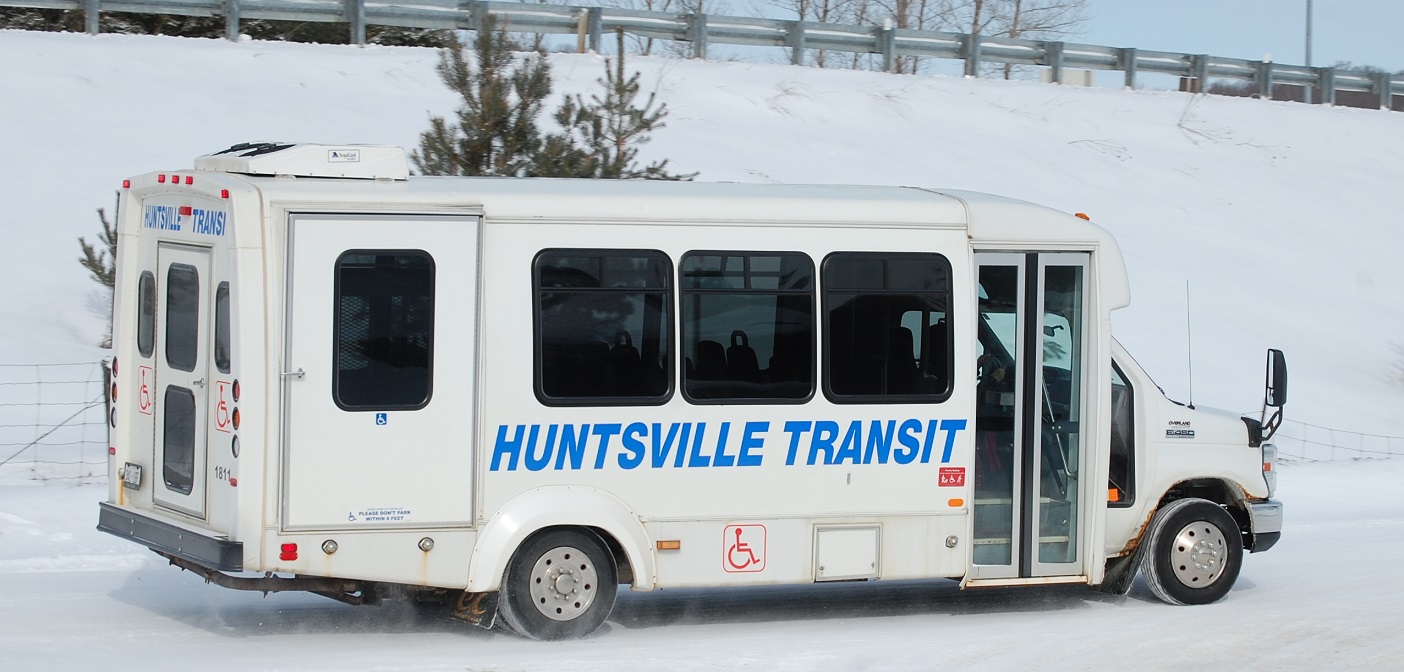
A recent survey of Huntsville Transit riders indicates that, overall, they are satisfied with the service, but a deeper look at the numbers suggests there are many improvements that could be made to make the service more accessible and a more attractive option to non-riders.
Survey results were presented to Huntsville’s General Committee at a meeting on March 1, along with a staff request for fare increases and approval to negotiate a new three-year agreement with operator Campbell Bus Lines. Approximately 150 responses were received by the Town.
Seventy-four per cent of survey respondents suggested that they were happy with the service, rating it as either excellent (27 per cent) or fair (47 per cent), but several councillors questioned whether the current service is truly meeting ridership needs, despite the overall good rating.
Councillor Nancy Alcock pointed out that a majority of respondents (54 per cent) are not satisfied with the current route, 68 per cent would like to see a route extension to include under-served areas, 62 per cent want increased hours for the conventional-modified service which provides easier access for riders with reduced mobility, and 82 per cent want increased hours for the regular service.
When asked what one improvement respondents would like to see in the current service, service to under-served areas, later hours and more frequent buses topped the list. [See a summary of the transit study results here (pages 6-9).]
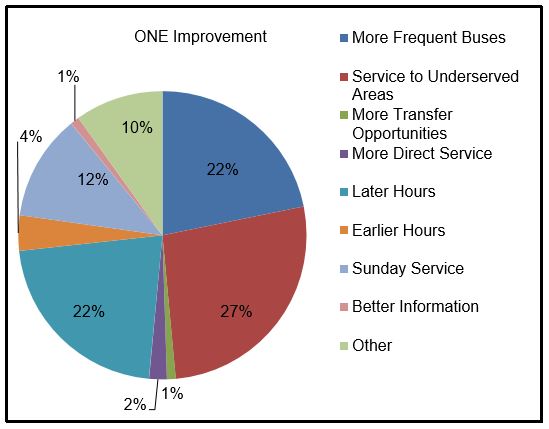
Huntsville Transit riders were asked what one improvement they’d like to see in the current service
The Town of Huntsville currently runs two buses: a conventional bus on a fixed route and what it calls a conventional-modified bus that will veer off its regular route to pick up riders at their homes or other locations with advance notice. The latter provides an accessible option for those with limited mobility. Transit operators will also stop for anyone on their route who flags them down, whether they are at a regular stop or not.
But the transit service only operates during limited hours – Monday to Friday from 8 a.m. to 7 p.m. (8-5 for the modified bus), and Saturdays from 10-5:30 – and the routes only serve Huntsville’s core with no service to outlying areas. (See the links at the bottom of the page for transit routes and schedules.)
Director of Operations and Protective Services, Steve Hernen, noted that an extended route to Deerhurst Resort was tried temporarily in the past but “it didn’t work.” He also said that even with the new fare increase of 25 cents for a single ride, which was approved by Huntsville Council on March 27, “we are nowhere near meeting the costs of the transit system. This (fare increase) would only add $3,000 per year and still won’t cover the full cost of it but it brings us in line with other municipalities that are running it.” Increased hours and extended routes would increase costs, and perhaps require the addition of a third bus, he noted.
The review of the current system is long overdue, with the last study competed in 2006 and scheduled for a review in 2011 which didn’t happen. Debbie Kirwin, Chair of the Accessibility Committee, said, “We’ve been pushing for a study because of accessibility but I think we have to look at it as an entire study of the whole system. What can we do to improve it?”
She noted that the door-to-door service for people with mobility issues is poorly advertised and not equivalent to what other riders receive because of its shortened hours. It also will only go within a specified distance of the existing route, leaving some unable to use it at all.
“Our ridership is substantially lower than other communities in Ontario. Why aren’t we increasing our ridership?” said Kirwin. “If we do that, we get more money from the government. Why aren’t we looking at a second route? We have 27 bus stops, Bracebridge has 47. Why aren’t we reassessing the system as a whole?”
Hernen acknowledged that “our buses are not as busy as we’d like to see them.”
To better inform the public about what’s available in the current system and provide opportunity for discussions, Mayor Scott Aitchison will host an open house on Saturday, April 8 from noon until 3:00 p.m. at the Active Living Centre, 20 Park Drive (Transit Stop 8B). Members of the public are welcome to drop in and discuss, one-on-one, their experience with the system and make recommendations for future transit operations. Residents who took part in the recent transit survey have the opportunity to review the results.
Both public transit buses will be operating April 8 to assist residents that wish to use the public transit system to attend.
Related links:
Huntsville Transit route map
Huntsville Transit fares and schedules
Don’t miss out on Doppler! Sign up for our free, twice-weekly newsletter here.
Some food for thought.
First i apologize and maybe should not comment at all as I have never ridden the service. I’m going to take the risk and make a few comments as food for thought for people going to the upcoming meeting.
First, I live in what the planners somewhat romantically call the hamlet of Dwight and public transit is virtually meaningless out here. Considering the comments in the article I suspect this is true of most outlying areas.
Second, I wondered a bit about the survey as these kinds of surveys are notorious for being statistically insignificant.
We are getting response from 150 people, maybe not all unique riders.
If a fare increase of 25 cents results in a yearly revenue increase of $3000 then we can see that there must have been about 12,000 rides provided in that year. (assuming all rides are paid for)
Not operating on Sundays gives 308 operating days and thus we are looking at a service that provides approximately 39 “rides” per day. A significant proportion of these rides are probably return trips, and with a great leap of assumption if they were all return trips we would have service, for a rough example, somewhere near 20 people per day. If half the rides were return trips this jumps to about 30 unique riders, still not very many.
Please correct me if I’m wrong as i took the numbers I worked with directly from the data in the article here on Doppler. I’ve made some large assumptions and I’d love to be shown to be wrong here but it occurs to me that if we are serving 20 to 30 people per operating day it might just be cheaper to let Uber or an existing taxi company do the job and pay the fees on an “on demand” basis for the riders. They could go on their schedule, we would not be running nearly empty buses around town all day and a greater area could be served, all changes that the existing riders in the survey say they would like.
Just some food for thought at this upcoming meeting.
When I used the bus service I knew when and where I would go to be picked up. I also knew that the complete run was 2 hrs. The hard part was coming back. They wouldon’t be back in minutes if I was at the pro building or hospital therefore I would have to wait until the bus did its run backwards and then to come back again. That was always an inconvenience. The drivers were and are great if they know you are coming they would wait a few minutes. The drivers are wonderful people that deserve a lot of credit. They should be thanked for making the present system work and will make a revised system work to. A smiling face goes a long way.