
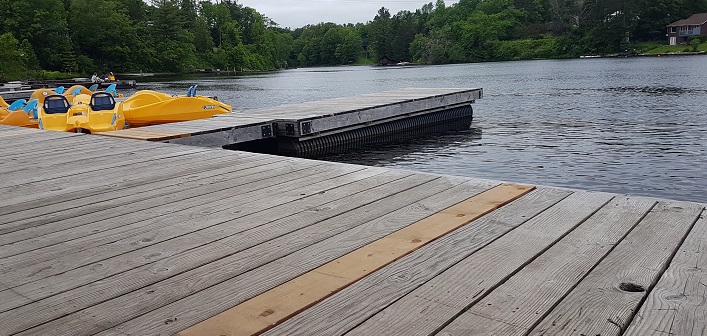
The Town Dock will be getting some unexpected work early this summer.
Just six years after the surface boards were replaced, they need to be replaced again because they are rotting from below from one end of the dock to the other.
Following flooding in 2013, the dock surface was replaced with untreated Douglas fir boards. Town staff first noted decay originating on the underside of some of those boards last fall, and this year have been conducting daily inspections and replacing boards as necessary.
“During a recent inspection staff walk [sic] the entire surface looking for soft areas or areas where the public has gone through the deck in the previous 24 hours,” noted a staff report. “It is not uncommon to find 2-3 different defective areas each day. As the summer season is just beginning and with many major community events planned for the dock, staff believe this has become a major liability issue if someone does in fact go through the deck.”
Steve Hernen, Director of Operations and Protective Services for the Town, presented a report at the council meeting on June 24 to request approval for emergency repairs to the dock.
When asked why the boards have deteriorated so quickly, Hernen said, “From what I’ve been told by some of the suppliers, it’s not a material that should be in and out of the water. You either submerse it in the water or leave it out of the water altogether. But basically because the underside is splashing with water it’s in a high moisture area… when you pull the boards up and look from underneath, you can see they’re all just rotting away.”
The staff report recommends replacement with a two-inch thick pressure-treated wood product. Composite decking material was considered but isn’t an option without additional cost to alter the structure because, “the deck stringers, which support the deck, are on 32” centre and composite material cannot span this distance,” noted the staff report. “They would require additional stringers and piles to support them. ”
The Town Dock’s support structure is comprised of steel piles and beams. Prior to 2013 the deck surface was made of three-inch thick hemlock boards.
The idea of using a pressure-treated product as a replacement material so close to the water didn’t sit well with Councillor Tim Withey.
“I understand you’re not supposed to, even though it might be common that people do it. Next time there’s a flood it will all be under water,” he said. “Pressure-treated [lumber] is basically a no-no as far as I’ve heard unless there’s a new product out there.”
After discussion about options for the surface material and associated costs, and the possibility of raising the dock above possible flood levels, council passed a motion to approve emergency repairs. Based on the lowest quote received by Town staff—$80,000 for labour and materials using a pressure-treated product—they approved a maximum spend of $100,000 for a cedar deck surface.
Don’t miss out on Doppler! Sign up for our free newsletter here.
I think we should be more worried about who made the decision to use Douglas Fir in the first place…RRnR
I agree with you, Rob Millman! Sounds like a terrific idea. Their docks look fantastic and if they last a lifetime, so much the better. This is a focal point for downtown Huntsville, used by residents and tourists alike. Mutual support is the icing on the proverbial cake!
Why not just use pressure treated wood, like they probably should have done in the first place. I believe if you check that the really “bad” materials used way back when for pressure treating are not the ones used today. My understanding is that the new treating compounds stay attached to the wood much better.
Also, think about all the rest of the “stuff” that is released and floats off during a flood event. If a tiny bit of some pressure treating chemical is released, it will be diluted by the huge flood flow and if you think of it in perspective to all the other items out there I think it is almost a non-issue.
Sometimes we “over worry” about things like this. Pet excrement and plastic waste are probably more of an issue than any pressure treated boards would ever be.
Why not get a price from Nydock? Not only are they one of our best corporate citizens, but their installation is guaranteed forever. The annual expense, therefore, would be determined by expense/interest rate = cost (the formula for an infinite annuity). The tops of the piles would have to be cut off; unless somehow, the piles can be salvaged for re-use or sale. After all the voluntary contributions the Town has received from Nydock, this would be a fitting payback and advertisement for their product.