
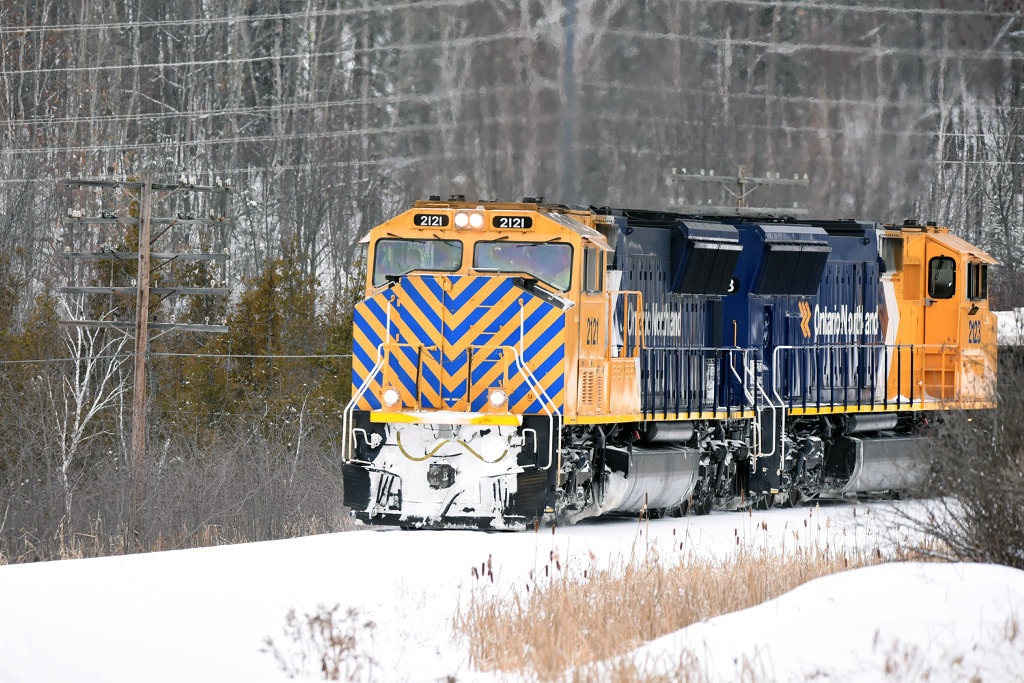
Psst. Have you heard the latest news about the Northlander? The Government of Ontario says it’s bringing it back in 2026.
No gimmicks. No more of the same old song and dance.
Sometime this year, Ontario Northland will reinstate passenger rail service between Timmins and Toronto.
The return of this train has been one of Premier Doug Ford’s longstanding promises to voters in the northeast region.
During his party’s first two terms in office, Metrolinx and Ontario Northland produced business case reports, carried out trial runs along the proposed route, and completed various track improvements.
The province also broke ground on the Timmins-Porcupine Station, and began constructing platforms and waiting facilities between Matheson and Muskoka.
At the beginning of January, plenty of politicians lined up to be photographed in front of the first of three new yellow and blue trainsets, delivered recently by the manufacturer.
I should be excited. Instead, I’m nervous.
While some may see this as a milestone moment, legitimate concerns have been raised about the ease of use and dependability of the new service, the trainsets themselves, the selection process of which communities would host stations, and the overall governance of provincially funded public transportation in Northern Ontario.
In an email from the Ministry of Transportation, a spokesperson claims that “Ontario Northland’s strong partnership with CN has helped […] develop a train schedule that will deliver reliable and consistent service for the return of the Northlander.”
How exactly?
The Canadian, an existing passenger train operated by VIA Rail, is routinely late along the same stretch of track the Northlander intends to use between Toronto and Washago.
A week before Christmas, it took VIA’s flagship train an embarrassing four hours to traverse a distance Ontario Northland expects to take slightly less than two.
Has the government made any progress on a new passing track (near the village of Zephyr) to ensure passenger and freight train meets are brief and seamless, as originally proposed in the Updated Initial Business Case?
The MTO says the Northlander “will not be subject to speed restrictions” by CN thanks to some specialized equipment that “improves the train’s electrical interaction with the track circuits.”
It’s a positive development, but ultimately meaningless if the trains themselves regularly fail during the winter. VIA Rail is allegedly using older locomotives to ensure their new equipment continues operating in cold temperatures, at least on a temporary basis.
Despite repeated appeals from residents and local leaders, the communities of Beaverton, Cobalt and Iroquois Falls — all located along the rail lines in question — will not have train stops without so much as an explanation from the province.
Instead, Ontario Northland is revising its “bus schedules and working with partners to explore the integration of local transportation options at Northlander stops.”
In theory, this should allow passengers to make last-mile connections — particularly in nearby cities and towns situated some distance from the railway.
In practice though, how is this supposed to work in communities that don’t operate local public transit during the middle of the night?
There’s also the issue of what the separate rail connection to Cochrane will look like.
Finally comes the 64,000 $ question: What mechanisms are in place to prevent new attempts at divestment of Ontario Northland’s assets?
Both the Progressive Conservatives and the Liberals came within a hair of liquidating this century-old, publicly-owned corporation in 2001, and again in 2012.
Transportation Minister Prabmeet Sarkaria stressed in an interview that the “Northlander will be around forever” and that it should have never been cancelled.
The province intends to fund passenger rail on the profits of Ontario Northland’s freight division.
However in the era of American tariffs imposed by Donald Trump on Canadian businesses, is this a viable plan? Does the Northlander’s existence depend solely whether or not the company can generate enough shipments of raw materials?
Restoring rail service in the North is going to be a true test of the government’s abilities to properly complete major transportation projects.
The mistakes made on the now cancelled London GO Train pilot, and delayed Eglinton Crosstown and Finch West light rail transit projects in Toronto sure leave a lot to be desired.
Convenient, comfortable, reliable and affordable train service is what travellers ultimately want.
As the playwright Clare Boothe Luce once said: The height of sophistication is simplicity.
Éric Boutilier is a columnist for Northern Tracks, a self-published blog related to
intercity transportation in Northern Ontario.
Don’t miss out on Doppler!
Sign up here to receive our email digest with links to our most recent stories.
Local news in your inbox so you don’t miss anything!
Click here to support local news
I’m a little concerned about the Northlander train.
I love trains, there is something about riding one that sort of feeds you imagination. It’s not like the security supervised cattle runs that air travel has turned into, where the advertised ticket price is approximately 50% of what it actually costs you. This said however we have to remember that the old Northlander was, or became uneconomic to the point where it was shut down and unless the new one addresses the issues that caused this it will suffer the same fate all over again.
For the long distance traveler, from “up north” going to Toronto this train would be a wonderful option but to make money you have to fill that train and I wonder if there are enough customers out there who will actually use this train to make the whole project work and be financially successful. We have proved that the last train was not and I’m looking for the differences that this new train boasts that will hopefully make it a success. These critical differences have not been clearly spelled out yet.
Perhaps this is not such a huge issue. Perhaps our government has decided to subsidize this train and make it operate without it actually paying it’s way. Much public traits works this way and there are many questions as much of the infrastructure has little or nothing to do with the Northlander and more to do with freight, boring but profitable.
Regardless the train has some big challenges. It has to run reliably to schedule. It cannot be too costly as one has to compare it to car or bus travel from a practical point of view. I don’t think air travel is a serious contender for this route as witness things like Porter Air’s aborted attempt to serve Muskoka. General rule of thumb is you use a plane for trips longer than 500 km.
It has to have convenient stations with waiting areas and these stations have to link to other forms of transport, like bus or taxi service. Probably there needs to be secure parking for customer’s cars at the stations as most likely a high proportion of train users will start by driving to their local station and they will want their car there when they return in a day or so.
We have closed a lot of the stations, Huntsville for example, so what are we going to do. A windblown platform with an unheated three sided bus shelter beside the tracks does not a station make so money needs to be spent.
I hope it works and I hope to, (plan to) ride it if only from a nostalgia perspective as I used to take the old Northlander several times a year in the past. I’d like the option of going to and from Toronto, downtown in the winter without having to run a bumper car lottery along highway 11-400 in whiteouts. Instead arriving relaxed and ready to enjoy something like the boat show, or maybe some concert or sports event.
So, like many I suppose, I watch and wait to see what exactly we get in this new reincarnation of our old train. I hope it works.
It is a great thing to have a rail service to the North
The challenges will be the schedule – which is not convenient for any senior given the very late and very early arrivals.
“explore the integration of local transportation options at Northlander stops”. Explore? Just acknowledge it is essential for success and announce a schedule of when and where the bus/road vehicle, if there is one, meets the train and stick to it (assuming the train is on time – see VIA and it’s non-connections any more in Atlantic Canada, for a bad example). Explore sounds like: “meh; maybe, maybe not”.
Well, lets give it a chance.
No public transportation system of any kind is self funding … Air, Roads, Bus, Rail.
They ALL depend on the public purse to survive.
Old information I researched is that every Ontario’n pays $165.00 per tax payer to fund the GTHA public transportation system. Kenora to Cochrane to Cornwall.
Lets leave our cars at home and use the Public systems. I know we sure will.