
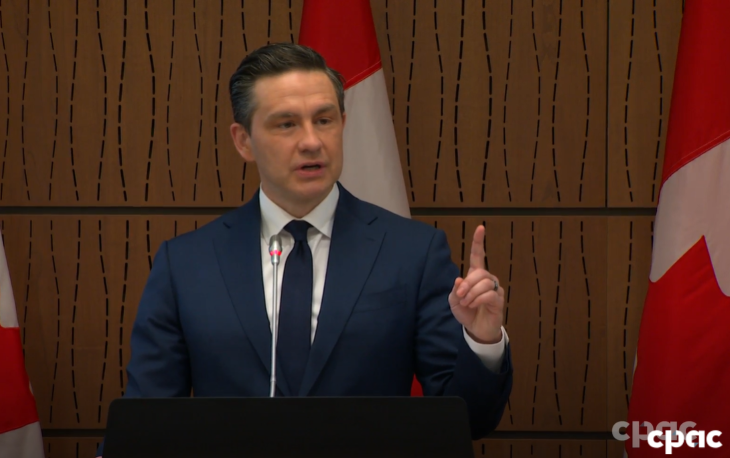
At the end of January, Conservative delegates will meet in Calgary for a national convention. Their major task will be casting a secret ballot to determine whether Conservative Leader Pierre Poilievre should remain in his post or if a leadership race should be called. This is required by the Constitution of the Conservative Party of Canada after an unsuccessful election.
Will Pierre Poilievre survive this leadership vote?
Although a secret ballot sometimes results in a surprise, he likely will. Tracking last month by Abacus Data shows that 77 per cent of Conservatives still support Pierre Poilievre.
Why? Arguably, because he significantly increased the popular vote for Conservatives, as well as winning more seats in the House of Commons for his party, since Brian Mulroney was Prime Minister of Canada.
Still, the Conservatives were not successful in winning the 2025 election, and one needs to take a hard look at that.
A few months before that election, the Conservatives were more than 20 points ahead of the governing Liberals. It was generally thought that a Tory win would be a slam-dunk. That, in part, was because many Liberals, disaffected with Justin Trudeau, parked their support with the Tories to send a clear message to Trudeau. It was time for him to leave.
When Mark Carney came along, many of those Liberals returned to their home base. As well, many traditional Conservative policies were kidnapped by Carney as he moved the Liberal Party of Canada back to the centre of the political spectrum.
Polling related to the 2025 federal election has shown that it was not Conservative policies that many voters rejected. Rather, they simply did not like Pierre Poilievre, and they rejected him. With Trudeau out of the way and Mark Carney becoming the Liberal leader, it was much easier to vote for Carney over Pierre Poilievre.
For those who doubt that, take a look at current polling numbers. Liberals and Conservatives are virtually tied at 41 per cent. But when it comes to which leader is most liked, Mark Carney beats Pierre Poilievre by 39 points. That would be a deciding factor in any election.
It seems pretty clear to me that a significant problem for the Conservative Party is that most Canadians do not like their leader, Pierre Poilievre. He has an aggressive and hostile style that many find offensive and unproductive. They are tired of his slogan-driven approach to policy and are concerned that he leans toward the right of his party.
Whether that is fair or not is another question. I know of several people who have met Pierre Poilievre at private gatherings and were impressed by a much different persona and his grasp of public policy issues.
But that is not the image that Poilievre presents in public, and since the election, he has been adamant that he has no intention of changing it. For this reason, if for no other, in my view, delegates to the Conservative convention in January should carefully consider the ballot question, and that is, whether Pierre Poilievre can ever become Prime Minister.
My sense is he cannot. Too many people just don’t like him, and one does not usually vote for someone they dislike.
The Conservative Party also faces at least one other major challenge as a result of the recent election if it wants to win government. They need to find a way to woo back centrist Conservatives who found it easier to vote for Mark Carney and his Tory-like policies than to vote for Pierre Poilievre.
Ever since the amalgamation between the Alliance Party and the Progressive Conservative Party in 2003, there has been a tug of war between centrists (Red Tories) and the right within the Conservative movement. The two elements have never effectively merged. Stephen Harper, when he was Prime Minister, was able to manage that. No subsequent Conservative leader has been successful in doing so.
Mark Carney’s election as Liberal leader and his embrace of many centrist policies provided progressive Conservatives an opportunity to effectively jump ship, leaving the Conservative Party dominated by those further to the right. In my view, unless they can get the progressive Conservatives back, it will be very difficult for the current Conservative Party to form government.
There is trouble on the Liberal side as well. While Mark Carney, as the newly minted Prime Minister, had a short honeymoon, that is over now. People are looking for results, and to date, there are not many. Tariff talks are stalled. Canadian unity and our sovereignty are still under stress. A stronger economy continues to be a real problem, and the ever-increasing cost of living continues to be top of mind for most Canadians.
For me, the jury on Mark Carny is still out. He has had the reins of power for almost a year, and it is time for Canadians to see how he is using them. For me, there have also been a couple of recent disappointments.
I did not like to see Carney rolling his eyes and throwing Ontario Premier Doug Ford under the bus in relation to the Reagan tariff ad the province aired in the United States, which broke records. Mark Carney now blames that as the major reason we do not have a trade agreement with the United States.
Mark Carney was well aware of the ad before it was aired and did nothing to stop it, as he could have. As well, it is hard to believe that Canada was that close to a trade deal with the Trump Administration, or the Prime Minister would have, or indeed should have, found a way to prevent its publication.
The floor crossings continue to be another irritating factor for me. The Prime Minister has denied his involvement, but these crossings could not have occurred without his knowledge, involvement, and agreement with whatever backroom deals were negotiated.
From time to time, Canadians have elected a minority government for a reason, as they did this time. They were not comfortable giving absolute power to a single political party. They did not expect one party to poach from another to gain a majority.
I continue to believe that floor-crossing is wrong. Successful candidates make a contract with their constituents as to how they will represent them in Parliament. That contract should not be broken for personal gain.
In fairness, Pierre Poilievre must shoulder some blame for these defections. Caucus management had to be at an all-time low. Most caucus members resent my-way-or-the-highway leadership, and all covet attention and respect from the leader and his team. These defections would simply not have happened in a Mulroney administration where the care of caucus was a primary strategy.
With their political parties now virtually tied, there is clearly an opportunity for Conservatives. To take advantage of these opportunities they will need to not only reconsider their leadership but also its messaging and outreach strategies, particularly to disaffected Tories. Building bridges with moderate voters and articulating a vision that resonates beyond the party’s base will be crucial going forward.
Without substantial change, including a new leader, the Conservatives, in my view, risk remaining in opposition, unable to capture the broad support required for electoral victory.
Delegates to the Tory conference in late January need to think seriously about that.
Hugh Mackenzie
Hugh Mackenzie has held elected office as a trustee on the Muskoka Board of Education, a Huntsville councillor, a District councillor, and mayor of Huntsville. He has also served as chairman of the District of Muskoka and as chief of staff to former premier of Ontario, Frank Miller.
Hugh has also served on a number of provincial, federal and local boards, including chair of the Ontario Health Disciplines Board, vice-chair of the Ontario Family Health Network, vice-chair of the Ontario Election Finance Commission, and board member of Roy Thomson Hall, the National Theatre School of Canada, and the Anglican Church of Canada. Locally, he has served as president of the Huntsville Rotary Club, chair of Huntsville District Memorial Hospital, chair of the Huntsville Hospital Foundation, president of Huntsville Festival of the Arts, and board member of Community Living Huntsville.
In business, Hugh Mackenzie has a background in radio and newspaper publishing. He was also a founding partner and CEO of Enterprise Canada, a national public affairs and strategic communications firm established in 1986.
Currently, Hugh is president of C3 Digital Media Inc., the parent company of Doppler Online, and he enjoys writing commentary for Huntsville Doppler.
Don’t miss out on Doppler!
Sign up here to receive our email digest with links to our most recent stories.
Local news in your inbox so you don’t miss anything!
Click here to support local news
Lisa Brooks: Bravo! Excellent comments.
As far I have been able to glean in my 30 years in Canada, Canadians are on the whole well balanced, moderate, middle of the road folks who do not trust extremes of any kind, except in their love of Winter perhaps.
The recent history shows how Mr. Stephen Harper, after 10 years at the helm, lost election and his position by being socially too Conservative. Well, his roots were in the right-wing populist Reform Party, so one should not expect him to shed the colours of his origin.
Mr. Justin Trudeau became, in the opinion of many, including in the eyes of a number of members of his own party and caucus, a liability as far as the electoral prospects were concerned. Mr. Trudeau was allegedly beginning to lean too far left. So, he had to go…
So, the extremes of any colour are not very popular in the arena of Canadian politics.
Mr. Mark Carney has been so far trying his best to walk the tight rope, trying to appease as many hues of the political spectrum as possible. The future will show if he will be successful in pleasing everyone in a long run. He will have to take care to keep his promises, as electors are very unforgiving when promises are not kept.
Mackenzie’s point is the one Conservatives keep trying to dodge: the real question isn’t whether Pierre Poilievre can survive a leadership vote inside the party — it’s whether he can ever win permission to govern the country.
Yes, the CPC increased its vote share and seat count. But despite those gains, the Conservatives still lost the popular vote — and their leader lost his own long-held riding. That matters. It points to a ceiling, not a breakthrough.
Voters didn’t reject conservative ideas wholesale; they rejected the leader and the method. When the race fundamentally changed, Poilievre refused to adapt. He doubled down on slogans, permanent outrage, and confrontation at the very moment Canadians were looking for reassurance, seriousness, and judgment.
That wasn’t just a style issue. It showed up in real errors: losing his own seat, mishandling institutional responsibilities, failing to manage caucus cohesion, and proving unable — or unwilling — to broaden his appeal once Trudeau was gone. Those aren’t media problems. They’re leadership problems.
If Conservatives want power again, they need a leader who can keep the base and reassure everyone else. Otherwise they’re just building the strongest opposition possible while someone else occupies the centre.
Winning the room at a rally isn’t the same as winning the country — no matter how hard Conservatives try to spin it. If they want to govern again, they’ll need a leader and a tone that can reach beyond grievance politics. Pierre Poilievre has yet to demonstrate that he can do that, and his base shows little appetite for a change in approach. The party appears caught in a self-reinforcing loop.
Younger persons are inheriting or have already inherited very large sums earned by the dying Boomer generation. I do not understand why Conservative leaning young people keep complaining about the “government”, when they have clearly benefitted from the post WWII economic and social development with basic infrastructure, health care and education built by taxpaying Boomers and Conservative governments too.A basic belief of the Conservative Party is that individuals are responsible for themselves- so why all the blaming coming from the young Conservative base that Pierre Poilievre seems to be manipulating and rage-farming with his sloganeering. If M. Poilievre is elected PM, I really doubt that magically the economy will self-regulate to make these young people or his disgruntled base into comfortable homeowners without any money worries. It mystifies me that Pierre Poilievre says he can “stop crime”( criminals seem to be very creative and unlikely to stop because Pierre says so) and build homes – when I doubt that he has made any structure beyond a tent.(governments are not generally known to be home builders) He will deeply disappoint his young fans who will indeed learn no matter what government is in place, they must take responsibility to make their own path, build their own good fortune and find their own good life. There is no escape from that.
I am always in awe when people realize that politicians lie. It’s been a long standing state of affairs and you have to take anything they say with a grain of salt.
I agree with a lot of what you say Hugh. Well done.
IMO PP can’t and won’t win the next election. Older and women voters just won’t vote for him because they don’t like him. Economics don’t affect them as much as younger voters (who also don’t vote as much as older voters).
Unfortunately I think the only ones benefiting from Carney are Brookfield shareholders. In this respect he is very similar to Trump.
So the big question the Conservatives must answer is who in the Conservative ranks could replace PP – lead and win. It’s a pretty short list.
Canada does not need another “Trump” leading anything. I wonder if the 77 % of Conservative members really support P.P. or are they only hoping to hold on to their pension and benefits? Jackie Howell said elected politicians make a contract with their constituents. When was the last time that the Conservative , the loosing party, not win a federal election seat in Muskoka? Muskoka is probably considered the most blue federal election area in Canada. I was surprised that P.P. did not get Scott Aitchison to step aside so that P.P. could return to parliament after loosing his seat. If the Conservative party wants to ever ever win a Canadian federal election it will have to be without P.P.
Should P.P. be booted out of the CPC leadership?
Short answer: No
Long answer: Noooooooooo
P.P. has won by every metric except the boomer vote (which is still the largest voter block in the country). P.P. has the young vote, the only issue is out of touch boomers who think the orange man is the reason why 10 years of terrible policies have ruined this country’s economy. Boomers need to walk a mile in the younger generations shoes to understand why P.P. has their vote. I see how much support he gets all over social media like on Instagram. Young people don’t pay attention to any mainstream media anymore because of how biased it has become. That being said, Hugh, you do have a very measured approach and I agree with a lot of what you said. However, as a younger person myself, the only thing I don’t agree with is the CPC needing a new leader.
Pierre is an honest and open politician who calls a spade a spade, this is exactly what we need is also extremely knowledgable in politics and how to handle things which Mark Carney hasn’t got a clue it’s not about loving everything. The leader says it’s about understanding what he’s saying and what he’s saying is correct Canadians need this type of leadership not this mockery that the liberal party has become. They have devastated Canada and it needs to stop.
Pierre should be the Prime Minister
Interesting that John K Davis seems to be the only one here supporting PP. At least that is what I see. We have a PM that has worked outside of government. Not a 20 year career politician that has never got his hands dirty
One Trump in this universe is one to many.
Yes, the leader of the conservatives should be replaced.
I am tired of political tribalism where people vote based on party tradition rather than what is needed today. It all boils down to “Who do you trust”. I trust the leader who can articulate positive, sensible ideas for solving todays biggest problems. . I do not trust a leader whose main strength is tearing others down.
Hugh, I think that your observations correctly identify one central truth of modern Canadian politics: elections are not won on policy alone. They are won on trust, temperament, and the ability to unite voters beyond a party’s core. But, I part ways with the argument that Pierre Poilievre’s leadership problem is framed as primarily a communications issue rather than a substantive one.
Canadians have repeatedly shown they are willing to tolerate ideological disagreement, but Poilievre’s slogan-driven politics (everything is broken/ gatekeepers/common sense) may energize a base, but they also alienate voters who expect seriousness from a prime minister, not perpetual outrage. The polling gap between Carney and Poilievre is not a superficial metric. It reflects something deeper as in a perceived fitness to govern.
This is where Mr. Carney benefited enormously from contrast. With Mr. Trudeau gone, voters were offered a leader who projected economic competence, institutional respect, and emotional restraint. For many Canadians ,including Red Tories and politically homeless centrists, that was enough. Frankly, Mr. Carney is a bit too conservative for me, but in this place and time, he’s the right person for the job.
I’d also challenge the notion that the Conservatives were robbed of an inevitable victory. Poll leads evaporate when voters get closer to the choice in front of them. When Canadians focused on leadership rather than protest, Poilievre lost decisively enough to trigger precisely the review the party now faces.
I agree that Mulroney understood that caucus care, coalition-building, and discipline were prerequisites for power, though I’m not as sure about Mr. Harper. Liberal leader Jean Chrétien’s tenure is also a prominent example of strong party and caucus management. Poilievre’s leadership style is the opposite of all of that so it’s going to contribute to defections. Don’t blame the legal manoeuvre of crossing the floor; put the blame on Poilievre where it belongs.
On the Liberal side, your critique is fair in parts. Carney’s honeymoon is over, and expectations are rightly high. Canadians want movement on affordability, trade stability, and economic growth. However, governing in a minority Parliament is qualitatively different from campaigning. The impatience many of us feel should not be confused with a loss of confidence.
As for floor-crossing, I get the squeamishness. But it is also worth remembering that parliamentary systems allow elected representatives to exercise judgment when party leadership becomes untenable or when governance demands stability. While voters rightly expect accountability, floor-crossing is not inherently anti-democratic especially when it prevents paralysis or extremism.
Ultimately, this moment exposes a broader truth that gives me hope. Canada is not drifting rightward in the way Conservative strategists hoped. It is gravitating toward pragmatism, moderation, and seriousness. If Conservatives want to form government again, the challenge is to decide whether they want to be a broad national party or a permanent opposition fuelled by grievance politics.
That is the real question before delegates.
What strikes me about Hugh Mackenzie’s piece is that it isn’t partisan — it’s practical.
Pierre Poilievre will probably survive the leadership vote because party members still support him. That doesn’t answer the real question, which is whether he can ever win a national election. The evidence from 2025 suggests he cannot.
The Conservatives didn’t lose because Canadians rejected conservative ideas. They lost because too many voters simply did not like or trust the leader delivering them. Once Trudeau stepped aside, Poilievre’s advantage disappeared almost overnight.
A 39-point gap in leader favourability isn’t a messaging problem — it’s a leadership problem.
Poilievre has built a movement that thrives on confrontation and grievance rather than persuasion. That may energize a base, but it narrows rather than expands support. When politics becomes permanently combative, rational debate is crowded out and trust erodes — and most Canadians sense that.
Winning the popular vote within a base is not the same as winning permission to govern a country. National leadership requires reassurance, coalition-building, and discipline, not permanent conflict.
Conservatives have a real opportunity going forward — but only if they choose to broaden, not harden, their appeal.
If Conservatives want to form government again, they need a leader who can unite the party and appeal beyond it. Right now, Pierre Poilievre does the first — but not the second.
That’s the uncomfortable reality delegates need to think about in January.
Well written Mr. Markle.
Why do Liberals hate Poilievre? Is it because he is honest with the people, is it because he stands up to them and tells them what Canadian’s really need and think about their helter-skelter policies. Carney knows the truth he was one of the authors of Trudeau’s policies, after all Trudeau said he wasn’t an economist and so the countries finances, would just have to handle itself.
To say Poilievre didn’t help Canada’s situation is sticking your head in the sand. Carney didn’t come up with cutting the Carbon Tax or cutting people’ in com taxes, Poilievre did, Carney was smart enough to realize that Poilievre didn’t just tilt at windmills but actually formulated ways to help Canadians. Building pipelines and opening up Provincial Trade barriers wasn’t Carney’s idea either, the Premier’e had decided that before Carney came on the scene.
Carney’s best friend, Donald Trump is the biggest reason for Carney’s visions. Trump forced Carney to increase defence spending, to seek improved relationships with the rest of the world. Trump is a true negotiator, signing deals with the world is driving USA’s dependency on Canada for raw materials, away.
We now know that past Liberal environmental policies were just sandcastles that Carney has quickly washed away, proving once again that Poilievre was right about what Canada needs.
Will 2026 see the Environmentalist Carney, the Economist Carney is the Snake Oil Salesman going to continue?
We saw how little got done when Poilievre wasn’t in the house last year. Without Poilievre and Conservative PM’s constantly keeping this government in check, our future will not be bright.
Does anyone think that Carney’s wait and see policy about dealing with Trump, will reap benefits for Canada when CUSMA opens next year?
I enjoyed Mr Markle’s comment- especially the “lie of politicians” term to describe a flock/herd of them. As the federal New Democrats and the Greens seem to have collapsed, the separatist/sovereigntist Bloc seems to be the only viable opposition to the federal Liberals – Mr Poilievre’s pit-bull like sloganeering, nasty, unproductive leadership is without dignity and presents only shallow, sophomoric analysis instead of authentic solutions for all Canadians- If he becomes PM, he will spend his term blaming the previous Liberal governance for his own failures. That is the only key he can sing in. Is the ultra-nasty Poilievre Conservative Party the only alternative, if the blueish Carney Liberals cannot hold the country together?
Pam , I’d settle for Wab Kinew and His common sense !
Thoroughly agree with the analysis of why old conservatives could not support Pierre.. the Conservative Party needs a new leader.
Mark Carney, even though he inherited Justin Trudeau’s closed door PM office, has made significant changes to be open to placing the best people in tariff negotiations, economic development.
Carney has conservative financial acumen.
We are in a fight to not just protect our workers but to also make sure that the First Nations hold a solid stake in our future growth.
The next three years will test our will to resist USA imperialism and realign with trust worthy allies, trading partners from across the globe.
Too bad for Conservatives that Carney isn’t their leader.
Our politics is getting to the point that too many people are just shrugging and thinking “Who gives a damn.” Parties and politicians are so interchangeable that they hardly matter. There was a time when you could feel that a politician was doing his or her best and was coming close to telling the truth. Not any more. Lie enough and people will begin to believe it. Like the ‘big lie’ What Hitler described in ‘Mein Kampf’. Not saying that our politicians are Nazis, but maybe they read the book and understand the concept.
In our House today, if you don’t like the program, just walk your butt across the aisle. Traitors are welcomed with open arms! How does the average person react when they are betrayed? Hurt? Indignant? Wary? But not politicians. “Man you lied like a politician! Good stuff. Join us. Wonder if we could ever trust you, but then who would trust a politician any more?”
Most of these elected officials must wonder if they’ll be kicked out of Hell. For Lying. And it’s unlikely the Devil would cross the floor just ’cause Hell is getting too hot. Displaying a lot more integrity than a lot of politicians.
Here’s a question. What is a group of politicians called? You know. Like an ostentation of peacocks. Or a gaze of racoons. Or a pod of whales. Would a ‘lie’ of politicians be too harsh? Use it if you choose.
As for Poilievre becoming PM, I don’t imagine I’ll ever see it. He’s a nasty sort. Kinda’ unlikeable. Though he does have a following. And there are those who cling to his leadership. Wonder what happens when there is that secret ballot at the upcoming PC convention. Will Pete discover that he shouldn’t have trusted this bunch of bootlickers? Will they become a lot of ankle-biters?
I really do hope that Pierre disappears into the history books. For that matter I don’t find our present PM to be all that virtuous or honest. Maybe the PCs can come up with a leader that more people can gravitate to and find believable. It’s the only way we will have an opposition with a chance of becoming the ruling party.
But would such a leader ever want a bunch of floor crossers in the party? Has Canadian politics ever reached such a low ebb?
I continue to believe that floor-crossing is wrong. Successful candidates make a contract with their constituents as to how they will represent them in Parliament. That contract should not be broken for personal gain.
This statement should also apply to LEADERS ?? who loose their seat and then require/ask/seek a by election is a “safe” riding The people elected a a representative let him/her sit in parliament.
Your last two paragraph send a clear message I hope this Opinion travels many miles Conservatives are waiting for change.
If the Conservatives want to make changes in this Country, They need to form the Government. That will not happen if P.P. is the leader.His popularity was due to the disdain for Trudeau junior not for his leadership qualities. He lost His own seat. The ” backroom boys “need to get Him out as the Ontario liberals did with their Provincial leader who lost her seat . Party success trumps ( sorry ) PP’s personal leadership aspirations.!