

The Ontario government has removed references in its proposed legislation, the Fighting Delays, Building Faster Act, 2025, that, if passed, would have ended rental tenure on the end date of rental leases.
The proposed changes were announced last week and generated opposition from rental advocates. Currently, when a lease agreement ends, the tenancy automatically continues on a month-to-month basis. The landlord cannot end the tenancy without a valid reason and without going through the Landlord and Tenant Board.
Part of the changes to legislation announced last week would have seen the province enter into consultations on alternative options for the end of lease agreements, giving landlords more control over who occupies their units and for how long, and thereby “allowing them to adjust tenancy arrangements based on market conditions, personal needs, or business strategies. This could add flexibility for some landlords in the approach to leases, potentially unlocking additional rental unit stock,” noted the media release from the province.
Rental housing advocates reacted swiftly and argued that the possibility of ending automatic lease renewals would effectively end rent control entirely in the province and increase rental rates even further.
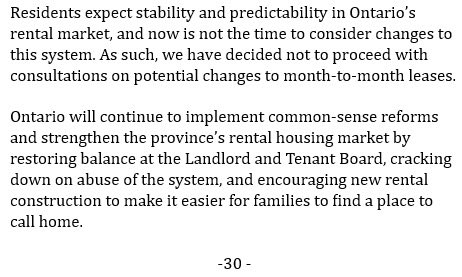
On Sunday, Ontario’s Minister of Municipal Affairs and Housing, Rob Flack, took to X and said his government is changing course and “not proceeding with consultations on potential changes to Ontario’s tenancy lease framework regarding month-to-month leases. We will continue to implement other common-sense reforms to strengthen the province’s rental housing market.” Flack also issued the statement below:
RELATED
Government says proposed legislation would protect Ontario’s economy
Don’t miss out on Doppler!
Sign up here to receive our email digest with links to our most recent stories.
Local news in your inbox so you don’t miss anything!
Click here to support local news
Ford is only out for his corporate buddies, speculators, developers not the average person!
Rent controls need to be put back in place. Reno evictions need to be stoped or at a clause the people can move back in at the same rent. Many people I know have lost thier homes/appartments due to this. Often times there were many need of repairs that were seriously neglected. I do know of a couple of ladies who were offered the money to move that had lived in thier apt for years.They wouldn’t take it.The property owners were given a grant for new windows. Thier apt. Windows were installed but never finished on the inside at all. Causing huge drafts. Leak & water damage so bad the ceilings were bowed. Taps wouldn’t work, one sink had the lower pipe removed but never replaced. All because they wouldn’t do the renovation!!
It’s said how out of touch conservatives are with the needs of the common people of the north. Finally, being held accountable for their misdeeds.
Doug Ford is handing out money as “training incentives” to his major donors. He is destroying the green belt, Ontario place, and countless wetlands across Ontario. Do you have a problem with hospitals, jails, and education? Ask Doug he has done nothing.
I doubt this comment will be posted for very long due to the fact that conservatives have their stamp all over this “newspaper”
As a renter I’ve had many landlords display prejudice opinions of a single person renting from them dispute an excellent credit score of 813. It’s been my experience as well that landlords find inexpensive property management registered groups of three manage their building.
It stated at once time landlords had to price a unit according to square footage which meant the same as rent control. It made sense to also have sharing walks, ceilings and floors regulated to be sound proof NOT cardboard carton thin without any sound proofing, sound proofing! Back to gear income for middle and single/senior affordability.
Ontario’s rental framework has become a heven
for “professional tenants” who exploit legal loopholes to commit fraud, extortion, and intentional delay. The Landlord and Tenant Board is overwhelmed and inefficient, leaving landlords without timely or meaningful recourse. Justice is delayed, and for many, justice is denied.
Most tenants who rent from small landlords would not qualify to rent in large corporate housing complexes. Many rely on social assistance or have poor credit histories. It is the small landlord who takes the financial and social risk to house them — often motivated not by greed, but by necessity, compassion, or a desire to invest responsibly.
In today’s market, with record-high interest rates and rising property taxes, many small landlords are effectively sponsoring their tenants — covering mortgage shortfalls and operating costs just to keep tenants sheltered. Yet, when disputes arise, these same landlords are left powerless in a system that favors delay and exploitation.
Large rental corporations can rely on legal departments and deep financial reserves. Small landlords, by contrast, face the system alone. They are treated as disposable entrepreneurs when, in reality, they are vital contributors to Ontario’s housing stability.
If Ontario truly wants a balanced and just housing system, it must stop equating property ownership with privilege and start protecting those who make housing possible. Supporting tenants should not mean sacrificing fairness.