

Hugh Mackenzie is taking a break this week.
By Hugh Holland
The Emperor Has No Clothes originates from a tale by Hans Christian Andersen, in which a vain emperor is tricked by two swindlers who promise to make him a set of clothes that are invisible to anyone who is unfit for office or is stupid. In today’s context, the emperor is Donald Trump, and the swindlers are a few very selfish oil company billionaires.
As Thomas Friedman writes in the New York Times, “The American people elected a man who is taking us to a future not of ‘America first,’ but of ‘America alone,’ and ‘Me first.'”
Trump is no better than Putin. Both are fighting the wrong battle with NO STRATEGY beyond winning. Both are delusional about humanity’s battle with climate change. If they win in the short-term, what have they won? They would have won a slightly bigger piece of a world that is quickly being torn apart by climate change. And they will have lost the respect of the entire world. And how many other casualties have they already incurred?
The USA already has the world’s highest insurance payments for severe climate events, and the world’s highest number of related insurance cancellations.
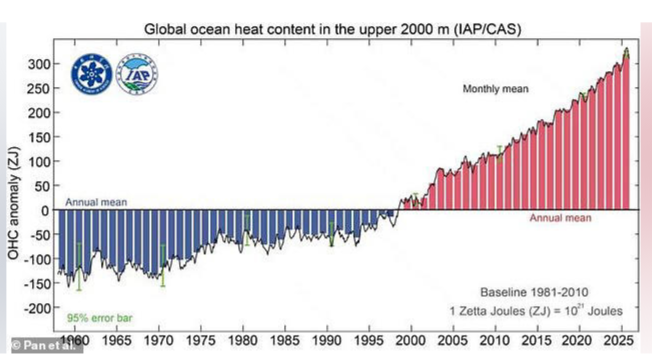
This chart shows that the impact of global warming on ocean temperatures, which drive global weather events, is now at its highest point ever. And it won’t stop there.
According to an analysis by the Center for American Progress (CAP), during the 2024 US election, 123 Republican members of the 118th Congress identified as climate change deniers. These members collectively received over $52 million (averaging $422,000 each) from the fossil-fuel industry. Multiple reports show industry spending from $219 million to $450 million supporting Donald Trump and Republican candidates.
For about a century, U.S. federal law prohibited direct corporate donations to election candidates, and this is still technically true today. Based on investigative reporting, what changed after the Koch network’s lobbying push was not the ban itself, but the creation of massive loopholes (via Citizens United and related rulings) that allowed corporations to spend unlimited money independently to influence elections. This makes the U.S. far more permissive than other democracies, even though the original ban technically still exists.
Fossil fuels have been both a blessing and a curse. Since the 1800s, they powered extraordinary growth in industrialization, transportation, and global trade. But fossil fuels are also unevenly distributed, geopolitically volatile, and environmentally costly.
There are now two important reasons to reduce the use of fossil fuels: 1) to prevent fast-increasing climate change, and 2) to prevent energy shortages by replacing fossil fuels well before finite supplies are used up. Which reason is the most urgent?
Climate change is the more urgent reason. Climate impacts are unfolding right now, not in some distant future. The consequences — heatwaves, wildfires, floods, rising sea levels, ecosystem collapse —are accelerating on a timescale of years to decades. Every tonne of CO₂ added to the atmosphere worsens the problem and is largely irreversible.
We’re already past safe thresholds of warming, and the window to avoid the worst outcomes is rapidly closing. Feedback loops (melting ice, methane release, forest dieback) can make warming self-reinforcing. Delaying action now locks in centuries of consequences, because CO₂ stays in the atmosphere for a very long time. The damage is non-linear: each additional bit of warming causes disproportionately more harm.
Fossil fuels are finite, but the timeline for running out is measured in decades to centuries, depending on the resource. The world is unlikely to suddenly “run out”; instead, extraction becomes more expensive over time, with oil prices rising from $60/bbl (barrels) in 2025 to $120/bbl by 2050 with rapid electrification, to $300/bbl with slow electrification. The main risk is economic disruption, not planetary destabilization.
But climate change is a near-term planetary emergency that turns fossil fuel replacement into an urgent necessity. The energy solutions now available are technically and economically viable, but implementationis far too slow. Current pledges still put the world on track for ~2.4 to 2.7°C warming by 2050, far above the 1.5°C Paris target signed in 2015 by 195 countries. Places like China, Costa Rica, and the EU are now leading the world in a positive direction, but getting to Net-Zero by 2050 will require the 12 top-emission countries, including Canada, to more than double their efforts. Science has shown beyond any doubt that by 2050, humanity will be experiencing, at great cost, how critical each tenth of a degree of global warming is to our planet and our societies.

Hugh Holland is a retired engineering and manufacturing executive now living in Huntsville, Ontario.
Don’t miss out on Doppler!
Sign up here to receive our email digest with links to our most recent stories.
Local news in your inbox so you don’t miss anything!
Click here to support local news
Thanks, Hugh, for your factual and enlightening commentary.
I like David Suzuki’s quotes on climate change being “the greatest threat to our survival in our short history on this planet.”
“The challenge is to create a society that is ecologically sustainable and socially just.”
“We are in a giant car heading towards a brick wall and everyone’s arguing over where they’re going to sit.”
Thank you Mr. Holland, for keeping us focused on climate change and important, understandable data, with updates. It is appreciated.
unfortunately, despite current climate change related events, fossil fuel pollution is not a political priority today, as we continue to depend on the oil and gas industry- as consumers and for Canada’s economic and federal unity- no matter the risks and costs. It can only be hoped that the third way proposed by our PM, will also recognize the shift needed away from American owned big projects like the LNG Kitamat plant that will need a huge amount of hydroelectric power from BC’s Site C Dam and likely American or other foreign investors in pipelines and also the draw on water for production. We are accepting the “world as it is” but what will be the future and what about our values?Why not invest in good paying renewable energy tech jobs and training for young people having a tough go today? Thanks Mr Holland for keeping the faith and reminding us that every tenth of a degree of global warming is crucial.
I am reminded that God holds up a mirror in front of a nation in the election of their leaders. Trump was a narcissistic criminal when he was elected. No one, least of all Americans, should be surprised by the outcome. Sadly, he reflects the heart of the nation. Perhaps America needs a time of repentance.
This piece is really about climate change — not as theory, but as lived reality. You see it in the weather, the forests, and in what insurance companies are quietly deciding they won’t cover anymore. I didn’t always see it this way, but it’s hard to ignore what’s right in front of us now.
The “emperor” story feels relevant closer to home too. In Canada, we’re trying — imperfectly, but seriously — to plan for a transition: EVs, energy diversification, and not leaving ourselves exposed down the road. None of that is easy, and none of it happens without pushback.
What’s concerning is watching a louder, more reactionary politics take hold here, borrowing straight from the U.S. playbook — lots of outrage, lots of certainty, and very little interest in dealing honestly with climate reality.
We’re dealing with a lot all at once because politics, regardless of party, has failed to think long-term for more than 30 years. At this point, we don’t need louder voices — we need serious, long-range planning.
We won’t plan our way out of this by tearing down the very government we expect to manage it. Bigger problems require bigger thinking, not constant outrage — and that kind of thinking usually comes from people with real experience managing economic and climate risk, not culture wars. Canada has usually done best when we focus on long-term planning instead of undermining our own institutions — and we could use more of that right now.
Around here, ignoring warning signs has never been considered wisdom. It’s just bad planning.
Thank you, Hugh, for describing the American kleptocracy and the consequences of converging climate-related ecosocial crises so clearly.