

The Town of Huntsville is using all the tools in its arsenal to incentivize the building of more housing in the community.
While housing is primarily a function of the District of Muskoka, Huntsville Mayor Nancy Alcock said Town officials have put their thinking hats on to consider everything they could do to try to help get that housing off the ground.
Alcock gave credit to Director of Planning Services Kirstin Maxwell for putting together a comprehensive housing action plan, one she and Councillor Scott Morrison provided input on.
The Housing Action Plan, which contains 17 recommendations across all different types of municipal policy areas, was approved by the council in March, and parts of it are slowly being implemented. Maxwell did note that the majority of the recommendations focus on multi-residential housing density development because that is the type of housing expected to address the municipality’s greatest needs: more rental housing, housing for seniors, and those entering the market.
Some of the changes include a more restrictive policy and a cap on short-term rental accommodations in the municipality. Looking at administrative procedures when it comes to approving multi-residential development to try to speed up the process. Helping those considering adding a secondary unit or two on their property by providing drawings and other information to make it simpler and more cost-effective. Other initiatives include mandating that a certain number of affordable housing units be included in multi-residential developments. Providing tax incentives where those building multi-residential housing could see their property tax increase incrementally, rather than all at once. Another incentive that Huntsville Council, in particular, is pushing the envelope on, but it has not been approved at the District level, said Alcock, is going back to the ability to build on smaller lots in the rural area.
She said Huntsville Council is proposing that one-acre lots with a minimum of 60 metres of road frontage be allowed as a right in the rural area of Huntsville. “That used to be our policy (before the OP was updated in 2006), and then we took a complete turn and went to the other extreme. We went from one acre to 4 hectares, that’s quite extreme.”
The Mayor said District Council has to approve the change, and it will be discussed in September. “So that one’s ongoing, and as a council, we’re pretty passionate about that.”
Both Alcock and Morrison were asked what one-acre lots would do to the rural character of the municipality. Alcock referred to the character of rural Huntsville as “absolutely critical and there are ways of implementing the policy to ensure that we maintain that character, for example, with setbacks… further into the property, not right at the property line.”
Alcock also said council can put conditions on approvals, such as that those building a home on a one-acre lot would not be able to build two secondary units on that lot (another initiative that’s fairly new and aimed at increasing rental housing in the community).
Both Alcock and Coucillor Morrison emphasized that allowing for smaller buildable lots in the rural community would bring the cost down, particularly, for example, for those wanting to create housing for family.
“If we don’t allow more density, then we’ll become like the Hamptons, and only the wealthy will be able to afford to live here. I don’t want to see another thousand units in our town, but we don’t have a choice because if we don’t build the units, then people just simply will not be able to live in Huntsville unless they’re rich, and we can’t have that for the next generation,” said Morrison. “So we need to think of the next generation and how we’re going to keep our kids in our town, and that doesn’t happen without density, sadly.”
Another initiative the municipality has been actively working on is to partner with the private sector to create affordable housing by donating municipal land. A Sabrina Park project did not go as expected, and the adage ‘live and learn’ is certainly one council and municipal staff are taking to the bank.
Alcock is pretty excited, though, about a new initiative to create affordable housing units on Florence Street West with the Muskoka Community Land Trust. The Town has donated the land, the District has supported the project with funding, and the model could be used as an example of what partnering with the not-for-profit sector could look like for other municipalities as well.
The Land Trust would be responsible for building, managing, and maintaining the development, which means it would not fall on the property tax. “We just don’t have that kind of money, but we do have municipal property, so that’s our leverage. So we’re constantly living and learning, and we’re doing things differently, that’s for sure,” said the Mayor.
The housing studies that have been done on behalf of the municipality, including its action plan, are also aimed at positioning the municipality favourably when senior levels of government make housing funding announcements.
“You can’t even apply for some of the funding unless you have a housing strategy and a housing needs study… so we’re setting ourselves up for funding for sure and we’re also encouraging development that helps the housing crisis, like smaller units where we’ll waive development charges, like allowing fourplexes on certain lots in town,” said Morrison.
Both Alcock and Morrison believe increasing housing units across the spectrum will help bring housing costs down.
“At the end of the day, the only thing that affects housing prices and rental prices is the two forces of supply and demand. We cannot control the demand, because Muskoka is so beautiful and everybody wants to be here. The only thing we can affect is the supply,” said Morrison, adding that you still have to be careful how the lots are developed. “Yes, the identity of Muskoka is huge and we have to protect it but, most importantly, people need to live and there’s employers trying to hire people with good paying jobs and they can’t even take the jobs because they can’t afford to live in our town, so you have to find the balance, the balance is key.”
Between 2024 and 2025, the rental housing vacancy rates remained below one per cent in Huntsville. According to the Town’s 2024 Housing Needs Assessment (HNA), if Huntsville were able to add 80 new rental units immediately, it would help ease the strain, provided that an additional 30 units are added annually.
That same report also notes that to accommodate expected growth, the municipality would need an additional 168 units annually.
” [The] HNA gives us the snapshot of existing conditions, with the Growth Strategy identifying the overall number of units (by density, not tenure) needed for anticipated growth over the next 30 years or so,” explained Maxwell. See the chart below.
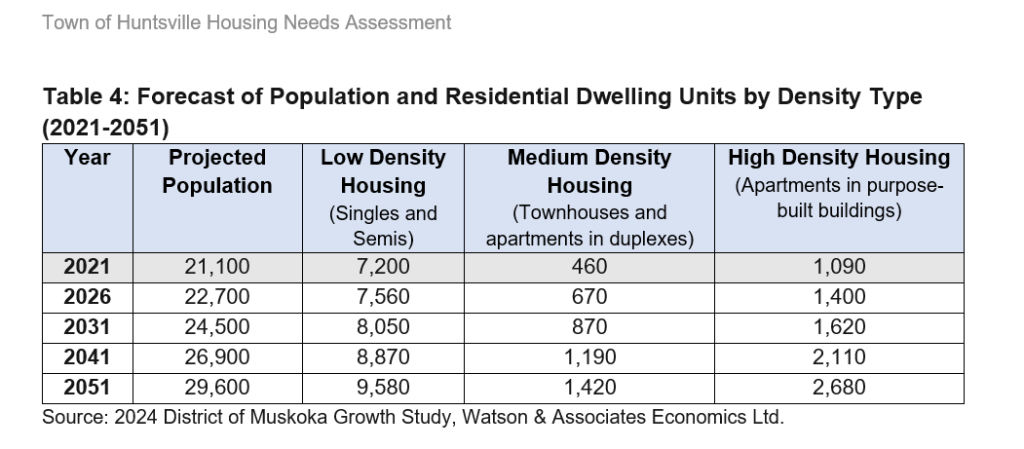
According to the Town’s planning department, in 2024, 83 low-density, 99 medium-density, and 219 high-density residential units were approved (but are not yet necessarily under construction). In the rental market, 39 units were approved, of which ten are guaranteed to be affordable. The number of new rental units approved to date in 2025 is 58, of which 16 will be affordable.
What is considered affordable housing?
According to the Huntsville Planning Department, based on the provincial bulletin that was issued as of August 1, 2025, housing for purchase at $363,100 is considered affordable. As for rental housing, a bachelor apartment for $900, a one-bedroom apartment for $1,294, and a two-bedroom apartment at $1,403 are considered affordable.
Don’t miss out on Doppler!
Sign up here to receive our email digest with links to our most recent stories.
Local news in your inbox so you don’t miss anything!
Click here to support local news
Just thinking.
In my travels ,I have noticed an enormous increase in both residential and commercial building literally everywhere…villages, towns and cities.
I have read the newspapers and noted the number of colleges and universities that will have a lower number of students in 2026 and later. The actual cut in immigration for the future has been announced.
With the lower population expected, will there be enough people left to fill the under construction houses?
This is excellent to hear, and it matches what I’ve been noticing too — the Town of Huntsville has shown a growing commitment to affordable housing. Mayor Alcock and Councilor Morrison in particular are incredible advocates for these efforts. District Chair Lehmen is the same, bringing great ideas forward and moving the needle in the right direction. Often, the challenge isn’t a lack of will from the municipality but rather navigating the diverse perspectives and concerns within the community, not to mention higher levels of government. People naturally have questions and worries about change, especially when it comes to their neighborhoods, and addressing those through open conversation and good information is key. The more we can work together to build understanding, the more progress we can make toward housing solutions that benefit everyone. It’s time to get behind the town and the district – indeed, their task is an admirable, and incredibly difficult one to navigate. If we just sit back and criticize every move, we are complicit.
Its already like the Hamptons. Too expensive for ordinary folks to buy or rent an affordable unit. And again that monstrosity of a building on Brunel is an eye sore. And it’s too expensive for even rich people. Concentrate on building for the regular people who can’t afford $2500 a month in rent. Everyone keeps saying we need affordable housing but as yet have done nothing but build big houses in subdivisions. I wont hold my breath. Soon I won’t be able to afford the property taxes on.my house and will find myself in the same position of not being able to afford rent. Why doesn’t council give themselves another big raise.
Where is the OP for Huntsville? We were encouraged to help outline a plan and be part of the building scene in our town through that plan. What a dream! The whole process seems to now operate on someone walking into planning with cash hanging from every pocket. We knew before we would have to ask and struggle to get variances, but now it seems that variances come almost automatically. And weird criteria, like half a parking spot!
To top it off we now have “strong mayor’ legislation. It seems that if a councilor disagrees with something in a building request, they can be ignored. The voice of all those who voted for that councilor is lost. That’s the OP? That’s democracy? ‘Strong mayors’, in my opinion, is just another way of giving builders easier access to what they want. Fewer people to convince. Fewer people to say NO. But that’s the point.
And the builders have money to build what they want. Council has a plan (?) but no money. And from reading some of the comments, little idea as to what to do. It seems to be a job for the very malleable because no developer will put cash where he doesn’t believe he will get a good return. ‘Affordable’ is simply a word thrown in to give the little people hope.
And I wonder just how all this building is going to fare. One contractor wants to sell off blocks that he says will leave the town building for 20 or so years. Do we need what we are building now? They are not what people getting into a home need. Banks accept you can pay $1600.00 a month rent but can’t work you a plan where you can be paying that $1600.00 toward a mortgage. The program to work round that, is what needs to happen. What first homebuyers need. Maybe the governments and the banks could split on the liability of the down payment? And don’t giggle, ’cause what we got now ain’t working!
So we’re told that the town is pulling all the stops to build more housing. For me they need the authority to build what is needed, at pricing that can be afforded, by contractors they can control. And contractors make such exorbitant demands on the Town in retaliation for all the hoops the Town requires those contractors to jump, leap and crawl through.
And I’m surprised that there were stops left to pull. Somebody missed one?
There is no affordable housing in town due to the exorbitant cost of the District’s water and sewer.
$200+/month or $2,400+/year is typical. And rising.
$100+/month even if you are away and have zero usage.
Including the costs shown/hidden on our property taxes.
After spending $45K to hook up to the District’s old, leaky, unreliable systems.
Highest costs in Ontario as a result of “smugly wasting taxpayer dollars.”
Rapidly approaching a BILLION dollars blown on water and sewer projects for only 12,000 or so connections.
Another $100 million blown in Huntsville right now.
Costs are so high it’s possible to save $1,000/yr with extreme water conservation/substitution.
Search “Oppose Bracebridge Sewers” for money saving tips.
Many people are not aware that the District hides around $1,000 of the water and sewer cost on our property taxes.
The cost depends on your assessment.
No other municipality puts costs like that on property taxes so it looks like we are paying reasonable water and sewer costs on the bills.
We are not.
Check your property tax bill and add up the costs under District Water A and District Sewer A.
Those charges only show up if the District happens to have their pipes in the road.
Whether you are hooked up or not.
Sometimes those charges are there even if the District doesn’t have pipes in the road.
As Gravenhurst residents found out. They were livid about that one.
Search “scammers-are-everywhere-including-muskoka” for details.
Solution for affordable housing?
Simply build on much cheaper, abundant, unserviced land beyond the District’s reach.
No need to drill a well. See the website for clean, inexpensive potable water sources.
Right now there are over 600 properties for sale withing 30 minutes of Huntsville , and another 700 condo type units being built … for rent or sale is a bit unclear. There are 2 new subdivisions planned for town – over 300 homes. And then there is the Freed plan for Deerhurst – 400 more units. It seems like we have lots of ‘buildings’ and a shortage of people, really.
Of course, the wild card here is the term ” affordable”. Who are you talking about? Where are all these needy people today?
Council is pretty frivolous with its statistics statements and not too generous with its sources. If it wants public support, ALL the facts need to be stated clearly.