

By Stephanie Chitpin, L’Université d’Ottawa/University of Ottawa
This week, Ontario teachers have planned province-wide rotating strikes. The Elementary Teachers’ Federation of Ontario says this is the first time in more than 20 years that four education unions have moved into a strike position.
This news comes after months of discontent among teachers’ unions and a December job action by the union representing Ontario secondary school teachers.
For some residents, this disruption in education under Doug Ford’s Conservative government may come as a surprise.
However, to those who have followed developments in how the province has managed education over the past two decades, it is in many ways a chilling reminder of the school fallout of 1995-2002, when Mike Harris was premier.
In 1997, an Ontario-wide teacher strike affecting more than two million students was at the time the largest teacher strike in North American history, according to media reports.
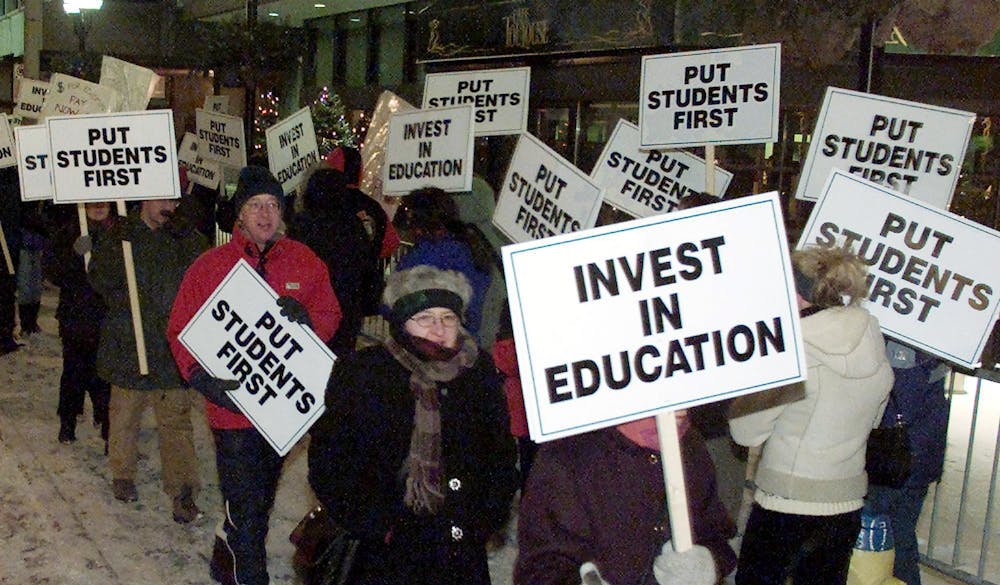
Protesters against cuts in education in Ontario march outside an Ottawa hotel, site of the Ontario Conservative Party Leadership debate, January 2002 (CP PHOTO/Fred Chartrand)
Manufactured Crisis
Harris’s Progressive Conservative government shaped educational policy through his vision of a “Common Sense Revolution.” The Ontario premier believed that schools, school districts and teaching staff were ineffective and inefficient. His “revolution” sought to bring a degree of restraint to a system that he deemed was out of control and in chaos.
In September 1995, Harris’s education minister, John Snobelen, was caught on tape announcing his government’s mandate to create a crisis in education in order to gain public support for reform. The tape became public and efforts to control the damage began.
One of the major ways that governments respond to such issues are to reinforce measures of control. As Oscar Wilde, the Irish poet and playwright said, “Nothing succeeds like excess.” Snobelen later admitted he had made the case for greater accountability in education sound more critical than it actually was.
Neoliberal education
While Harris introduced a comprehensive program that aimed to reduce taxes while balancing the budget and reducing the size and role of government, his plan closely mirrored the politics of British Prime Minister Margaret Thatcher and U.S. President Ronald Reagan. These governments drew on 19th-century neoliberal ideas associated with laissez-faire economics and free market capitalism.
(Read more: What exactly is neoliberalism?)
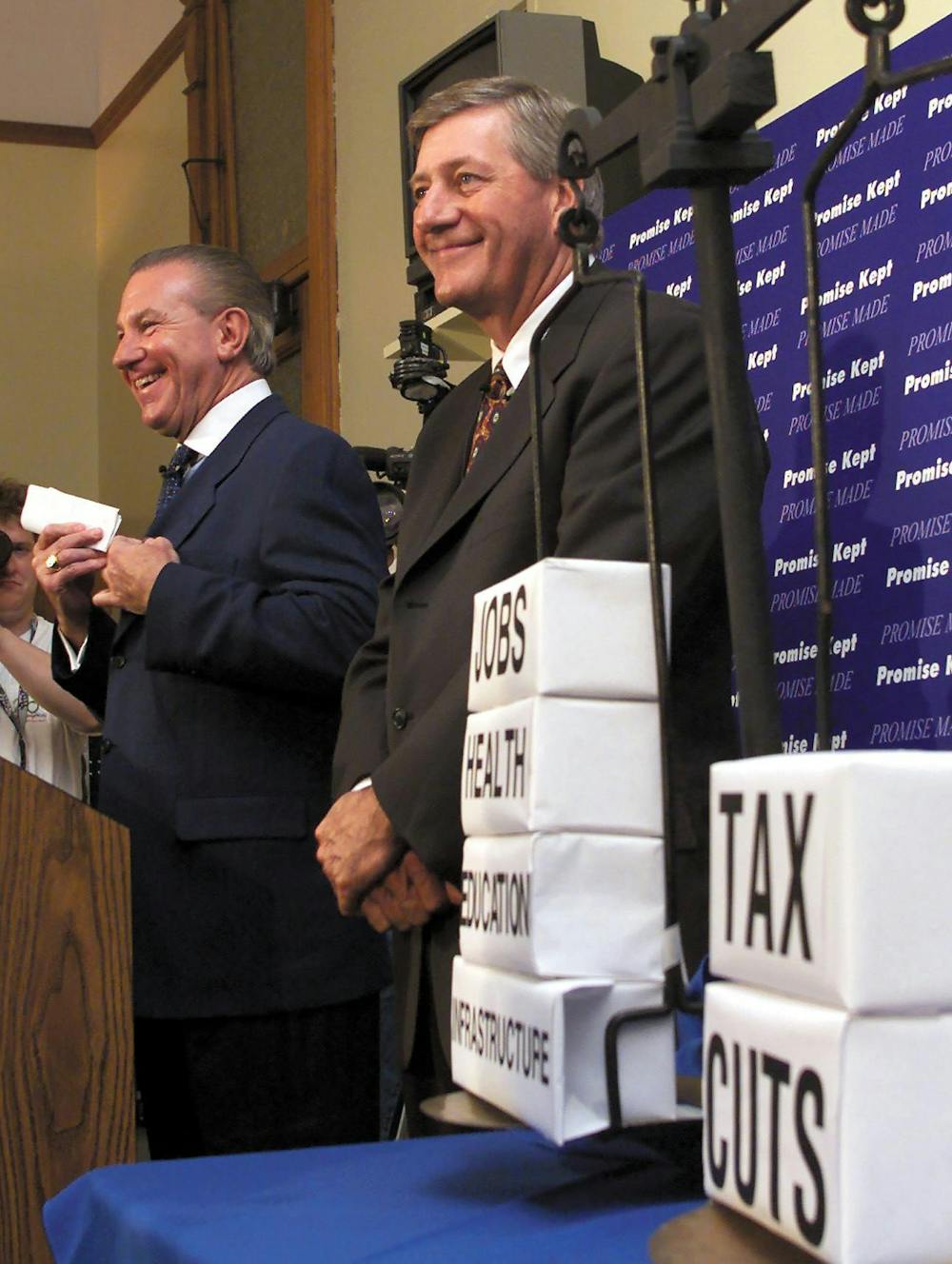
Harris and his finance minister, Ernie Eves, stand beside a display of scales meant to illustrate the balance between tax cuts and jobs, health, education and infrastructure in Toronto in May 2000. (CP PHOTO/Frank Gunn)
Creating a crisis in education by calling into question teacher professionalism has become a familiar strategy by neoliberal educational policy-makers.
Journalist Naomi Klein has argued that advocates of neoliberal free market policies have sought to exploit or even create crises in order to push controversial policies on citizens while they are too distracted to mount resistance.
The neoliberal model for analyzing education examines students primarily as human capital who must become more economically competitive as future workers, and must develop the skills and attitudes to compete efficiently and effectively.
Math scores first attacked
In Harris’s Ontario, student math scores were attacked, followed by literacy scores. However, these attacks soon became a general call for greater accountability overall, including the periodic testing and re-certification of teachers.
(Read more: Ontario math has always covered ‘the basics’)
Harris’s government called for standardized testing and the Education and Quality Accountability Office Act (EQAO) was passed into law in 1996.
Currently, the EQAO oversees reading, writing and mathematics testing for grades 3, 6, 9 and 10. Although the process may have been somewhat clandestine, the message was obvious. The attack on education to justify outcomes quantified as scores had begun.
Outcomes-based education
Standards-based education fits in current contexts of neoliberalism, in which schools are often viewed as consuming huge amounts of money without producing adequate results.
Neoliberal educational reform had its beginnings in the United Kingdom, and the Office for Standards in Education (OFSTED) continues to monitor the success or failure of public schools to improve student achievement scores in Great Britain. The United States and other countries have followed suit with outcomes-based education wedded to standardized testing.But isn’t it more costly to society — and to the economy — if cuts erode opportunities to positively shape young people’s lifelong success through early and ongoing quality education?
Compulsive standards?
Education researcher Linda McNeil of Rice University notes in her book Contradictions of School Reform that high student scores doesn’t necessarily mean students are learning for the long-term.
Students become adept at test-taking, she argues, but do not retain what they’ve learned because it never moves to the long-term memory. Tests typically rely only on short-term memory, which is why progressive education tends to be more projects-based than exam-based.
Her analysis also points to the compulsive nature of standardizing education whereby teachers are forced to take time away from teaching the curriculum to prepare students for tests. This is becoming a global phenomenon in the name of a vibrant economy.
As standards-based education has grown and teachers’ credibility or professionalism is besmirched, private corporations have benefited.
Multi-trust academies have benefited financially by taking over failing schools in the U.K. Companies that offer education modules, tutoring or lesson plans reap benefits as fee-for-service providers. Indirectly, they may also benefit if teachers, strapped for time and resources, rely on free corporate lesson plans, such as through Disney lesson plans. While the impacts are global, the implications are local.
In Ontario, educators’ rotating strikes are drawing attention to the needs of their students. Will the solution be to offer more standardized tests and more competition? Only time will tell.
In the meantime, Yogi Berra, the famous baseball player, may have said it best: “It’s like déjà vu, all over again.” We have been here before.
This article is republished from The Conversation under a Creative Commons license. Read the original article.

Don’t miss out on Doppler!
Sign up here to receive our email digest with links to our most recent stories.
Local news in your inbox three times per week!
Excellent article.
Thank you, Karen Wherstein for your very accurate comment. Teachers are over worked, and often under appreciated. Their jobs are part educators, part day care providers, part surrogate parents. Our children’s future is often their hands. I’m in my seventies, and I have had many teachers, some good, some not so good, that have helped to shape my life, and to this day, I thank them all…good or bad…for giving of themselves for me…yes, for me, because without them, I would not be the person I am today.
To all the teachers, thank you!!
Wow Jim I can’t believe there is at least one person that agrees with me on some things. I have been accused of hating teachers and a lot of other things when in reality I feel kind of sorry for the teachers but not to the point that I think they should be striking for more money. I worked most all my life 9 or 10 hours a day just to make ends meet and feed my four boy’s and payed taxes with most other people that were no better off than I was so the teachers of today could get the education now they are still wanting us to pay more. I hear about how hard it is to be a teacher at this time being assaulted and all kinds of stuff but If I didn’t like how I was treated I went and found another job where I was appreciated never thought about going on strike not that it would have done any good with no union to back me up.
Ray ,hats off to you for offering some very pertinent historical perspective.
We have created a generation that is programmed to avoid failure and yet some of my best lessons in life were achieved by making mistakes.
Ah, right wingers. The only people who think you can improve something by spending less money on it.
.
I think it’s an entry requirement for being right wing to despise teachers — a career so unselfish that down in the United States, they often pay for school supplies out of their own pockets so their young students can learn.
.
If you think teaching is easy or unworthy of good pay, you should spend one day as a teacher. Just one day. Age of the class full of kids doesn’t matter. It doesn’t just take skill — it takes love. People who think it’s easy aren’t smart or emotionally generous enough to handle it even for a day. The kids outnumber you as much as 30-odd to one, and will shred you. Yes, even if you are a man. I’ve seen it done.
.
I think what’s at the root of right wing attitudes about public education is anti-intellectualism: the undervaluing or even denigration of academia, science, all the ologies, IQs in the high percentiles and people who devote their lives to learning and research — despite all the ways that intellectual work has benefited humanity (providing little things like, you know, civilization, not to mention every one of those gizmos you love). It’s far too common for kids to be called nerds and geeks by other kids who aren’t as smart as they are, rather than being respected and appreciated. Anti-intellectualism is a cancer on a society, for reasons that should be obvious.
.
I suspect there is sexism behind it also. At one time, teacher was one of the only three occupations available to women (the other two being nurse and secretary), and it continues to be women-dominated especially in the lower grades where more surrogate parenting is required. And of course in the right wing mind, women are supposed to accept whatever crappy deal they and those who depend on them are handed, in silence and with a smile. When they don’t, out come the right wing fangs.
.
History has shown that the more emphasis a society puts on education, the smarter the whole society is. Or to put it the other way, the less emphasis, the more stupid. Being on the front lines, teachers are fully aware of this. Remember it when you see those picket signs.
Mike Harris was never a principle. He taught 7-8 math @ W. J. Fricker Public School for a couple of years, couldn’t hack-it, left to be a ski/golf pro. Two years is really not enough experience to give you knowledge to fix that system, but certainly enough time to make you bitter about the profession, if you don’t excel.
Presently, Ontario cannot afford Socialism as defined by the Liberals.
Nice to know that the teachers quit teaching , – (read Striking,) – in order to ‘help’ the kids. I think this is a case of the old meets the new. Knowledge can be disseminated via Google, but that would mean the loss of teaching jobs.
It IS rather difficult to acknowledge that the blacksmith’s job was redundant when the horseless carriage caught on, but the world moved on.
I applaud Doug Ford’s efforts to help the education system move forward and if the teachers were smart they would help kids to move ahead into this wondrous computer age. The teachers themselves are striking ‘IN THE NAME OF the kids to keep their own livelihoods intact.
The future is in the computer. It is time to move ahead and admit it.
As for the kids who need specialized help? The average teacher is NOT qualified to extend help to that kid. If the teacher would get onside, we could have a wonderful world ahead for our next generation.
If you want to go back in History why not go back to the 40’s and 50s when students had to pass an entry exam to be able to go to high school and if they could not pass it they went back to public school until they could or they left school completely. At the very least most of them could read and write so they made out just fine. Now they push kids through school no matter if they can read or not just get them out of my class and let someone else teach them . Now not all this is the teachers fault most of the blame goes to whoever makes up the rules that a 14 year old has to go to high school or to the next grade if your age is right . Does not matter what you know just have to go ahead no one can fail anymore or at least not until they are out of the school system then look out. The Education system is broken and far to expensive so something has to be done the union is doing what it feels it has to do no matter if it’s right or wrong they just keep asking for more because if they don’t the teachers will just say why are we paying you guy’s you do nothing for us. Not sure just what the solution is but I know the tax payers are running out of money so something has to give sooner or later.
The teachers are not striking, in large part, for themselves this time; but for their students, and the educational system in general. That’s why (unheard of in previous job actions), they have been joined by parents and students on the picket lines.
Mike Harris, a former principal, was famous for many reasons: his consistent use of “kiddie garden”; and the Walkerton debacle. His 1/3 cuts to social workers has led to school issues for the children of many of those lost “cases”.
Treating students as “widgets” is a ridiculous: Any metric based on this premise is inherently flawed. Incredible pressure may produce a handful of “diamonds” (who would have succeeded anyway); but for the majority (especially those with mental health and social issues); pressure produces failure (from which, most never recover).
Ontario has an excellent educational record; but overly large classes, and split-year classes are allowing far too many to slip through the cracks. Some students NEED extra attention: They ARE NOT lacking in intelligence. But in classrooms of 30-35 students, or split-classes; where one class is sent to the hall, while the teacher instructs the other; where is the time for the needy students?
One picket sign summed up the problem concisely: “I’ve seen better cabinets at Ikea”.
How many more public social institutions such as universal health care and quality public education, can Doug Ford’s CON government ruin during the remainder of their one and only term in power?