
Wayback Wednesday, sponsored by Jamie Lockwood, broker/owner of Sutton Group Muskoka Realty!

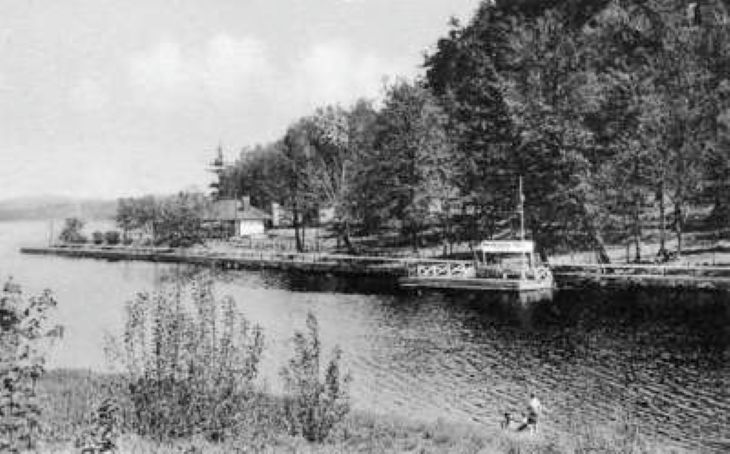
Memorial Park, Huntsville, Ontario. Swimming and camping facilities at the mouth of the Muskoka River and Fairy Lake at the base of Lookout Mountain.
From Muskoka Digital Archives
Charles E. Paget spearheaded a fundraising effort in the spring of 1922 to purchase the property for a new park, which opened July 2, 1923, as a memorial to the men who had died in the Great War. In 1923, the council formed a parks commission to look after the park under the chairmanship of Charles E. Paget. In 1924, the parks commission purchased the point at the north of the river with a view to establishing a safe bathing beach and a scenic driveway along the river. In 1925, a road was constructed, a new kitchen was built, and campsites were established for motorists. In 1926, a lookout was opened on the mountain. By July 1929, six furnished cabins had been added to the park, and the navigation company had erected a new dock.
Do you have interesting photos to share of days gone by? We’d love to see them! Email: [email protected]
See more Wayback Wednesday photos HERE.
Don’t miss out on Doppler!
Sign up here to receive our email digest with links to our most recent stories.
Local news in your inbox three times per week!
Click here to support local news
The lookout track and field were created to replace the track and field that were located immediately behind the high school. We needed that area for parking so we could rebuild the arena and add the swimming pool. Prior to that the area that became the new track and field was used as a dump for snow that was removed from the Town streets. There were demolition derbies held there as part of the winter carnival. It was a very unattractive waste dump area.
The concerns raised about using that location spurred us to find a new location for the Waterloo University building. That led to us acquiring the site that became Conroy Park. Thus we avoided having to build a sewage pumping station on what was then called Town Line East. The track and field plus the tennis courts completed that project for about the cost of the pumping station we did not have to build.
I believe this is a photograph of what we now call Camp Kitchen. Isn’t the track and field property just above and behind Camp Kitchen–below and on the way up to the Lookout– called Memorial Park? I know because in initial preparation for the G8 meetings there were plans to build a large building there. These building plans were vigorously opposed by two groups of people in Huntsville–people like myself who considered it a sacred public place for running and walking and meditating and another group with strong childhood attachments to this public wild space because it was a gift to the town dedicated to the memory of those who sacrificed their lives in World War 1. My group was prepared to hold a public ceremonial lament for the loss of a beloved and shared sacred space; the other group began to raise funds for a lawsuit regarding the misuse of public land. Luckily neither of us had to proceed because the G8 building plans were changed, the field was saved and the building (now called the De Novo Treatment Centre) was moved to another location.